
Self-incompatibility of U.S. Great Basin Sphaeralcea (Malvaceae) and regional prevalence, pollination efficacy, and floral infidelity of their oligolectic Diadasia bees
DOI:
https://doi.org/10.26786/1920-7603(2026)930Keywords:
Anthophila, globemallow, oligolecty, specialization, Apiformes, pollinatorAbstract
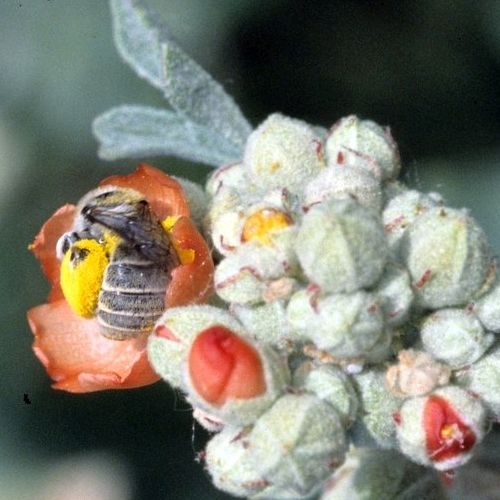
Three globemallows -- Sphaeralcea coccinea, S. grossularifolia and S. munroana (Malvaceae) -- are widespread, summer-flowering perennial forbs found throughout the sagebrush-steppe and neighbouring biomes of the western USA. Their seed is desirable for rehabilitating degraded rangelands. This study had four objectives: 1) determine each species’ breeding biology, 2) quantitatively characterize their regional pollinator guilds, and evaluate 3) pollination efficacy and 4) floral constancy of a bee that is an abundant Sphaeralcea specialist.
All three globemallows are self-incompatible. On average, 43-76% of manually outcrossed flowers formed capsules (schizocarps) averaging 7-9 seeds each (potential of 11 seeds). In contrast, autogamy and geitonogamy yielded few capsules, half of them seedless. Autogamy yielded few mature seeds despite proximity of anthers and stigmas.
Floral visitors to S. grossularifolia and S. munroana were systematically surveyed across the American sagebrush-steppe. Bees foraging at wild and cultivated populations were non-social ground-nesters. Three globemallow pollen specialists (oligoleges, particularly Diadasia diminuta) were frequent and often abundant, as were several common generalist halictid bees among the 38 species collected. Single floral visits by pollen-foraging females of D. diminuta deposited sufficient pollen to effect full seed set (means of 42 and 34 grains per stigma at S. coccinea and S. grossularifolia, respectively).
Newly planted Sphaeralcea plots were colonized within several years by D. diminuta. Females foraging a mixed experimental garden frequently switched between globemallow species during foraging bouts, evidence that these floral specialists will facilitate hybridization rather than behavioral isolation of Sphaeralcea. The abundant pollinators at these Sphaeralcea species should deliver sufficient outcrossing at most locales, including both wildlands and farmed fields.
References
Cane JH (2011) Specialist Osmia bees forage indiscriminately among hybridizing Balsamorhiza floral hosts. Oecologia 167:107–116. DOI: https://doi.org/10.1007/s00442-011-1977-1
Cane JH, Love B (2016) Floral guilds of bees in sagebrush steppe: Comparing bee usage of wildflowers available for postfire restoration. Natural Areas Journal 36:377–391. DOI: https://doi.org/10.3375/043.036.0405
Cane JH, Sipes S (2006) Floral specialization by bees: analytical methods and a revised lexicon for oligolecty. In: Waser NM, Ollerton J (eds) Plant-Pollinator Interactions: From Specialization to Generalization. Univ. Chicago, Chicago, Illinois USA, pp 99–122.
Danforth BN (1991) Female foraging and intranest behavior of a communal bee, Perdita portalis (Hymenoptera: Andrenidae). Annals of the Entomological Society of America 84:537–548. DOI: https://doi.org/10.1093/aesa/84.5.537
Dreher SE (2014) Interspecific hybridization in Sphaeralcea (Malvaceae). The Claremont Graduate University
García-Franco JG, Arroyo MTK (1995) Breeding system, sex ratio and individual size of the gynodioecious Nototriche compacta (Malvaceae) in the Andes of central Chile. Plant Species Biology 10:147–153. DOI: https://doi.org/10.1111/j.1442-1984.1995.tb00134.x
Ghazoul J (2005) Pollen and seed dispersal among dispersed plants. Biological Reviews 80:413–443. DOI: https://doi.org/10.1017/S1464793105006731
Gutiérrez A, Monzón MP, Micheletto S, Marinangeli PA (2024) Reproductive biology of Sphaeralcea species with ornamental interest. Advances in Horticultural Science 37:345–352. DOI: https://doi.org/10.36253/ahsc-13616
Hammon R, Franklin M (2012) Seed-feeding insects impacting globemallow seed production. Native Plants Journal 13:95–97. DOI: https://doi.org/10.3368/npj.13.2.95
Holmgren NH, Holmgren PK, Cronquist A (2005) Intermountain Flora Cronquist A (ed). New York Botanical Garden Press, New York.
Hubbard T, Conta DM, Smith SE (1993) Seed production and pollen tube growth following cross- and self-pollinations in Sphaeralcea laxa Woot. & Standl. Southwestern Naturalist 38:331–335. DOI: https://doi.org/10.2307/3671611
Hulvey KB, Leger EA, Porensky LM, Roche LM, Veblen KE, Fund A, Shaw J, Gornish ES (2017) Restoration islands: a tool for efficiently restoring dryland ecosystems? Restoration Ecology, 25, S124-S134. DOI: https://doi.org/10.1111/rec.12614
Laduke JC (1986) Chromosome numbers in Sphaeralcea section Fendlerianae. American Journal of Botany 73:1400–1404. DOI: https://doi.org/10.1002/j.1537-2197.1986.tb10885.x
Linsley EG, MacSwain JW (1957) The nesting habits, flower relationships, and parasites of some North American species of Diadasia (Hymenoptera: Anthophoridae). Wasmann Journal of Biology 15:199–235.
Littell RC, Milliken GA, Stroup WW, Wolfinger RD, Schabenberger O (1996) SAS for mixed models (2nd ed.). SAS Institute. ISBN 1-59047-500-3.
McIntosh ME (2005) Pollination of two species of Ferocactus: interactions between cactus-specialist bees and their host plants. Functional Ecology 19:727–734. DOI: https://doi.org/10.1111/j.1365-2435.2005.00990.x
Moldenke AR, Neff JL (1974) The bees of California: a catalogue with special relevance to pollination and ecological research. Board of Studies in Biology, University of California.
Ott JE, Cox RD, Shaw NL, Newingham BA, Ganguli AC, Pellant M, Roundy BA, Eggett DL (2016) Postfire drill-seeding of Great Basin plants: effects of contrasting drills on seeded and nonseeded species. Rangeland Ecology & Management 69:373–385. DOI: https://doi.org/10.1016/j.rama.2016.05.001
Raju A, Rani DS (2016) Pollination ecology of Sida acuta, S. cordata and S. cordifolia (Malvaceae). Phytologia Balcanica 22:363–376.
Shock MP, Shock CC, Feibert EB, Shaw NL, Saunders LD, Sampangi RK (2012) Cultivation and irrigation of fernleaf biscuitroot (Lomatium dissectum) for seed production. HortScience 47:1525–1528. DOI: https://doi.org/10.21273/HORTSCI.47.10.1525
Sipes SD, Tepedino VJ (2005) Pollen-host specificity and evolutionary patterns of host switching in a clade of specialist bees (Apoidea: Diadasia). Biological Journal of the Linnean Society 86:487–505. DOI: https://doi.org/10.1111/j.1095-8312.2005.00544.x
Sriladda C, Kratsch HA, Larson SR, Kjelgren RK (2021) Morphological and genetic variation among four high desert Sphaeralcea species. HortScience 47:715–720. DOI: https://doi.org/10.21273/HORTSCI.47.6.715
Tate JA, Aguilar JF, Wagstaff SJ, La Duke JC, Slotta TAB, Simpson BB (2005) Phylogenetic relationships within the tribe Malveae (Malvaceae, subfamily Malvoideae) as inferred from its sequence data. American Journal of Botany 92:584–602. DOI: https://doi.org/10.3732/ajb.92.4.584
Tate JA, Simpson BB (2004) Breeding system evolution in Tarasa (Malvaceae) and selection for reduced pollen grain size in the polyploid species. American Journal of Botany 91:207–213. DOI: https://doi.org/10.3732/ajb.91.2.207
Tepedino VJ, Arneson LC, Durham SL (2016) Pollen removal and deposition by pollen- and nectar- collecting specialist and generalist bee visitors to Iliamna bakeri. Journal of Pollination Ecology 19:50–56. DOI: https://doi.org/10.26786/1920-7603(2016)2
Wisdom MJ, Rowland MM, Surber JL (2005) Habitat threats in the sagebrush ecosystem: methods of regional assessment and applications in the Great Basin. Alliance Communications Group, Lawrence, Kansas. 301 pp.
Zeisler M (1938) Über die Abgrenzung der eigentlichen Narbenfläche mit Hilfe von Reaktionen. Beihefte zum Botanisches Zentralblatt A 58:308–318.
Downloads
Additional Files
Published
How to Cite
Issue
Section
License
Copyright (c) 2026 James H Cane, Byron Love

This work is licensed under a Creative Commons Attribution 4.0 International License.