
Evaluating the effects of observation period, floral density, and weather conditions on the consistency and accuracy of timed pollinator counts
DOI:
https://doi.org/10.26786/1920-7603(2022)699Keywords:
Ecosystem services, insect declines, non-detection errors, pollinator monitoring, bees, SyrphidaeAbstract
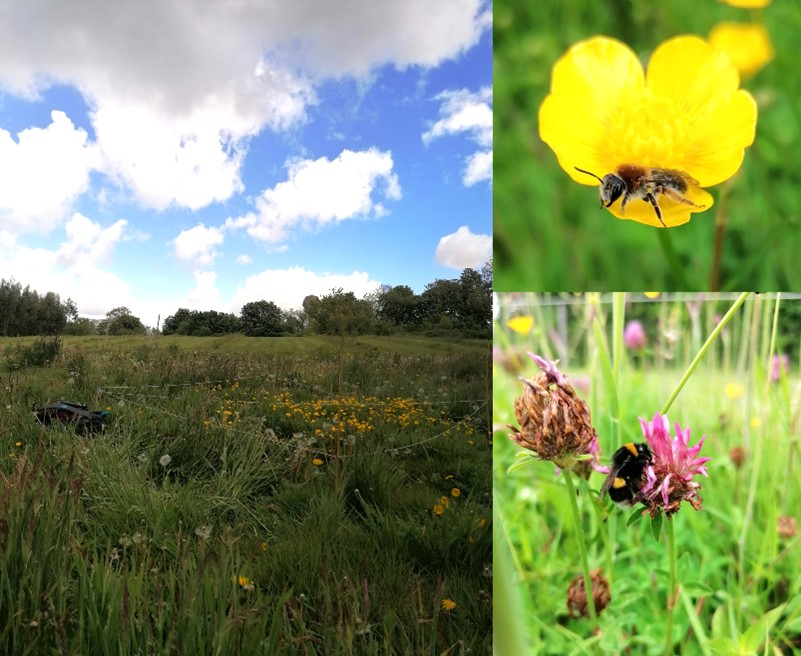
Insect pollinators are experiencing substantial declines as a result of habitat loss, agricultural intensification, invasive pests, and climate change. To investigate factors causing pollinator declines, evaluate the success of conservation measures, and institute long-term monitoring schemes, it is essential to validate and standardize pollinator sampling techniques. This study investigated how sampling duration, weather conditions, and abundance of floral resources influenced the results of timed pollinator counts by repeatedly sampling the same pollinator assemblage in an Irish meadow. The likelihood of detection of Apis mellifera, Bombus spp, solitary bees, and Syrphidae was strongly associated with the density of floral units or floral cover in the observation plot. Also, even though protocol criteria restricted pollinator counts to the middle of the day and benevolent weather, pollinator counts were strongly influenced by factors such as cloud cover, light levels, wind speed and relative humidity. Increasing the duration of the timed counts from 5-minutes to 30-minutes considerably increased the probability of detection of each pollinator group. Additionally, the perceived diversity of the pollinator assemblage at the meadow was markedly affected by sampling duration and floral abundance. To improve the consistency or comparability of studies using timed pollinator counts, we recommend that criteria are set restricting surveys to narrow ranges of weather conditions and floral density when possible. Additionally, pollinator field investigations or monitoring programs would benefit from a systematic evaluation of how erroneous non-detection of target taxa can be reduced to acceptable levels by modifying sampling duration.
References
AIPP 2021. All-Ireland Pollinator Plan 2021-2025 (2021) National Biodiversity Data Centre Series No. 25, Waterford. March 2021. pp63
Blasco‐Moreno A, Pérez‐Casany M, Puig P, Morante M, Castells E (2019) What does a zero mean? Understanding false, random and structural zeros in ecology. Methods in Ecology and Evolution, 10:949–959
Brittain CA, Vighi M, Bommarco R, Settele J, Potts SG (2010) Impacts of a pesticide on pollinator species richness at different spatial scales. Basic and Applied Ecology, 11(2), 106–115.
Brunet J, Flick AJ, Bauer AA (2021) Phenotypic selection on flower color and floral display size by three bee species. Frontiers in Plant Science, 11, 2244. doi.org/10.3389/fpls.2020.587528
Burrill RM, Dietz A (1981) The response of honeybees to variations in solar radiation and temperature. Apidologie, 12(4), 319–328.
Byrne F, DelBarco-Trillo J (2019) The effect of management practices on bumblebee densities in hedgerow and grassland habitats. Basic and Applied Ecology, 35, 28–33.
Carvell C, Meek WR, Pywell RF, Goulson D, Nowakowski M (2007) Comparing the efficacy of agri-environment schemes to enhance bumble bee abundance and diversity on arable field margins. Journal of Applied Ecology, 44(1), 29–40.
Clarke D, Robert D (2018) Predictive modelling of honey bee foraging activity using local weather conditions. Apidologie, 49(3), 386–396.
Comba L (1999) Patch use by bumblebees (hymenoptera apidae): Temperature, wind, flower density and traplining. Ethology Ecology and Evolution, 11(3), 243–264.
Corbet SA (1990) Pollination and the Weather. Israel Journal of Botany, 39(1–2), 13–30.
Corbet SA, Fussell M, Ake R, Fraser A, Gunson C, Savage A, Smith K (1993) Temperature and the pollinating activity of social bees. Ecological Entomology, 18(1), 17–30.
Dicks LV, Breeze TD, Ngo HT, et al. (2021) A global-scale expert assessment of drivers and risks associated with pollinator decline. Nature Ecology and Evolution, 5, 1453–1461.
Dreisig H (1995) Ideal Free Distributions of Nectar Foraging Bumblebees. Oikos, 72(2), 161.
Ebeling A, Klein AM, Schumacher J, Weisser WW, Tscharntke T (2008) How does plant richness affect pollinator richness and temporal stability of flower visits? Oikos, 117(12), 1808–1815.
Fijen TPM, Kleijn D (2017) How to efficiently obtain accurate estimates of flower visitation rates by pollinators. Basic and Applied Ecology, 19, 11–18.
Gilbert FS (1985) Diurnal activity patterns in hoverflies (Diptera, Syrphidae). Ecological Entomology, 10(4), 385–392.
Hegland SJ, Boeke L (2006) Relationships between the density and diversity of floral resources and flower visitor activity in a temperate grassland community. Ecological Entomology, 31(5), 532–538.
Hennessy G, Harris C, Pirot L, Lefter A, Goulson D, Ratnieks FLW (2021) Wind slows play: increasing wind speed reduces flower visiting rate in honey bees. Animal Behaviour, 178, 87–93.
Hodge S (2020) When I’m sixty-four: long-term monitoring and the (missing?) New Zealand insect apocalypse. The Wētā, 54, 1-11
Hodge S, Curtis N, Vink CJ, Marris J, Brown SDJ (2017) Native arthropods on exotic sand dune flowers: consideration of sample size and number for investigating rare species and sparse communities. Arthropod-Plant Interactions, 11, 691-701. doi 10.1007/S11829-017-9521-9
Hodge S, Stout J (2019) Protocols for Methods of Field Sampling. Deliverable D1. 1 PoshBee Project, Grant agreement No. 773921. Available online: Poshbee.eu
Hodge S, Vink CJ (2016) Evidence of absence is not proof of absence: the case of the New Brighton katipō. New Zealand Journal of Zoology, 47: 14-24 doi10.1080/03014223.2016.1227343
Hutchinson LA, Oliver TH, Breeze TD, O’Connor RS, Potts SG, Roberts SPM, et al. (2022) Inventorying and monitoring crop pollinating bees: Evaluating the effectiveness of common sampling methods. Insect Conservation and Diversity, 15(3), 299 311.
Kleijn D, Winfree R, Bartomeus I, et al. (2015) Delivery of crop pollination services is an insufficient argument for wild pollinator conservation. Nature Communications, 6(1), 36.
Krahner A, Schmidt J, Maixner M, Porten M, Schmitt T (2021) Evaluation of four different methods for assessing bee diversity as ecological indicators of agro-ecosystems. Ecological Indicators, 125, 107573.
Lebuhn G, Droege S, Connor EF, Gemmill-Herren B, Potts SG, Minckley RL, Griswold T, Jean R, Kula E, Roubik DW, Cane J, Wright KW, Frankie G, Parker F (2013) Detecting Insect Pollinator Declines on Regional and Global Scales. Conservation Biology, 27(1), 113–120.
Leclercq N, Marshall L, Weekers T, et al. (2022) A comparative analysis of crop pollinator survey methods along a large-scale climatic gradient. Agriculture, Ecosystems and Environment. 329: 107871
MacKenzie DI (2005) What are the issues with presence‐absence data for wildlife managers? The Journal of Wildlife Management, 69(3), 849-860.
O’Connor RS, Kunin WE, Garratt MPD, Potts SG, Roy HE, Andrews C, Jones CM, Peyton JM, Savage J, Harvey MC, Morris RKA, Roberts SPM, Wright I, Vanbergen AJ, Carvell C (2019) Monitoring insect pollinators and flower visitation: The effectiveness and feasibility of different survey methods. Methods in Ecology and Evolution, 10(12), 2129–2140.
Ohashi K, Yahara T (2002) Visit larger displays but probe proportionally fewer flowers: counterintuitive behaviour of nectar-collecting bumble bees achieves an ideal free distribution. Functional Ecology, 16(4), 492–503.
Peat J, Goulson D (2005) Effects of experience and weather on foraging rate and pollen versus nectar collection in the bumblebee, Bombus terrestris. Behavioral Ecology and Sociobiology, 58(2), 152–156.
Potts SG, Biesmeijer JC, Kremen C, Neumann P, Schweiger O, Kunin WE (2010) Global pollinator declines: Trends, impacts and drivers. In Trends in Ecology and Evolution 25:345–353. Elsevier Current Trends.
Prasad AV, Hodge S (2013) Factors influencing the foraging activity of the allodapine bee Braunsapis puangensis on creeping daisy (Sphagneticola trilobata) in Fiji. Journal of Hymenoptera Research, 35, 59-69. doi 10.3897/JHR.35.6006
Prendergast KS, Hogendoorn K (2021) Methodological shortcomings and lack of taxonomic effort beleaguer Australian bee studies. Austral Ecol.
Prendergast KS, Menz MHM, Dixon KW, Bateman PW (2020) The relative performance of sampling methods for native bees: an empirical test and review of the literature. Ecosphere 11(5):e03076. 10.1002/ecs2.3076
Primack RB, Inouye DW (1993) Factors Affecting Pollinator Visitation Rates - a Biogeographic Comparison. Current Science, 65(3), 257–262. https://www.jstor.org/stable/24095126
Pyke GH, Pulliam HR, Charnov EL (1977) Optimal Foraging: A Selective Review of Theory and Tests. The Quarterly Review of Biology, 52(2), 137–154.
Royle JA, Chandler RB, Yackulic C, Nichols JD (2012) Likelihood analysis of species occurrence probability from presence‐only data for modelling species distributions. Methods in Ecology and Evolution, 3(3), 545-554.
Russo L, Buckley YM, Hamilton H, Kavanagh M, Stout JC (2020) Low concentrations of fertilizer and herbicide alter plant growth and interactions with flower-visiting insects. Agriculture, Ecosystems & Environment, 304, 107141.
Saunders ME, Hall MA, Lentini PE, Brown J, Cunningham SA (2021) Scholarly shortcomings and a lack of evidence beleaguer bee sampling critique: A response to Prendergast and Hogendoorn (2021). In Austral Ecology. Blackwell Publishing.
Sühs RB, Somavilla A, Giehl ELH (2021) Weather variables affecting the behaviour of Insect flower visitors and main pollinators of Erythroxylum myrsinites Martius (Erythroxylaceae). Sociobiology, 68(1), 5451.
Tamburini G, Berti A, Morari F, Marini L (2016) Degradation of soil fertility can cancel pollination benefits in sunflower. Oecologia, 180(2), 581–587.
Tepedino VJ, Durham S, Cameron SA, Goodell K (2015) Documenting bee decline or squandering scarce resources. Conservation Biology 29: 280-282
Thompson A, Frenzel M, Schweiger O, Musche M, Groth T, Roberts SP, Kuhlmann M, Knight TM (2021) Pollinator sampling methods influence community patterns assessments by capturing species with different traits and at different abundances. Ecological Indicators, 132, 108284.
Tikoca S, Hodge S, Tuiwawa M, Brodie G, Pene S, Clayton J (2016) An appraisal of sampling methods and effort for investigating moth assemblages in a Fijian forest. Austral Entomology, 55(4), 455–462.
Tregenza T (1995) Building on the Ideal Free Distribution. Advances in Ecological Research, 26(C), 253–307.
Waddington KD (1980) Flight patterns of foraging bees relative to density of artificial flowers and distribution of nectar. Oecologia, 44(2), 199–204.
Westphal C, Bommarco R, Carré G, Lamborn E, Morison N, Petanidou T, Potts SG, Roberts SPM, Szentgyörgyi H, Tscheulin T, Vaissière BE, Woyciechowski M, Biesmeuer JC, Kunin WE, Settele J, Steffan-Dewenter I (2008) Measuring bee diversity in different European habitats and biogeographical regions. Ecological Monographs, 78(4), 653–671.
Wheelock MJ, Rey KP, O’Neal ME (2016) Defining the insect pollinator community found in Iowa corn and soybean fields: implications for pollinator conservation. Environmental Entomology, 45(5), 1099-1106.
Whittingham MJ, Stephens PA, Bradbury RB, Freckleton RP (2006) Why do we still use stepwise modelling in ecology and behaviour? Journal of Animal Ecology, 75(5), 1182-1189.
Zimmerman M (1981) Optimal foraging, plant density and the marginal value theorem. Oecologia, 49(2), 148–153.
Downloads
Published
How to Cite
Issue
Section
License
Copyright (c) 2022 Neil Mahon, Simon Hodge

This work is licensed under a Creative Commons Attribution 4.0 International License.