
Complementary insights from transect observations and palynological analyses on Andrena and Lasioglossum foraging in field margins
DOI:
https://doi.org/10.26786/1920-7603(2026)880Keywords:
wild bees, pollen analyses, plant-pollinator networks, agroecosystems, transectAbstract
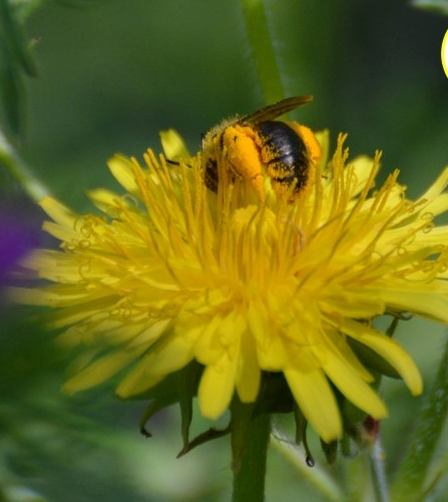
Field margins support wild bees by providing richer floral resources than most crops. While transect-based hand netting offers insight into bee–plant interactions, it underrepresents the full range of each bee’s foraging activity. To uncover more of each bee's foraging behaviour, we complemented transect data with palynological analysis of pollen loads from captured bees. In 2021 and 2022, we collected 58 Andrena and 176 Lasioglossum females plus males during transect surveys. Sixty-six plant species were identified along the transects, at least to genus level. All bee specimens were identified to species level by a taxonomist, and their pollen loads (pollen carried on the body in various positions) analysed in the lab. The 19 Andrena species were mostly active in spring, showing a succession of species, whereas the 18 Lasioglossum species were more common in summer, with some overlap. Field observations showed Crepis species were the most frequently visited, with 52.7% of Andrena and 58.2% of Lasioglossum collected on them. Cichorium intybus was also a common resource for Lasioglossum (17.6%). Pollen analysis identified 63 taxa (40% overlapping with transect data) substantially expanding the list of visited plant species. Our findings highlight the crucial role of palynological analyses in revealing bee foraging preferences, even pointing to an underappreciated role of trees, and the importance of considering also male individuals. Yet, some observations on transects revealed unexpected food sources. For better understanding of lesser-known Apoidea species, we recommend incorporating planned pollen analyses into transect monitoring. Both bee and pollen identification require specialised expertise, but this integrated approach provides vital insights into plant-pollinator dynamics.
References
Ascher JS, Pickering J (2020) Discover Life bee species guide and world checklist (Hymenoptera: Apoidea: Anthophila). http://www.discoverlife.org/mp/20q?guide=Apoidea_species. Accessed 16 July 2024
Beil M, Horn H, Schwabe A (2008) Analysis of pollen loads in a wild bee community (Hymenoptera: Apidae) – a method for elucidating habitat use and foraging distances. Apidologie 39: 456–467.
Bogo G, Albertazzi S, Capano V, Caringi V, Corvucci F, Dettori A, Giovanetti M, Grillenzoni FV, Guerra I, Vitti C, Medrzycki P, Bortolotti L (2025) Beebread pollen composition is affected by seasonality and landscape structure. Environmental Monitoring and Assessment 197: 1–14.
Borański M, Jachuła J, Pustkowiak S, Celary W, Splitt A (2025) Solitary bees (Osmia bicornis) avoid creating single-component pollen provisions from mass-flowering crops in favor of trees’ pollen. Arthropod–Plant Interactions 19: 1–16.
Brodschneider R, Kalcher-Sommersguter E, Kuchling S, Dietemann V, Gray A, Božič J, van der Steen JJM (2021) CSI Pollen: Diversity of honey bee collected pollen studied by citizen scientists. Insects 12: 987.
Cane JH (2016) Adult pollen diet essential for egg maturation by a solitary Osmia bee. Journal of Insect Physiology 95: 105–109.
Cane JH, Dobson HE, Boyer B (2017) Timing and size of daily pollen meals eaten by adult females of a solitary bee (Nomia melanderi) (Apiformes: Halictidae). Apidologie 48: 17–30.
Chambers VH (1968) Pollens collected by species of Andrena (Hymenoptera: Apidae). Proceedings of the Royal Entomological Society of London. Series A, General Entomology 43: 155–160.
Chrzanowska E, Denisow B, Strzałkowska-Abramek M, Dmitruk M, Winiarczyk K, Bożek M (2024) Nectar and pollen in Acer trees can contribute to improvement of food resources for pollinators. Scientific Reports 14: 27705.
Clifford HT (1962) Insect pollination of Plantago lanceolata L. Nature 193: 196.
Danforth BN, Minckley RL, Neff JL (2019) The solitary bees: biology, evolution, conservation. Princeton University Press, Princeton.
Dorchin A, Dafni A, Izhaki I, Sapir Y, Vereecken NJ (2018) Patterns and drivers of wild bee community assembly in a Mediterranean IUCN important plant area. Biodiversity and Conservation 27: 695–717.
Dormann CF, Gruber B, Fruend J (2008) Introducing the bipartite package: Analysing Ecological Networks. R news 8: 8-11.
Filipiak M (2019) Key pollen host plants provide balanced diets for wild bee larvae: A lesson for planting flower strips and hedgerows. Journal of Applied Ecology 56: 1410-1418.
Fisogni A, Quaranta M, Grillenzoni FV, Corvucci F, De Manincor N, Bogo G, Bortolotti L, Galloni M (2018) Pollen load diversity and foraging niche overlap in a pollinator community of the rare Dictamnus albus L. Arthropod–Plant Interactions 12: 191–200.
Forman RTT, Baudry J (1984) Hedgerows and hedgerow networks in landscape ecology. Environmental Management 8: 495–510.
Ghisbain G, Radchenko VG, Cejas D, Molina FP, Michez D (2021) Assessment and conservation status of an endemic bee in a diversity hotspot (Hymenoptera, Melittidae, Dasypoda). Journal of Hymenoptera Research 81: 127-142.
Giovanetti M, Bortolotti L (2021) Report on a project: BeeNet at the start. Bulletin of Insectology 74(2).
Giovanetti M, Bortolotti L (2023) Pollinators and policy: the intersecting path of various actors across an evolving CAP. Renewable Agriculture and Food Systems 38: e27.
Giovanetti M, Lasso E (2005) Body size, loading capacity and rate of reproduction in the communal bee Andrena agilissima (Hymenoptera; Andrenidae). Apidologie 36: 439-447.
Giovanetti M, Luppino S, Zola R (2006) Preliminary note on the relative frequencies of two bees on wild Brassicaceae: oligolectic Andrena agilissima vs polylectic Apis mellifera. Bulletin of Insectology 59: 153
Gonzalez VH, Griswold T, Engel MS (2013) Obtaining a better taxonomic understanding of native bees: where do we start? Systematic Entomology 38(4).
Heuel KC, Haßlberger TA, Ayasse M, Burger H (2024) Floral trait preferences of three common wild bee species. Insects 15: 427.
Hoffmann Black F, Sheperd M, Vaughan M, LaBar C, Hodges N (2009) Farming for bees: Guidelines for providing native bee habitat on farms. The Xerces Society for Invertebrate Conservation. Publication No. 15-007_0. https://www.xerces.org/
Kobayashi-Kidokoro M, Higashi S (2010) Flower constancy in the generalist pollinator Ceratina flavipes (Hymenoptera: Apidae): an evaluation by pollen analysis. Psyche: A Journal of Entomology 2010: 891906.
Liang H, Zhao YH, Rafferty NE, Ren ZX, Zhong L, Li HD, Li DZ, Wang H (2021) Evolutionary and ecological factors structure a plant-bumblebee network in a biodiversity hotspot, the Himalaya-Hengduan Mountains. Functional Ecology 35: 2523-2535.
Librán-Embid F, Grass I, Emer C, Alarcón-Segura V, Behling H, Biagioni S, Ganuza C, Herrera-Krings C, Setyaningsih CA, Tscharntke T (2024) Flower–bee versus pollen–bee metanetworks in fragmented landscapes. Proceedings of the Royal Society B: Biological Sciences 291: 20232604.
Louveaux J, Maurizio A, Vorwohl G (1978) Methods of melissopalynology. Bee World 59: 139-157.
Mandelik Y, Winfree R, Neeson T, Kremen C (2012) Complementary habitat use by wild bees in agro‐natural landscapes. Ecological Applications 22: 1535-1546.
McHugh NM, Bown B, McVeigh A, Powell R, Swan E, Szczur J, Holland J (2022) The value of two agri-environment scheme habitats for pollinators: Annually cultivated margins for arable plants and floristically enhanced grass margins. Agriculture, Ecosystems & Environment 326: 107773.
Michener CD (2007) The Bees of the World, 2nd Edition. Johns Hopkins University Press, Baltimore.
Morrison J, Izquierdo J, Plaza EH, González-Andújar JL (2017) The role of field margins in supporting wild bees in Mediterranean cereal agroecosystems: Which biotic and abiotic factors are important? Agriculture, Ecosystems & Environment 247: 216-224.
Nicholson CC, Knapp J, Kiljanek T, Albrecht M, Chauzat MP, Costa C, Pilar De la Rúa, Klein AM, Mänd M, Potts SG, Schweiger O, Bottero I, Cini E, de Miranda JR, Di Prisco G, Dominik C, Hodge S, Kaunath V, Knauer A, Laurent M, Martínez-López V, Medrzycki P, Pereira-Peixoto MH, Raimets R, Schwarz JM, Senapathi D, Tamburini G, Brown MJF, Stout JC, Rundlöf M (2024) Pesticide use negatively affects bumble bees across European landscapes. Nature 628: 355-358.
Olsson O, Karlsson M, Persson AS, Smith HG, Varadarajan V, Yourstone J, Stjernman M (2021) Efficient, automated and robust pollen analysis using deep learning. Methods in Ecology and Evolution 12: 850–862.
Pérez-Marcos M, Ortiz-Sánchez FJ, López-Gallego E, Ibáñez H, Carrasco A, Sanchez JA (2023) Effects of Managed and Unmanaged Floral Margins on Pollination Services and Production in Melon Crops. Insects 14: 296.
Portman ZM, Tepedino VJ (2021) Successful bee monitoring programs require sustained support of taxonomists and taxonomic research. Biological Conservation 256: 109080.
Potts SG, Dauber J, Hochkirch A, Oteman B, Roy D, Ahnré K, Biesmeijer K, Breeze T, Carvell C, Ferreira C, Fitzpatrick Ú, Isaac N, Kuussaari M, Ljubomirov T, Maes J, Ngo H, Pardo A, Polce C, Quaranta M, Settele J, Sorg M, Stefănescu C, Vujic A (2021) Refined proposal for an EU Pollinator Monitoring Scheme (EUR 30416 EN). Publications Office of the European Union.
Praz C, Genoud D, Vaucher K, Bénon D, Monks J, Wood TJ (2022) Unexpected levels of cryptic diversity in European bees of the genus Andrena subgenus Taeniandrena (Hymenoptera, Andrenidae): implications for conservation. Journal of Hymenoptera Research 91: 375-428.
Priyadarshana TS, Martin EA, Sirami C, Woodcock BA, Goodale E, Martínez-Núñez C, Lee MB, Pagani-Núñez E, Raderschall CA, Brotons L, Rege A, Ouin A, Tscharntke T, Slade EM (2024) Crop and landscape heterogeneity increase biodiversity in agricultural landscapes: A global review and meta-analysis. Ecology Letters 27: e14412.
Rasmont P, Franzén M, Lecocq T, Harpke A, Roberts SPM, Biesmeijer JC, Castro L, Cederberg B, Dvorák L, Fitzpatrick Ú, Gonseth Y, Haubruge E, Mahé G, Manino A, Michez D, Neumayer J, Ødegaard F, Paukkunen J, Pawlikowski T, Potts SG, Reemer M, Settele J, Straka J, Schweiger O (2015) Climatic Risk and Distribution Atlas of European Bumblebees. Biorisk 10 (Special Issue), 246 pp.
Roswell M, Dushoff J, Winfree R (2019) Male and female bees show large differences in floral preference. PLOS ONE 14: e0214909.
Sabugosa-Madeira B, Ribeiro H, Cunha M, Abreu I (2008) The importance of plantain (Plantago spp.) as a supplementary pollen source in the diet of honey bees. Journal of Apicultural Research 47: 77-81.
Saunders ME (2018) Insect pollinators collect pollen from wind-pollinated plants: implications for pollination ecology and sustainable agriculture. Insect Conservation and Diversity 11: 13–31.
Standfuss K, Standfuss L (2010) Andrena pellucens Pérez, 1895 und Nomada argentata Herrich-Schäffer, 1839 in Griechenland. Bembix 30: 35-40.
Stoate C, Boatman ND, Borralho RJ, Carvalho CR, de Snoo GR, Eden P (2001) Ecological impacts of arable intensification in Europe. Journal of Environmental Management 63: 337–365.
Tourbez C, Gómez-Martínez C, González-Estévez MA, Lázaro A (2024) Pollen analysis reveals the effects of uncovered interactions, pollen-carrying structures, and pollinator sex on the structure of wild bee–plant networks. Insect Science 31: 971–988.
Tur C, Vigalondo B, Trøjelsgaard K, Olesen JM, Traveset A (2014) Downscaling pollen-transport networks to the level of individuals. Journal of Animal Ecology 83: 306–317.
Urban-Mead KR, Walter E, McArt SH, Danforth BN (2022) Nearly half of spring-flying male Andrena bees consume pollen, but less than female conspecifics. Apidologie 53: 49.
Vanderplanck M, Moerman R, Rasmont P, Lognay G, Wathelet B, Michez D (2014) How does pollen chemistry impact development and feeding behaviour of polylectic bees? PLOS ONE 9: e86209.
Vannucci A, Andreoli M, Rovai M (2022) Land use change and disappearance of hedgerows in a Tuscan rural landscape: a discussion on policy tools to revert this trend. Sustainability 14: 13341.
Vaudo AD, Biddinger DJ, Sickel W, Keller A, López-Uribe MM (2020) Introduced bees (Osmia cornifrons) collect pollen from both coevolved and novel host-plant species within their family-level phylogenetic preferences. Royal Society Open Science 7: 200225.
Watts S, Dormann CF, Martín González AM, Ollerton J (2016) The influence of floral traits on specialization and modularity of plant-pollinator networks in a biodiversity hotspot in the Peruvian Andes. Annals of Botany 118: 415-429.
Weber M, Diekötter T, Dietzsch AC, Erler S, Greil H, Jütte T, Krahner A, Pistorius J (2023) Urban wild bees benefit from flower-rich anthropogenic land use depending on bee trait and scale. Landscape Ecology 38: 2981-2999.
Wood TJ (2023) The genus Andrena Fabricius, 1775 in the Iberian Peninsula (Hymenoptera, Andrenidae). Journal of Hymenoptera Research 96: 241-484.
Wood TJ, Holland JM, Goulson D (2016) Diet characterisation of solitary bees on farmland: dietary specialisation predicts rarity. Biodiversity and Conservation 25: 2655-2671.
Wood TJ, Roberts SPM (2017) An assessment of historical and contemporary diet breadth in polylectic Andrena bee species. Biological Conservation 215: 72–80.
Zenga E, Cilia G, D’Agostino M, Zavatta L, Ranalli R, Bortolotti L, Flaminio S (2024) New ecological insights on wild pollinator Andrena hesperia. Journal of Pollination Ecology 37: 303–325.
Zurbuchen A, Landert L, Klaiber J, Müller A, Hein S, Dorn S (2010) Maximum foraging ranges in solitary bees: only few individuals have the capability to cover long foraging distances. Biological Conservation 143: 669–676.
Downloads
Additional Files
Published
How to Cite
Issue
Section
License
Copyright (c) 2026 Manuela Giovanetti, Laura Zavatta, Simone Flaminio , Francesca Corvucci , Francesca-Vittoria Grillenzoni , Rosa Ranalli , Marino Quaranta , Laura Bortolotti , Gherardo Bogo

This work is licensed under a Creative Commons Attribution 4.0 International License.