
Insect-flower interactions in the Mediterranean area: a Citizen Science dataset collated within the LIFE 4 Pollinators project
DOI:
https://doi.org/10.26786/1920-7603(2025)872Keywords:
pollinators, biodiversity conservation, Natura 2000, plant diversity, citizen scienceAbstract
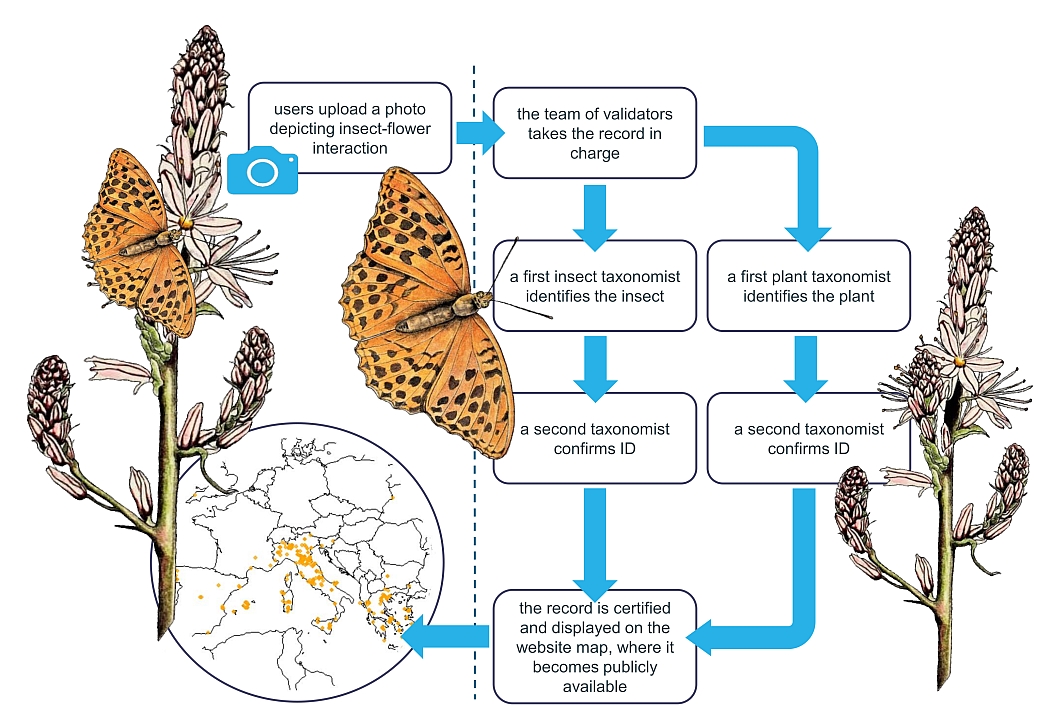
Pollinators play a vital role in most terrestrial ecosystems, supporting wild plant communities and enhancing agricultural yields. However, despite their ecological and economic importance, they have been experiencing an alarming decline over the past decades. The Mediterranean region, known for harboring highly diverse communities of plants and pollinators, is particularly vulnerable due to intense anthropogenic pressures. Furthermore, the ecological roles of many floral visitors remain poorly understood, hindering conservation efforts. In response, in recent years, growing attention has been directed toward the contribution that citizens can give in support of pollinator research. An increasing number of projects have adopted a Citizen Science approach to enable large-scale data collection. The LIFE 4 Pollinators project (LIFE18/GIE/IT/000755) “Involving people to protect wild bees and other pollinators in the Mediterranean” aims to promote the conservation of pollinating insects and entomophilous plants across the Mediterranean region by fostering progressive changes in human practices that threaten wild pollinators. In addition to the implementation of several actions to raise awareness, the project launched a web platform to collect photographic records of flower–insect interaction from the public. The platform is expected to remain active for at least ten years, during which we encourage continuing record submissions by interested bodies. With this data paper we are making the current dataset freely accessible to anyone, committing to periodic online updates.
References
Aavik T, Reitalu T, Kivastik M, Reinula I, Träger S, Uuemaa E, Barberis M, Biere A, Castro S, Cousins SAO, Cseccserits A, Dariotis E, Fišer Ž, Grzejszczak G, Huu CN, Hool K, Jacquemyn H, Julien M, Klisz M, Kmoch A, Krigas N, Lengyel A, Lenhard M, Moges DM, Münzbergová Z, Niinemets Ü, Odé B, Pánková H, Pärtel M, Pätsch R, Petanidou T, Plue J, Puchalka R, Rienks F, Samartza I, Sheard JK, Stojanova B, Töpper JP, Tsoktouridis G, Uzunov S, Zobel M(2025) A pan-European citizen science study shows population size, climate and land use are related to biased morph ratios in the heterostylous plant Primula veris. Journal of Ecology 00:1–19.
Bennett JM, Steets JA, Burns JH, Burkle LA, Vamosi JC, Wolowski M, Arceo-Gómez G, Burd M, Durka W, Ellis AG, Freitas L, Li J, Rodger JG, Ştefan V, Xia J, Knight TM, Ashman T-L (2020) Land use and pollinator dependency drives global patterns of pollen limitation in the Anthropocene. Nature Communications 11:3999.
Bilz M, Kell SP, Maxted N, Lansdown RV (2011) European Red List of Vascular Plants. Luxembourg: Publications Office of the European Union.
Bitonto FF, Costantino R, Barberis M, Bogo G, Birtele D, Cangelmi G, Dal Cin M, Devalez J, Lenzi L, Magagnoli S, Minici A, Sánchez JM, Zenga EL, Bortolotti L, Navarro L, Petanidou T, Sgolastra F, Traveset A, Galloni M (2025) LIFE4Pollinators’ Platform: How Citizen Science can help monitoring plants and pollinators. AoBPlants plaf023.
Borchard KE, Morales C, Aizen M, Toth AL (2021) Plant-pollinator conservation from the perspective of systems ecology. Current Opinion in Insect Science 47:154–161.
Bortolotti L, Galloni M (2025) Citizen Science: theory and applications. In: Cilia G, Ranalli R, Zavatta L, Flaminio S (eds.) Hidden and Wild: An Integrated Study of European Wild Bees. Springer
Chaplin-Kramer R, Dombeck E, Gerber J, Knuth KA, Mueller ND, Mueller M, Ziv G Klein AM (2014) Global malnutrition overlaps with pollinator-dependent micronutrient production. Proceedings of the Royal Society B: Biological Sciences 281(1794):20141799.
Dibner KA, Pandya R (2018) Learning through citizen science: Enhancing opportunities by design. Washington, DC: The National Academies Press.
Flaminio S, Ranalli R, Zavatta L, Galloni M, Bortolotti L (2021) Beewatching: a project for monitoring bees through photos. Insects 12(9):841.
Ghisbain G, Rosa P, Bogusch P, Flaminio S, Le Divelec R, Dorchin A, Kasparek M, Kuhlmann M, Litman J, Maud M, Müller A, Praz C, Radchenko V, Rasmont P, Risch S, Roberts SPM, Wood TJ, Michez D, Reverté Saiz S (2023) The new annotated checklist of the wild bees of Europe (Hymenoptera: Anthophila). Zootaxa 5327(1):1–147.
Gregory RD, van Strien A, Vorisek P, Meyling AWG, Noble DG, Foppen RPB, Gibbons DW (2005) Developing indicators for European birds. Philosophical Transactions of the Royal Society of London Series B Biological Sciences 1454:269–288.
Herrera C (2019) Complex long-term dynamics of pollinator abundance in undisturbed Mediterranean montane habitats over two decades. Ecological Monographs 89(1):e01338.
Irwin A (2018) No PhDs needed: how citizen science is transforming research. Nature 562(7726):480–483.
Klein AM, Vaissière BE, Cane JH, Steffan-Dewenter I, Cunningham SA, Kremen C, Tscharntke T (2007) Importance of pollinators in changing landscapes for world crops. Proceedings of the Royal Society B: Biological Sciences 274(1608):303–313.
Lewandowski EJ, Oberhauser KS (2917) Butterfly citizen scientists in the United States increase their engagement in conservation. Biological Conservation 208:106–112.
Lughadha E, Bachman SP, Leão TCC, Forest F, Halley JM, Moat J, Acedo C, Bacon KL, Brewer RFA, Gâteblé G, Gonçalves SC, Govaerts R, Hollingsworth PM, Krisai-Greilhuber I, de Lirio EJ, Moore PGP, Negrão R, Onana JM, Rajaovelona LR, Razanajatovo H, Reich PB, Richards SL, Rivers MC, Cooper A, Iganci J, Lewis GP, Smidt EC, Antonelli A, Mueller GM, Walker BE (2020) Extinction risk and threats to plants and fungi. Plants, People, Planet 2:389–408.
Nieto A, Roberts SPM, Kemp J, Rasmont P, Kuhlmann M, García Criado M, Biesmeijer JC, Bogusch P, Dathe HH, De la Rúa P, De Meulemeester T, Dehon M, Dewulf A, Ortiz-Sánchez FJ, Lhomme P, Pauly A, Potts SG, Praz C, Quaranta M, Radchenko VG, Scheuchl E, Smit J, Straka J, Terzo M, Tomozii B, Window J, Michez D (2014) European Red List of bees. Luxembourg: Publication Office of the European Union.
Popescu VD, Rozylowicz L, Niculae IM, Cucu AL, Hartel T (2014) Species, habitats, society: an evaluation of research supporting EU's Natura 2000 network. PloS one 9(11):e113648.
Potts S, Imperatriz-Fonseca V, Ngo H, Aizen MA, Biesmeijer JC, Breeze TD, Dicks LV, Garibaldi LA, Hill R, Settele J, Vanbergen AJ (2016) Safeguarding pollinators and their values to human well-being. Nature 540:220–229.
Potts SG, Biesmeijer JC, Kremen C, Neumann P, Schweiger O, Kunin WE (2010) Global pollinator declines: trends, impacts and drivers. Trends in Ecology & Evolution 25(6):345–353.
Potts SG, Petanidou T, Roberts S, O’Toole C, Hulbert A, Willmer P (2006) Plant-pollinator biodiversity and pollination services in a complex Mediterranean landscape. Biological Conservation 129(4):519–529.
Raven PH, Wagner DL (2021) Agricultural intensification and climate change are rapidly decreasing insect biodiversity. Proceedings of the National Academy of Sciences 118(2):e2002548117.
Requier F, Andersson GK, Oddi FJ, Garibaldi LA (2020) Citizen science in developing countries: how to improve volunteer participation. Frontiers in Ecology and the Environment 18(2):101–108.
Reverté S, Miličić M, Ačanski J, Andrić A, Aracil A, Aubert M, Balzan MV, Bartomeus I, Bogusch P, Bosch J, Budrys E, Cantú-Salazar L, Castro S, Cornalba M, Demeter I, Devalez J, Dorchin A, Dufrêne E, Đorđević A, Fisler L, Fitzpatrick Ú, Flaminio S, Földesi R, Gaspar H, Genoud D, Geslin B, Ghisbain G, Gilbert F, Gogala A, Grković A, Heimburg H, Herrera-Mesías F, Jacobs M, Janković Milosavljević M, Janssen K, Jensen J-K, Ješovnik A, Józan Z, Karlis G, Kasparek M, Kovács-Hostyánszki A, Kuhlmann M, Le Divelec R, Leclercq N, Likov L, Litman J, Ljubomirov T, Bang Madsen H, Marshall L, Mazánek L, Milić D, Mignot M, Mudri-Stojnić S, Müller A, Nedeljković Z, Nikolić P, Ødegaard F, Patiny S, Paukkunen J, Pennards G, Pérez-Bañón C, Perrard A, Petanidou T, Petersson LB, Popov G, Popov S, Praz C, Prokhorov A, Quaranta M, Radchenko VG, Radenković S, Rasmont P, Rasmussen C, Reemer M, Ricarte A, Risch S, Roberts SPM, Rojo S, Ropars L, Rosa P, Ruiz C, Sentil A, Shparyk V, Smit J, Sommaggio D, Soon V, Ssymank A, Ståhls G, Stavrinides M, Straka J, Tarlap P, Terzo M, Tomozii B, Tot T, van der Ent L-J, van Steenis J, van Steenis W, Varnava AI, Vereecken NJ, Veselić S, Vesnić A, Wigand A, Wisniowski B, Wood TJ, Zimmermann D, Michez D, Vujić A (2023) National records of 3000 European bee and hoverfly species: A contribution to pollinator conservation. Insect Conservation and Diversity 16(6):758–775.
Ricketts TH, Regetz J, Steffan‐Dewenter I, Cunningham SA, Kremen C, Bogdanski A, Gemmill-Herren B, Greenleaf SS, Klein AM, Mayfield MM, Morandin LA, Ochieng’ A, Potts SG, Viana BF (2008) Landscape effects on crop pollination services: are there general patterns? Ecology Letters 11(5):499–515.
Ropars L, Affre L, Aubert M, Fernandez C, Flacher F, Genoud D, Guiter F, Jaworski C, Lair X, Mutillod C, Nève G, Schurr L, Geslin B (2020) Pollinator specific richness and their interactions with local plant species: 10 years of sampling in Mediterranean habitats. Environmental Entomology 49(4):947–955.
Salim JA, Saraiva AM, Zermoglio PF, Agostini K, Wolowski M, Drucker DP, Soares FM, Bergamo PJ, Varassin IG, Freitas L, Maués MM, Rech AR, Veiga AK, Acosta AL, Araujo AC, Nogueira A, Blochtein B, Freitas BM, Albertini BC, Maia-Silva C, Nunes CEP, Pires CSS, dos Santos CF, Queiroz EP, Cartolano EA, de Oliveira FF, Amorim FW, Fontúrbel FE, da Silva GV, Consolaro H, Alves-dos-Santos I, Machado IC, Silva JS, Aleixo KP, Carvalheiro LG, Rocca MA, Pinheiro M, Hrncir M, Streher NS, Ferreira PA, de Albuquerque PMC, Maruyama PK, Borges RC, Giannini TC, Brito VLG (2022) Data standardization of plant-pollinator interactions. GigaScience 11:1–15.
Tong ZY, Wu LY, Feng HH, Zhang M, Armbruster WS, Renner SS, Huang SQ (2023) New calculations indicate that 90% of flowering plant species are animal-pollinated. National Science Review 10(10):nwad219.
Vamosi JC, Knight TM, Steets JA, Mazer SJ, Burd M, Ashman TL (2006) Pollination decays in biodiversity hotspots. Proceedings of the National Academy of Sciences 103(4):956–961.
Vohland K, Land-Zandstra A, Ceccaroni L, Lemmens R, Perello J, Ponti M, Samson R, Wagenknecht K (2021) The science of citizen science. In Springer eBooks.
Wagner DL (2020) Insect declines in the Anthropocene. Annual Review of Entomology 65(1):457–480.
Wieczorek J, Bloom D, Guralnick R, Blum S, Döring M, Giovanni R, Robbertson T, Vieglais D (2012) Darwin Core: an evolving community-developed biodiversity data standards. PLOS One 7(1): e29715.
Wiemers M, Balletto E, Dincă V, Fric ZF, Lamas G, Lukhtanov V, Munguira ML, van Swaay CAM, Vila R, Vliegenthart A, Wahlberg N, Verovnik R (2018) An updated checklist of the European butterflies (Lepidoptera, Papilionoidea). ZooKeys (811):9.
Downloads
Additional Files
Published
How to Cite
Issue
Section
License
Copyright (c) 2025 Marta Barberis, Fortunato Fulvio Bitonto, Roberto Costantino, Lorenzo Bianco, Daniele Birtele, Marco Bonifacino, Giacomo Cangelmi, Miquel Capò, Athanasia Chroni, Marco d'Agostino, Matteo Dal Cin, Jelle Devalez, Laura Bortolotti, Simone Flaminio, Antonio Giacò, Lucia Lenzi, Serena Magagnoli, Alessio Minici, Georgios Nakas, Luis Navarro, Gianfranco Samuele, José María Sánchez, Theodora Petanidou, Marino Quaranta, Rosa Ranalli, Michele Rossini, Enrico Ruzzier, Fabio Sgolastra, Anna Traveset, Emanuele Luigi Zenga, Marta Galloni

This work is licensed under a Creative Commons Attribution 4.0 International License.