
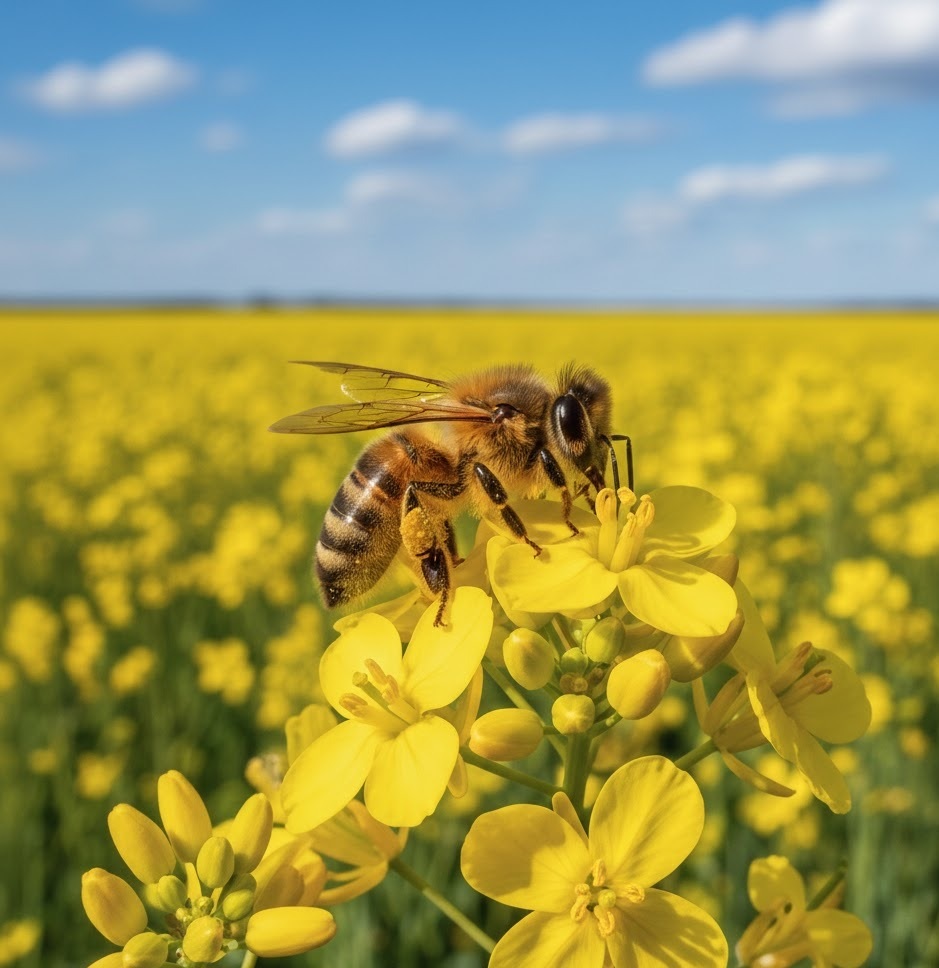
Effect of honey bees (Apis mellifera) and wild insect pollination on rapeseed (Brassica napus) yield in the Argentine Pampas
Results of a caging experiment
DOI:
https://doi.org/10.26786/1920-7603(2026)856Keywords:
insect pollination, canola, apiculture, crop production, sustainabilityAbstract
Rapeseed (Brassica napus) can benefit from insect pollination to maximize yield. The Argentine Pampas represent one of the most intensively cultivated regions of the world, characterized by landscape homogenization and a reduced availability of natural habitats for wild pollinators. These conditions provide a unique context to explore the contribution of managed and wild pollinators to rapeseed (Brassica napus) yield under highly intensified agricultural systems. The objective of this study was to evaluate the influence of Apis mellifera and wild insect pollinators on quantitative and qualitative components of rapeseed seed yield in fields of the Argentine Pampas, using a caging experiment. Three pollination treatments were applied: open pollination, pollinator exclusion, and A. mellifera-only. Compared to the exclusion treatment, pollination exclusive by A. mellifera increased crop yield by 33%, whereas open pollination resulted in a 20% increase. These differences in total yield were mainly explained by increases in quantitative components, such as number of seeds per fruit and fruits per plant. Seed physiological quality (ripeness, germination power and vigor) followed the same pattern among treatments. Our findings emphasize the importance of adjusting agricultural practices to promote the conservation of wild pollinators in rapeseed crops, and suggest that supplemental pollination with A. mellifera could serve as a useful tool for enhancing crop production under intensive management systems.
References
Aizen MA, Arbetman MP, Chacoff NP, Chacoff VR, Feinsinger P, Garibaldi LA, Harder LD, Morales CL, Sáez A, Vanbergen AJ (2020) Chapter Two - Invasive bees and their impact on agriculture. Advances in Ecological Research. 63: 49-92.
Araneda X, Ulloa RB, Carrillo JA, Lavín Contreras J, Toneatti Bastidas M (2010) Evaluation of Yield Component Traits of Honeybee-Pollinated (Apis mellifera L.) Rapeseed Canola (Brassica napus L.). Chilean Journal of Agricultural Research 70: 309–314.
Astegiano J, Carbone L, Zamudio F, Tavella J, Ashworth L, Aguilar R, Beccacece HM, Mulieri PR, Nolasco M, Torretta JP, Calviño A (2024). Diversifying agroecological systems: Plant-pollinator network organisation and landscape heterogeneity matter. Agriculture, Ecosystems & Environment, 361, 108816.
Atmowidi TRI, Buchori D, Manuwoto S, Suryobroto B, Hidayat P (2007). Diversity of Pollinator Insects in Relation to Seed Set of Mustard (Brassica rapa L.: Cruciferae). Journal of Biosciences 14(4): 155–161.
Aytac S, Gizlenci S, Acar M, Ustun A (2006) Changes in Erucic Acid Concentration of Rape Seeds in Advanced Generations. Online Journal of Biological Sciences 6: 71–73.
Bartual AM, Sutter L, Bocci G, Moonen AC, Cresswell J, Entling M, Giffard B, Jacot K, Jeanneret P, Holland J, Pfister S, Pintér O, Veromann E, Winkler K, Albrecht M (2019) The potential of different semi-natural habitats to sustain pollinators and natural enemies in European agricultural landscapes. Agriculture, Ecosystems & Environment 279: 43–52.
Bates D, Mächler M, Bolker BM, Walker SC (2015) Fitting linear mixed-effects models using lme4. Journal of Statistical Software 67.
Bommarco R, Marini L, Vaissière BE (2012) Insect pollination enhances seed yield, quality, and market value in oilseed rape. Oecologia 169: 1025–1032.
Brunet J, Fragoso FP (2024) What are the main reasons for the worldwide decline in pollinator populations? CABI Reviews.
Camacho JCB, Franke LB (2008) Efeito da polinização sobre a produção e qualidade de sementes de Adesmia latifolia. Revista Brasileira De Sementes 30: 81–90.
Carvalheiro LG, Seymour CL, Nicolson SW, Veldtman R (2012) Creating patches of native flowers facilitates crop pollination in large agricultural fields: mango as a case study. Journal of Applied Ecology 49: 1373–1383.
Chambó ED, Camargo SC, Garcia RC, Carvalho, CAL, Ruvolo-Takasusuki, MCC, Ludimilla Ronqui Júnior C S, Santos PR, Toledo VA (2018) Benefits of Entomophile Pollination in Crops of Brassica napus and Aspects of Plant Floral Biology. Brassica Germplasm - Characterization, Breeding and Utilization.
Chambó ED, De Oliveira NTE, Garcia RC, Duarte-Júnior JB, Ruvolo-Takasusuki MCC, Toledo VA (2014) Pollination of rapeseed (Brassica napus) by Africanized honeybees (Hymenoptera: Apidae) on two sowing dates. Anais Da Academia Brasileira de Ciencias 86(4):2087–2100.
Chiari WC, Hoffmann-Campo CB, Arrabal Arias C, Silva Lopes T, de Oliveira Arnaut de Toledo TCS, Chambó ED, Ruvolo-Takasusuki MC, de Alencar Arnaut de Toledo V (2013) Floral Biology and Africanized Honeybee Behaviour in Transgenic (Roundup ReadyTM var. BR-245 RR) and Conventional (var. BRS-133) Soybean (Glycine max L. Merrill) Flowers. Herbicides - Advances in Research.
Concejo Deliberante de San Antonio de Areco (2014) Ordenanza N.º 3919/2014: Reglamento de pulverizaciones (art. 17, título VI: Distancias de aplicación). http://www.instituciones.areco.gob.ar/hcd/index.php/2014/3975-3919-2014-reglamento-pulverizaciones
D’Angelo G, Terré E, Calzada J (2023) Actualidad y panorama de la colza en Argentina, Sudamérica y el mundo. In: Bolsa de Comercio de Rosario. https://www.bcr.com.ar/es/mercados/investigacion-y-desarrollo/informativo-semanal/noticias-informativo-semanal/actualidad-y
Degrandi-Hoffman G, Chambers M (2006) Effects of Honey Bee (Hymenoptera: Apidae) Foraging on Seed Set in Self-fertile Sunflowers (Helianthus annuus L). Environmental Entomoly 35: 1103–1108.
Delaplane KS, Van Der Steen J, Guzman-Novoa E (2013) Standard methods for estimating strength parameters of Apis mellifera colonies. Journal of Apicultural Research 52(1).
Free JB (1993) Insect pollination of crops. London: Academic Press
Garibaldi LA, Steffan-Dewenter I, Winfree R, Aizen MA, Bommarco R, Cunningham SA, Kremen C, Carvalheiro LG, Harder LD, Afik O, Bartomeus I, Benjamin F, Boreux V, Cariveau D, Chacoff NP, Dudenhöffer JH, Freitas BM, Ghazoul J, Greenleaf S, … Klein AM. (2013) Wild pollinators enhance fruit set of crops regardless of honey bee abundance. Science 339:1608–1611.
Holland JM, Douma JC, Crowley L, James L, Kor L, Stevenson DRW, Smith BM (2017) Semi-natural habitats support biological control, pollination and soil conservation in Europe. A review. Agronomy for Sustainable Development 37: 1–23.
INTA (2023) Mapa de suelos de la Provincia de Buenos Aires - escala 1:50.000 - Geo INTA. https://geo-backend.inta.gob.ar/catalogue/#/dataset/486
International Seed Testing Association (ISTA). (2018). International Rules for Seed Testing: 2018 Edition. Bassersdorf, Switzerland: ISTA.
Kevan PG, Eisikowitch D (1990) The effects of insect pollination on canola (Brassica napus L. cv. O.A.C. Triton) seed germination. Euphytica 45:39–41.
Klein AM, Vaissière BE, Cane JH, Steffan-Dewenter I, Cunningham SA, Kremen C, Tscharntke T (2007) Importance of pollinators in changing landscapes for world crops. Proceedings of the Royal Society B: Biological Sciences 274: 303–313.
Mandal KG, Saha KP, Ghosh PK, Hati KM, Bandyopadhyay KK (2002) Bioenergy and economic analysis of soybean-based crop production systems in central India. Biomass Bioenergy 23: 337–345.
Mazzei MP, Vesprini JL, Galetto L (2021) Seminatural habitats and their proximity to the crop enhances canola (Brassica napus) pollination and reproductive parameters in Argentina. Crop Science 61:2713–2721.
Mazzilli SR, Abbate S, Mendoza Y, Dobreff N, Rosas M, Silchenko S, De Andrea F, Fros D (2016) El rol de Apis mellifera en el cultivo de canola (Brassica napus L.). Cangüé 37: 14-18. https://ainfo.inia.uy/digital/bitstream/item/10616/1/Cangue-2016-no.-37-p.-14-18-Massilli-et-al.pdf
Mesquida J, Renard M, Pierre JS. Rapeseed (Brassica napus L.) productivity: the effect of honeybees (Apis mellifera L.) and different pollination conditions in cage and field tests. Apidologie 19(1): 51-72.
Michener CD (2007) The bees of the world, 2nd edition. Johns Hopkins University Press
Ouvrard P, Quinet M, Jacquemart AL (2017) Breeding system and pollination biology of Belgian oilseed rape cultivars (Brassica napus). Crop Science 57: 1455–1463.
Page ML, Williams NM (2023) Honey bee introductions displace native bees and decrease pollination of a native wildflower. Ecology 104(2).
Pinheiro J, Bates D, DebRoy S, Sarkar D, R Core Team (2024). nlme: Linear and Nonlinear Mixed Effects Models. R package version 3: 1-164. https://CRAN.R-project.org/package=nlme
R Core Team (2024) A language and environment for statistical computing. R Foundation for Statistical Computing. Viena, Austria
Rijal SP, Thapa RB, Sharma MD, Shrawan KS, Yubak Dhoj GC (2018) Pollinators diversity and their effects on rapeseed (Brassica campestris L. var. toria) production and productivity in Chitwan, Nepal. Journal of Agriculture and Environment 18: 151–161.
Rosa A de S, Blochtein B, Lima DK (2011) Honey bee contribution to canola pollination in Southern Brazil. Scientia Agricola 68: 255–259.
SAGPyA (1994) Resolución-1075. https://www.senasa.gob.ar/normativas/resolucion-1075-1994-sagpya-secretaria-de-agricultura-ganaderia-pesca-y-alimentos
Sarkar S, Ganguly B (2024) The Declining Population of insect pollinators: a global concern. Indian Farmer 11(12): 545-549.
Scally B, Santadino M, Zufiaurre E, Picca P, Liendo C, Catalano MI, Scannapieco AC (2025) Semi-natural habitats benefit the community of diurnal floral visitors of canola (Brassica napus L.) in the Argentine Pampas. Studies on Neotropical Fauna and Environment.
Sharma A, Reddy GVP (2020) IPM and Pollinator Protection in Canola Production in the USA. In: Gao Y, Hokkanen H, Menzler-Hokkanen I (eds) Integrative Biological Control. Progress in Biological Control Springer 20: 165–176.
Stamm M, Roozeboom K, Holman J (2013) Harvest Management of Canola. Kansas State University Agricultural Experiment Station and Cooperative Extension Service. https://bookstore.ksre.ksu.edu/pubs/harvest-management-of-canola_MF3092.pdf
Stanley DA, Gunning D, Stout JC (2013) Pollinators and pollination of oilseed rape crops (Brassica napus L.) in Ireland: Ecological and economic incentives for pollinator conservation. Journal of Insect Conservation 17:1181–1189.
Stiles S, Lundgren JG, Fenster CB, Nottebrock H (2021) Maximizing ecosystem services to the oil crop Brassica carinata through landscape heterogeneity and arthropod diversity. Ecosphere 12:e03624.
Tittonell P, Piñeiro G, Garibaldi LA, Dogliotti S, Olff H, Jobbagy EG (2020) Agroecology in Large Scale Farming—A Research Agenda. Frontiers in Sustainable Food Systems 4.
Tomm GO, Wiethölter S, Dalmago GA, Dos Santos HP (2009) Tecnologia para produção de canola no Rio Grande do Sul. Ministério da Agricultura, Pecuária e Abastecimento. URL: https://www.infoteca.cnptia.embrapa.br/infoteca/bitstream/doc/852550/1/pdo113.pdf
Woodcock BA, Garratt MPD, Powney GD, Shaw RF, Osborne JL, Soroka J, Lindström SAM, Stanley D, Ouvrard P, Edwards ME, Jauker F, McCracken ME, Zou Y, Potts SG, Rundlöf M, Noriega JA, Greenop A, Smith HG, Bommarco R, van der Werf W, Stout JC, Steffan-Dewenter I, Morandin L, Bullock JM, Pywell RF (2019) Meta-analysis reveals that pollinator functional diversity and abundance enhance crop pollination and yield. Nature Communications 10(1481).
Yang J, Wu P, Zhao Y, Olhnuud A, Bai J, Wu K, Zhang Y, Liu Y (2024) Managed pollinators improve oilseed rape yield: A global meta-analysis. Agriculture, Ecosystems & Environment 374:109135.
Downloads
Published
How to Cite
Issue
Section
License
Copyright (c) 2026 Bruno Scally, Marina Santadino, Emmanuel Zufiaurre, María Inés Catalano, Alejandra Carla Scannapieco

This work is licensed under a Creative Commons Attribution 4.0 International License.