
Flobots: Robotic flowers for bee behaviour experiments
DOI:
https://doi.org/10.26786/1920-7603(2015)7Abstract
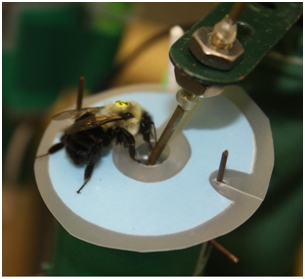
Studies of pollinator foraging behaviour often require artificial flowers that can refill themselves, allowing pollinators to forage for long periods of time under experimental conditions. Here I describe a design for inexpensive flowers that can refill themselves upon demand and that are easy enough to set up and clean that they can be used in arrays of 30 or more flowers. I also summarize of a variety of artificial flower designs developed by other researchers.
References
Boisvert MJ, Sherry DF (2006) Interval timing by an invertebrate, the bumble bee Bombus impatiens. Current Biology 16:1974-1974.
Brown GS, Gass CL (1993) Spatial association learning by hummingbirds. Animal Behaviour 46:487-497.
Chittka L, Thomson JD, Waser NM (1999) Flower constancy, insect psychology, and plant evolution. Naturwissenschaften 86:361-377.
Church DL, Plowright CMS (2006) Spatial encoding by bumblebees (Bombus impatiens) of a reward within an artificial flower array. Animal Cognition 9:131-140.
Cnaani J, Thomson JD, Papaj DR (2006) Flower choice and learning in foraging bumblebees: Effects of variation in nectar volume and concentration. Ethology 112:278-285.
Fülöp A, Menzel R (2000) Risk-indifferent foraging behaviour in honeybees. Animal Behaviour 60:657-666.
Gegear RJ, Laverty TM (2005) Flower constancy in bumblebees: a test of the trait variability hypothesis. Animal Behaviour 69:939-949.
Giurfa M, Núñez JA (1992) Honeybees mark with scent and reject recently visited flowers. Oecologia 89:113-117.
Goulson D (2009) The use of scent marks by foraging bumble bees. In: Food Exploitation by Social Insects: Ecological, Behavioral, and Theoretical Approaches. CRC Press, pp 251-260.
Greggers U, Menzel R (1993) Memory dynamics and foraging strategies of honeybees. Behavioral Ecology and Sociobiology 32:17-29.
Grossman KE (1973) Continuous, fixed-ratio, and fixed-interval reinforcement in honey bees. Journal of the Experimental Analysis of Behavior 20:105-109.
Hartling LK, Plowright RC (1979) Foraging by bumble bees on patches of artificial flowers: laboratory study. Canadian Journal of Zoology-Revue Canadienne de Zoologie 57:1866-1870.
Ings TC, Chittka L (2008) Speed-accuracy tradeoffs and false alarms in bee responses to cryptic predators. Current Biology 18:1520-1524.
Keasar T (2000) The spatial distribution of nonrewarding artificial flowers affects pollinator attraction. Animal Behaviour 60:639-646.
Keasar T, Sadeh A, Shmida A (2008) Variability in nectar production and standing crop, and their relation to pollinator visits in a Mediterranean shrub. Arthropod-Plant Interactions 2:117-123.
Lihoreau M, Chittka L, Raine NE (2010) Travel optimization by foraging bumblebees through readjustments of traplines after discovery of new feeding locations. American Naturalist 176:744-757.
Makino TT, Sakai S (2007) Experience changes pollinator responses to floral display size: from size-based to reward-based foraging. Functional Ecology 21:854-863.
Maloof JE, Inouye DW (2000) Are nectar robbers cheaters or mutualists? Ecology 81:2651-2661.
Moffatt L (2001) Metabolic rate and thermal stability during honeybee foraging at different reward rates. Journal of Experimental Biology 204:759-766.
Nachev V, Winter Y (2012) The psychophysics of uneconomical choice: non-linear reward evaluation by a nectar feeder. Animal Cognition 15:393-400.
Naug D, Arathi HS (2007) Receiver bias for exaggerated signals in honeybees and its implications for the evolution of floral displays. Biology Letters 3:635-637.
Núñez JA (1971) A simulador for learning studies in the bee Apis mellifera L. Acta Cientifica Venezolana 22:101-106.
Ohashi K, D'Souza D, Thomson JD (2010) An automated system for tracking and identifying individual nectar foragers at multiple feeders. Behavioral Ecology and Sociobiology 64:891-897.
Ohashi K, Leslie A, Thomson JD (2013) Trapline foraging by bumble bees: VII. Adjustments for foraging success following competitor removal. Behavioral Ecology 24:768-778.
Paldi N, Zilber S, Shafir S (2003) Associative olfactory learning of honeybees to differential rewards in multiple contexts - effect of odor component and mixture similarity. Journal of Chemical Ecology 29:2515-2538.
Schmitt J (1980) Pollinator foraging behavior and gene dispersal in Senecio (Compositae). Evolution 34:934-943.
Schmitt U, Bertsch A (1990) Do foraging bumblebees scent mark food sources and does it matter? Oecologia 82:137-144.
Sigurdson JE (1981) Measurement of consummatory behavior in honey bees. Behavior Research Methods & Instrumentation 13:308-310.
Sokolowski MBC, Abramson CI (2010) From foraging to operant conditioning: a new computer-controlled Skinner box to study free-flying nectar gathering behavior in bees. Journal of Neuroscience Methods 188:235-242.
Thakar JD, Kunte K, Chauhan AK, Watve AV, Watve MG (2003) Nectarless flowers: ecological correlates and evolutionary stability. Oecologia 136:565-570.
Thomson JD et al. (2012) Estimating pollination success with novel artificial flowers: effects of nectar concentration. Journal of Pollination Ecology 9:108-114.
Tofilski A (2000) Senescence and learning in honeybee (Apis mellifera) workers. Acta Neurobiologiae Experimentalis 60:35-39.
Waddington KD, Allen T, Heinrich B (1981) Floral preferences of bumblebees (Bombus edwardsii) in relation to intermittent versus continuous rewards. Animal Behaviour 29:779-784.
Winter Y, Stich KP (2005) Foraging in a complex naturalistic environment: capacity of spatial working memory in flower bats. Journal of Experimental Biology 208:539-548.
Zimmerman M (1988) Pollination biology of montane plants: relationship between rate of nectar production and standing crop. American Midland Naturalist 120:50-57.
Downloads
Published
How to Cite
Issue
Section
License
Copyright (c) 2015 Carla Jean Essenberg

This work is licensed under a Creative Commons Attribution 4.0 International License.