
Spatial variation in pollinator communities and reproductive performance of Prosopis juliflora (Fabaceae)
DOI:
https://doi.org/10.26786/1920-7603(2012)8Abstract
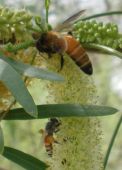
This study was conducted in an effort to understand the effects of spatial variations in pollinator assemblage due to habitat isolation on the reproductive performance of perennial plant species. Variations in pollinator assemblage structure (abundance, diversity and Shannon-Wiener index) were studied at three widely isolated (100 to 200 km apart) nature reserves of Southern Punjab, Pakistan, in order to explore its effects on reproductive performance of Prosopis juliflora. Species richness and abundance were highest in Pirowal Sanctuary followed by Chichawatni Sanctuary and Chak Katora forest reserve. The pollination system of P. juliflora was highly generalized with 77 insect visitor species in four orders among all the three sites. However, pollinator assemblage varied significantly in composition among the sites. Out of the four reproductive parameters considered, the number of pods per raceme and germination varied significantly among the three locations. The reproductive performance of P. juliflora in terms of number of pods per raceme and germination improved with abundance of pollinators.
References
Ali M, Saeed S, Sajjad A, Whittington A (2011) In search of the best pollinators for canola (Brassica napus L.) production in Pakistan. Applied Entomology and Zoology 46:353-361.
Bingham CT (1987) The Fauna of British India, including Ceylon and Burma, Hymenoptera. Vol. I Wasps and Bees. Taylor and Francies, London.
Borror DJ, Long DM, Triplehorn CA (1981) An introduction to the study of insects. Saunders College Publishing, Philadelphia.
Chaiyawong T, Deowanish S, Wongsiri S, Sylvester HA, Rinderer TE, Guzman LD (2004) Multivariate morphometric study of Apis florea in Thailand. Journal of Apicultural Research 43(3): 123-127.
Cunningham SA (2000) Depressed pollination in habitat fragments causes low fruit set. Proceedings of the Royal Society of London 567: 1149-1152.
De Oliveira VR, Pires IE (1990) Pollination efficiency of P. juliflora (Sw) DC in Petrolina, Pernambuco. In: The Current State of Knowledge on P. juliflora. Habit MA, Saavedra JC (eds), FAO, Rome, Italy, 233-239.
Devy MS, Davidar P (2003) Pollination systems of trees in Kakachi, a mid-elevation wet evergreen forest in Western Ghats, India. American Journal of Botany 90: 650-657.
Donaldson J, Nanni J, Zachariades C, Kemper J (2002) Effects of habitat fragmentation pollinator diversity and plant reproductive success in renosterveld shrublands of South Africa. Conservation Biology 16: 1267-1276.
Dubale A (2006) Impacts of Prosopis juliflora invasion and control using charcoal production in Afar National Regional State, Ethiopia. MSc thesis University of Wales, Bangor, UK.
Gilbert FS (1981) Foraging ecology of hoverflies: morphology of the mouthparts in relation to feeding on nectar and pollen in some common urban species. Ecological Entomology. 6: 245-262
Goel VL, Behl HM (1995) Propagation of Prosopis juliflora from rooted stem cuttings. International Tree Crops Journal 8: 193-201.
Gomez JM, Bosch J, Perfectti F, Fernandez J, Abdelaziz M (2007) Pollinator diversity affects plant reproduction and recruitments: the tradeoffs of generalization. Oecologia 153: 597-605.
Gomez JM, Abdelaziz M, Lorite J, Pajares AJM, Perfectti F (2010) Changes in pollinator fauna cause spatial variation in pollen limitation. Journal of Ecology 98: 1243-1252.
Gotelli NJ, Entsminger DF (2005) EcoSim, Null models software for ecology, v 7.72 Acquired Intelligence Inc and Kesey-Bearm, at http://www.homepages.together.net/~gentsmin/ecosim.htm
Hammer Ø, Harper DAT, Ryan PD (2001) PAST: Paleontological statistics software for education and data analysis. Paleontologia Electronica 4 (1): 9.
Herrera CM (2005) Plant generalization on pollinators, species property or local phenomenon? American Journal of Botany 92: 13-20.
Hingston AB, McQuillan PB (2000) Are pollination syndromes useful predictors of floral visitors in Tasmania? Austral Ecology 25: 600-609.
Hurlbert SH (1971) The nonconcept of species diversity: a critique and alternative parameters. Ecology 52: 577-586
Iqbal MZ, Shafiq M (1997) Seedling performance of two desert plant species (Prosopis juliflora and Blepharis sindica) grown under uniform edaphic conditions. Journal of Tropical Forest Science 9: 458-464.
Jennersten O (1988) Pollination in Dianthus deltoides (Caryophyllaceae): Effects of habitat fragmentation on visitation and seed set. Conservation Biology 2 (4): 359-366.
Jennersten O, Nilsson SG (1993) Insect flower visitation frequency and seed production in relation to patch size of Viscaria vulgaris (Caryophyllaceae). Oikos 68: 283-292.
Kallimanis AS, Petanidou T, Tzanopoulos J, Pantis JD, Sgardelis SP (2009) Do plant-pollinator interaction networks result from stochastic process? Ecological Modelling 220: 684-693.
Karron JD, Mitchell RJ (2011) Effects of floral display size on male and female reproductive success in Mimulus ringens. Annals of Botany doi: 10.1093/aob/mcr193
Khan SU, Hassan M, Khan FK, Bari A. (2010) Climate classification of Pakistan. Balwois 2010 Conference, Ohrid, Republic of Macedonia, http://www.balwois.com/balwois/administration/full_paper/ffp-1295.pdf: 1-47 (Date of access: 20 Aug. 2011)
Kleijn D, Langevelde FV (2006) Interacting effects of landscape context and habitat quality on flower visiting insects in agricultural landscapes. Basic and Applied Ecology 7: 201-214.
Luna R K (1996) Prosopis juliflora (Swartz) DC. In: Plantation Trees. International Book Distributors, Delhi,
India.
Magurran AE (2004) Ecological Diversity and Measurements. 2nd edn. Princeton University Press, Princeton, N.J.
McCall C, Primack RB (1992) Influence of flower characteristics, weather, time of day, and season on insect visitation rates in three plant communities. American Journal of Botany 79: 434-442.
Michener CD (2000) The Bees of the World. John Hopkins University Press, Baltimore.
Moeller DA, Tiffin P (2005) Genetic diversity and the evolutionary history of plant immunity genes in two species of Zea. Molecular Biology and Evolution 22: 2480-2490.
Murren OJ (2002) Effect of habitat fragmentation on pollination: pollinators, pollinia viability and reproductive success. Journal of Ecology 90: 100-107.
Muzaffar N, Ahmad R (1991) Some honeybee flora for Apis spp. in Pakistan. Pakistan Journal of Zoology 23:201-218.
Mwangi E and Swallow B (2005) Invasion of Prosopis juliflora and local livelihoods: Case study from the lake Baringo area of Kenya. ICRAF Working Paper -no. 3, Nairobi, World Agroforestry Centre.
Ockinger E, Smith HD (2007) Semi-natural grasslands as population sources for pollination insects in agricultural landscapes. Journal of Applied Ecology 44: 50-59.
Olesen JM, Jordano P (2002) Geographic patterns in plant-pollinator mutualistic networks. Ecology 83: 2416-2424.
Ollerton J, Cranmer L (2002) Latitudinal trends in plant-pollinator interactions: are tropical plants more specialized? Oikos 98: 340-350.
Pasiecznik NM (2001) Managing Prosopis juliflora for timber production in arid zones. In: Neelakantan KS et al., eds. Management and Utilisation of Prosopis juliflora - Training Manual, pp85-90. Forest College and Research Institute, Tamil Nadu Agricultural University, Mettupalayam, India.
Pasiecznik NM, Felker P, Harris PJC, Harsh LN, Cruz G., Tewari JC, Cadoret K, Maldonado LJ (2001) The Prosopis juliflora - Prosopis pallida complex: a monograph. HDRA, Coventry, UK. 162pp.
Rathcke BJ, Jules ES (1993) Habitat fragmentation and plant-pollinator interactions. Current Science 65: 273-277.
Richardson DM, Allsopp N, D'Antonio CM, Milton SJ, Rejmanek M (2000) Plant invasions – the role of mutualisms. Biological Reviews 75: 63-99.
Root RB (1973) Organization of a plant-arthropod association in simple and diverse habitats: the fauna of collards (Brassica oleraceae). Ecological Monographs 43: 95-124.
Sajjad A, Saeed S, Masood A (2008) Pollinator community of onion (Allium cepa L.) and its role in crop reproductive success. Pakistan Journal of Zoology 40(6):451-456.
Sajjad A, Saeed S, Muhammad W, Arif MJ (2009) Role of insects in cross-pollination and yield attributing components of Susbania sesban. International Journal of Agriculture and Biology 11(1): 77-80.
Sahli HF, Conner JK (2006) Characterizing ecological generalization in plant-pollinator systems. Oecologia 148:365-372.
Saunders DA, Hobbs RJ, Margules CR (1991) Biological consequences of ecosystem fragmentation: a review. Conservation Biology 5: 18-32.
Simpson BB (1977) Mesquite, its Biology in Two Desert Shrub Ecosystems. Dowden, Hutchinson and Ross, Stroudsberg, Pennsylvania, USA.
Somanathan H, Warrant EJ, Borges RM, Wallen R, Kelber A (2009) Resolution and sensitivity of eyes of the Asian honeybees Apis florea, Apis cerana and Apis dorsata. The Journal of Experimental Biology 212: 2448-2453.
Steffan-Dewenter I, Tscharntke T (1999) Effects of habitat isolation on pollinator communities and seed set. Oecologia 121: 432-440.
Steffan-Dewenter I, Munzenberg U, Burger C, Thies C, Tscharntke T (2002) Scaled-dependent effects of landscape context on three pollinator guilds. Ecology 83: 1421-1432.
Talavera S, Bastida F, Ortiz PL, Arista M (2001) Pollinator attendance and reproductive success in Cistus libanotis L. (Cistaceae). International Journal of Plant Sciences 162:343-352.
Truman ST, Wallace HM (1999) Pollination and resource constraints on fruit set and fruit size of Persoonia rigida (Proteaceae). Annals of Botany 83: 145-155.
Van Treuren R, Bijlsma R, Ouborg NJ, Kwak MM (1994) Relationship between plant density, outcrossing rates and seed set in natural and experimental populations of Scabiosa columbaria. Journal of Evolutionary Biology 7: 287-302.
Ward CR, O’Brien CW, O’Brien LB, Foster DE, Huddleston EW (1977) Annotated Checklist of New World Insects Associated with Prosopis (Mesquite). Technical Bulletin Vol. 1557. United States Department of Agriculture, USA.
Winfree R, Bartomeus I, Cariveau DP (2011) Native pollinators in anthropogenic habitats. Annual Review of Ecology, Evolution and Systematic 42:1-22.
Zaitoun S, Al-Ghzawi AA, Samarah N, Mullen R (2009) Pod production of Prosopis juliflora (Sw.) DC. As affected by supplementary and honeybee pollination under arid conditions. Acta Agriculturae Scandinavica 59: 349-356.
Published
How to Cite
Issue
Section
License
Copyright (c) 2012 Asif Sajjad, Shafqat Saeed, Muhammad Amjad Bashir

This work is licensed under a Creative Commons Attribution 4.0 International License.