
Assessing pollinator efficiency in blueberry: From bumblebee buzzing to ant foraging
DOI:
https://doi.org/10.26786/1920-7603(2026)928Keywords:
Non-bee pollinators, Pollination, Plant-pollinator interactions, Pollen loads, VacciniumAbstract
Highbush blueberry (Vaccinium corymbosum) depends on biotic pollination to produce marketable fruits. A wide range of insects, from managed honey bees (Apis mellifera) to wild bees, hoverflies and other insects, visit blueberry flowers, but their efficiency as pollinators varies greatly. This variation is partially related to blueberry flower morphology, which limits access to nectar and pollen, and to the presence of poricidal anthers that require buzz pollination for more efficient pollen release.
We assessed the pollination efficiency of the main floral visitors of blueberry in Portugal. Previously bagged flowers of cultivar Duke were exposed to individual visitors, and pollen loads on stigmas were quantified after each visit. Additionally, we monitored plant-pollinator interactions throughout the day and assessed pollen deposition on the stigmas from flowers exposed to open pollination.
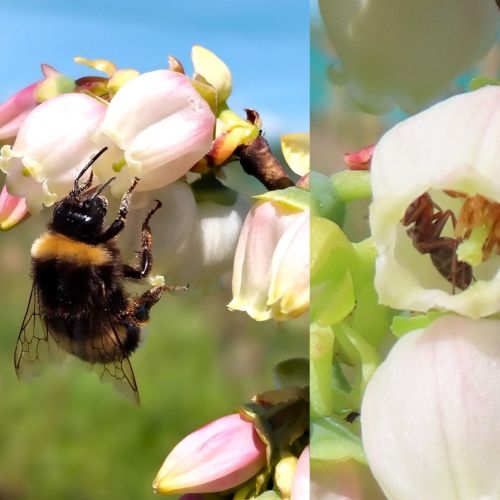
Surprisingly, most visits were made by the ant Formica rufibarbis, closely followed by the bumblebee Bombus terrestris. These were also the only taxa recorded visiting flowers within the pollinator efficiency experiment. Bombus terrestris deposited significantly more pollen tetrads, and flowers visited by this species consequently developed more pollen tubes than those visited by F. rufibarbis. However, open pollinated flowers exhibited greater pollen deposition and higher pollen tube numbers than flowers visited by either B. terrestris or F. rufibarbis. Our results indicate that B. terrestris is a more efficient pollinator than F. rufibarbis and can deliver sufficient pollen tetrads to achieve full pollination in a single visit, depending on its foraging behaviour. Despite their low efficiency, ants may still contribute to blueberry pollination under conditions that limit the activity of flying pollinators.
References
Bates D, Maechler M, Bolker B, Walker S (2015) lme4: Linear mixed-effects models using Eigen and S4. [online] URL: https://cran.r-project.org/package=lme4
Bobiwash K, Uriel Y, Elle E (2018) Pollen Foraging Differences among Three Managed Pollinators in the Highbush Blueberry (Vaccinium corymbosum) Agroecosystem. Journal of Economic Entomology 111:26–32.
Borghi M, DeVetter LW, Edger PP, Gutensohn M, Grotewold E, Sagili R, Graham KK, Body MA, Li C, Galinato SP, Melathopoulos A, Cane JH, Sandefur P, Dela Luz A, Schaeffer RN, Rering CC, Jadhav SS, Chu Y, Chitwood DH (2025) Enhancing entomophilous pollination for sustainable crop production. Plant Journal 122:1–11.
Carvalheiro LG, Seymour CL, Veldtman R, Nicolson SW (2010) Pollination services decline with distance from natural habitat even in biodiversity-rich areas. Journal of Applied Ecology 47:810–820.
Castro H, Branco AM, Chaves B, Gaspar H, Loureiro J, Castro S (2026) Blueberry floral morphology influences pollinator visitation and behavioural patterns. Web Ecology 26:83–92.
Castro H, Gaspar H, Loureiro J, Castro S (2023) Effect of Extreme Climatic Events on Plant-Pollinator Interactions in Blueberry. In: Climate Change Management. Springer Nature Switzerland, pp 165–181.
Cavigliasso P, Negri P, Viel M, Graziani MM, Challiol C, Bello F, Saez A (2021) Precision management of pollination services to blueberry crops. Scientific Reports:1–8.
Chabert S, DeVetter LW, Isaacs R, Morales SN, Walters J, Mallinger RE (2026). Cross-pollination improves fruit quantity and quality across Northern and Southern Highbush Blueberry cultivars. HortScience 61:1621–1629
Core Development Team R (2016) A language and environment for statistical computing. Vienna: R Foundation for Statistical Computing. [online] URL: http://www.r-project.org/
Cortés-Rivas B, Monzón VH, Rego JO, Mesquita-Neto JN (2023a) Pollination by native bees achieves high fruit quantity and quality of highbush blueberry: a sustainable alternative to managed pollinators. Frontiers in Sustainable Food Systems 7
Cortés‐Rivas B, Smith‐Ramirez C, Monzón VH, Mesquita‐Neto JN (2023b) Native bees with floral sonication behaviour can achieve high‐performance pollination of highbush blueberry in Chile. Agricultural and Forest Entomology 25:91–102.
Dafni A, Kevan PG, Husband BC (2005) Pratical Pollination Ecology. Enviroquest, Lta.
DeVetter LW, Chabert S, Milbrath MO, Mallinger RE, Walters J, Isaacs R, Galinato SP, Kogan C, Brouwer K, Melathopoulos A, Eeraerts M (2022) Toward evidence-based decision support systems to optimize pollination and yields in highbush blueberry. Frontiers in Sustainable Food Systems 6
Díaz MA, Pirk GI, Chalcoff VR (2025) Ants as Potential Pollinators in Agroecological Crops. Journal of Applied Entomology 149:1237–1247.
Dogterom MH, Winston ML, Mukai A (2000) Effect of pollen load size and source (self, outcross) on seed and fruit production in highbush blueberry cv. ‘Bluecrop’ (Vaccinium corymbosum; Ericaceae). American Journal of Botany 87:1584–1591.
Eeraerts M, DeVetter LW, Batáry P, Ternest JJ, Mallinger R, Arrington M, Benjamin FE, Blaauw BR, Campbell JW, Cavigliasso P, Daniels JC, de Groot GA, Ellis JD, Gibbs J, Goldstein L, Hoffman GD, Kleijn D, Melathopoulos A, Miller SZ, Montero-Castaño A, Naranjo SM, Nicholson CC, Perkins JA, Rao S, Raine NE, Reilly JR, Ricketts TH, Rogers E, Isaacs R (2023) Synthesis of highbush blueberry pollination research reveals region-specific differences in the contributions of honeybees and wild bees. Journal of Applied Ecology 60:2528–2539.
Eeraerts M, Smagghe G, Meeus I (2019) Pollinator diversity, floral resources and semi-natural habitat, instead of honey bees and intensive agriculture, enhance pollination service to sweet cherry. Agriculture, Ecosystems & Environment 284:106586.
Fürjes-Mikó, Á, Csősz, S, Paulin, MJ, Csóka, G (2025) The Role of Red Wood Ants (Formica rufa Species Group) in Central European Forest Ecosystems - A Literature Review. Insects 16: 518
Hartig F (2016) DHARMa: Residual Diagnostics for Hierarchical (Multi-Level / Mixed) Regression Models. [online] URL:https://github.com/florianhartig/dharma
Isaacs R, Kirk AK (2010) Pollination services provided to small and large highbush blueberry fields by wild and managed bees. Journal of Applied Ecology 47:841–849.
Komatz A, Cromie J, Adunola P, Chabert S, Muñoz PR (2025) Quantitative pollination requirements: A buzzworthy breeding objective for improving blueberry yield. Scientia Horticulturae 348
Lenth R, Piaskowski J (2026). emmeans: Estimated Marginal Means, aka Least-Squares Means. R package version 2.0.3, https://rvlenth.github.io/emmeans/
Nunes-Silva P, Hrncir M, Shipp L, Kevan P, Imperatriz-Fonseca VL (2013) The behaviour of Bombus impatiens (Apidae, Bombini) on tomato (Lycopersicon esculentum Mill., Solanaceae) flowers: pollination and reward perception. Journal of Pollination Ecology 11:33–40.
Ramírez-Mejía AF, Chacoff NP, Cavigliasso P, Blendinger PG (2024a) How much is enough? Optimizing beehive stocking densities to maximize the production of a pollinator-dependent crop. Ecological Modelling 498:110891.
Ramírez-Mejía AF, Chacoff NP, Lomáscolo SB, Woodcock BA, Schmucki R, Blendinger PG (2024b) Optimal pollination thresholds to maximize blueberry production. Agriculture, Ecosystems & Environment 365:108903.
Seifert B, Schultz R (2009) A taxonomic revision of the Formica rufibarbis Fabricius, 1793 group (Hymenoptera: Formicidae). Myrmecological News 12: 255-272
Sun Q, Zhao X, Wu L, Zhao J, Yang Y, Zhang Y (2021) Differences in pollination efficiency among three bee species in a greenhouse and their effects on yield and fruit quality of Northern highbush “Bluecrop” Blueberry. HortScience 56:603–607.
Svensson L (1985) An estimate of pollen carryover by ants in a natural population of Scleranthus perennis L. (Caryophyllaceae). Oecologia 66:373-377.
Svensson L (1986) Secondary pollen carryover by ants in a natural population of Scleranthus perennis (Caryophyllaceae). Oecologia 70:631-632.
Vander Kloet S P (1988). The genus Vaccinium in North 516 America. Research Branch Agriculture Canada Publication 1828, Ottawa, Ontario, Canada.
Wickham H, Chang W, Henry L, Takahashi K, Wilke C, Woo K, Yutani H, Dunnington D, Brand T (2024) ggplot2: 518 Create Elegant Data Visualisations Using the Grammar 519 of Graphics. R package version 3.x.
Downloads
Published
How to Cite
Issue
Section
License
Copyright (c) 2026 Helena Castro, Catarina Moniz, João Loureiro, Arminda Lopes, Sílvia Castro

This work is licensed under a Creative Commons Attribution 4.0 International License.