
Reproductive system, floral biology and pollinators of Abutilon grandifolium in urban green spaces of Ciudad Autónoma de Buenos Aires.
DOI:
https://doi.org/10.26786/1920-7603(2026)914Keywords:
Abutilon grandifolium, floral rewards, floral visitors, native pollinators, urban green spaces, ApoideaAbstract
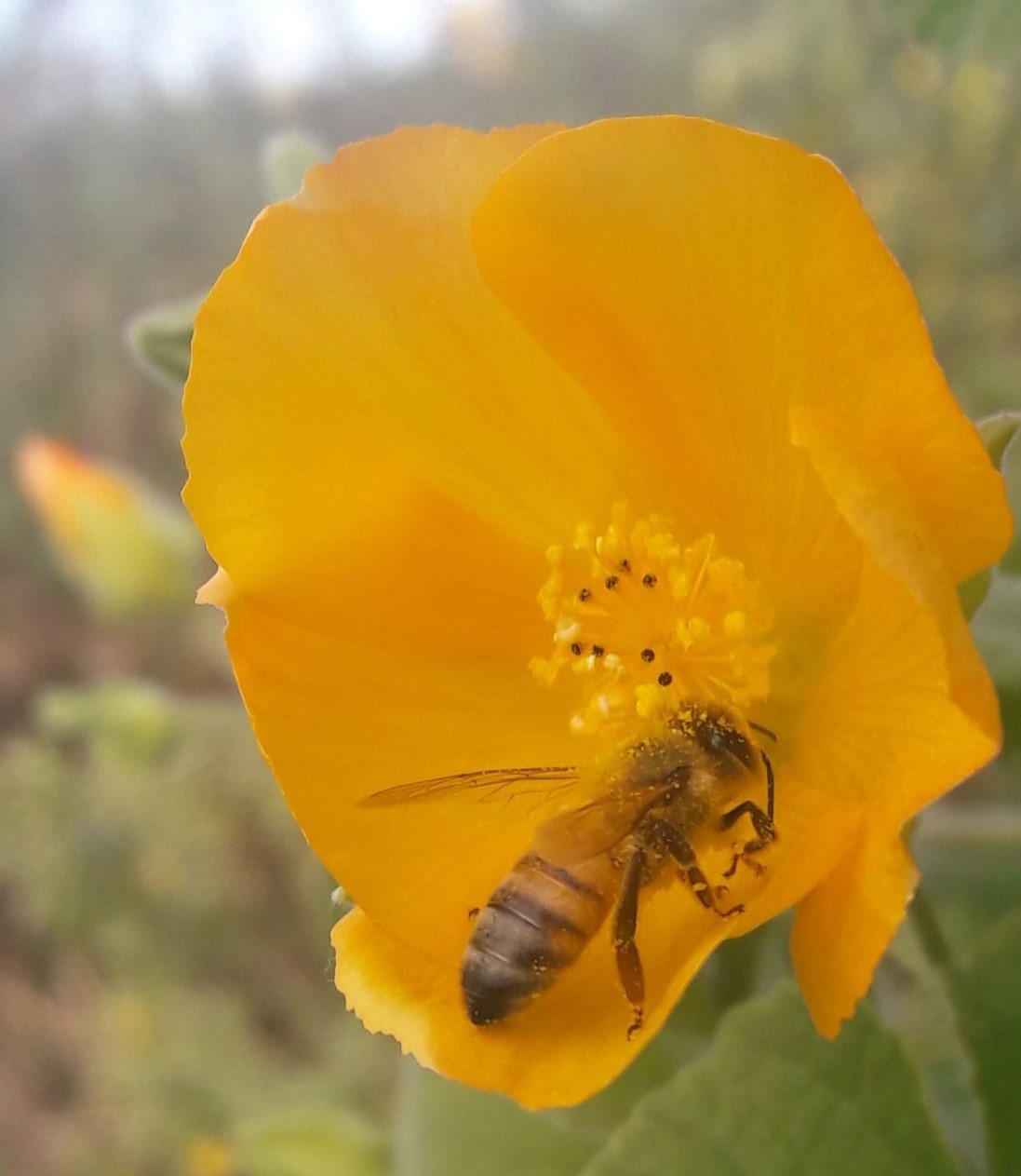
Urban green spaces have gained importance in view of growing urbanization; however, limited research exists on the interactions of native plants with the local fauna, particularly comparing protected natural areas vs. recreated ones. To help fill this gap, the floral biology and pollination of Abutilon grandifolium (Malvaceae) were studied in an Ecological Reserve and in a square where the local environment had been recreated with native plants, both located in Ciudad Autónoma de Buenos Aires, Argentina. A. grandifolium was self-compatible. The flowers presented typical traits associated with biotic pollination (ornamented pollen, conspicuous perianth and rewards), particularly melittophily (diurnal anthesis, nectar, yellow-orange coloration and pleasant odour). At both sites, the most frequent visitors were Apis mellifera and halictid bees, collecting nectar and/or pollen. While visits from the former were predominantly illegitimate, halictids mostly performed legitimate visits. Occasional visitors included the bees Xylocopa sp. and Bombus pauloensis, syrphid flies and, more rarely, beetles. Large quantities of A. grandifolium pollen were found on all bee species, in positions compatible with an effective transfer to the stigmas, indicating that they likely pollinate when accessing flowers legitimately. In contrast, flies and beetles would be mainly pollen and nectar thieves. In general, the identity, frequency and activity of the floral visitors were similar at both sites, with species richness even higher in the square; suggesting that restored native plantings can support functional pollination processes in urban green spaces.
References
Abdel Khalik K, Al-Ruzayza S, Assiri A, Elkordy A (2021) Pollen morphology of Malvaceae genera from Saudi Arabia and its taxonomic significance. Australian Journal of Crop Science 15(5):725–742.
Abrahamovich AH, Díaz NB (2002) Bumble bees of the neotropical region (Hymenoptera: Apidae). Biota Colombiana 3(2). Available at: https://revistas.humboldt.org.co/index.php/biota/article/view/115 (accessed 20 February 2024).
Abid R (2006) Reproductive biology of Abutilon fruticosum Guill. & Perr. International Journal of Biology and Biotechnology 3:543–545.
Abid R, Alam J, Qaiser M (2010) Pollination mechanism and role of insects in Abutilon indicum (L.) Sweet. Pakistan Journal of Botany 42(3):1395–1399.
Araújo FP, Klein PA, Fernandes M, Renck MVK, Rolim RG (2022) Se essa rua fosse minha eu mandava semear: plantas ornamentais nativas para manutenção de polinizadores em áreas urbanas nos campos de cima da serra, Rio Grande do Sul, Brasil. Pesquisas, Botânica 76:193–217.
Amela García MT (1999) Biología floral y sistema reproductivo de especies nativas de Passiflora (Passifloraceae) de la Argentina. Doctoral thesis, FCEyN, Universidad de Buenos Aires, Buenos Aires, Argentina.
Andrada FD, Chacoff NP, Lomáscolo SB (2024) Effect of green spaces and floral composition on the community of flower visitors in a piedmont city in Argentina. Ecología Austral 34:563–578.
Baldock KCR (2020) Opportunities and threats for pollinator conservation in global towns and cities. Current Opinion in Insect Science 38:63–71.
Barrett SCH, Arunkumar R, Wright SI (2014) The demography and population genomics of evolutionary transitions to self-fertilization in plants. Philosophical Transactions of the Royal Society B 369(1648):20130344.
Bernhardt P (2000) Convergent evolution and adaptive radiation of beetle-pollinated angiosperms. In: Dafni A, Kevan PG, Husband BC (eds) Pollen and pollination. Springer, Vienna, pp 293–320.
Brooks ME, Kristensen K, van Benthem KJ, Magnusson A, Berg CW, Nielsen A, Skaug HJ, Mächler M, Bolker BM (2017) glmmTMB balances speed and flexibility among packages for zero-inflated generalized linear mixed modeling. The R Journal 9(2):378–400.
https://doi.org/10.32614/RJ-2017-066
Burgueño G, Nardini C (2019) Introducción al paisaje natural. Diseño de espacios verdes con plantas nativas. Orientación Gráfica Editora, Buenos Aires.
Chambers JM, Hastie TJ (eds) (1992) Statistical models in S. Wadsworth & Brooks/Cole, Pacific Grove, CA.
Christensen PB (1986) Pollen morphological studies in the Malvaceae. Grana 25(2):95–117.
Costa VBS, Pimentel RMM, Chagas MGS, Alves GD, Castro CC (2017) Petal micromorphology and its relationship to pollination. Plant Biology 19(2):115–122.
Dafni A (1992) Pollination ecology: a practical approach. Oxford University Press, Oxford.
Dalmazzo M, González-Vaquero RA, Debandi G, Roig-Alsina A (2014) Hymenoptera: Halictidae. In: Roig-Juñent S, Claps LE, Morrone JJ (eds) Biodiversidad de artrópodos argentinos Vol. 4. Editorial INSUE–UNT, San Miguel de Tucumán, pp 203–219.
Dawar R, Ali T, Qaiser M (1994) Hybridization in Sida ovata complex II. Evidence from breeding studies. Pakistan Journal of Botany 26(1):83–97.
Del Pino JA, Díez Dapena MJ (1990) Aportación a la palinología de plantas ornamentales de la ciudad de Sevilla. I. Lagascalia 15(2):199–222.
Domingues de Almeida JD, Freitas H. (2012). Exotic flora of continental Portugal–a new assessment. Bocconea, 24, 231-237.
El Naggar SM, Sawady N (2008) Pollen morphology of Malvaceae and its taxonomic significance in Yemen. Flora Mediterranea 18:431–439.
Endress PK (1996) Diversity and Evolutionary Biology of Tropical Flowers. Cambridge University Press, Cambridge.
Erdtman G (1952) Pollen morphology and plant taxonomy: angiosperms. Almqvist & Wiksell, Stockholm.
Erdtman G (1986) Pollen morphology and plant taxonomy: angiosperms Vol. 1. Hafner Publishing Company, New York and London.
Faggi A, Ignatieva M (2009) Urban green spaces in Buenos Aires and Christchurch. Proceedings of the Institution of Civil Engineers – Municipal Engineer 162(4):241–250.
Faegri K, van der Pijl L (1979) The principles of pollination ecology (3rd edn). Pergamon Press, Oxford/New York.
Freitas L, Vizentin-Bugoni J, Wolowski M, Souza JMT, de Varassin IG (2014) Interações planta-polinizador e a estruturação das comunidades. In: Rech AR, Agostini K, Oliveira PE, Machado IC (eds) Biologia da polinização. Projeto Cultural, Rio de Janeiro, pp 373–397.
Fryxell PA (2002) An Abutilon nomenclator (Malvaceae). Lundellia 5:79–118.
Gathmann A, Tscharntke T (2002) Foraging ranges of solitary bees. Journal of Animal Ecology 71(5):757–764.
Genise J, Palacios RA, Hoc PS, Carrizo R, Moffat L, Mom MP, Torregrosa S (1990) Observaciones sobre la biología floral de Prosopis (Leguminosae, Mimosoideae). II. Fases florales y visitantes en el Distrito Chaqueño Serrano. Darwiniana 30:71–85. Available at: https://www.jstor.org/stable/23222518 (accessed 09 December 2025).
Global Compendium of Weeds (2007) Abutilon grandifolium. Available at: http://www.hear.org/gcw/species/abutilon_grandifolium/ (accessed 14 February 2024).
Goddard MA, Dougill AJ, Benton TG (2010) Scaling up from gardens: biodiversity conservation in urban environments. Trends in Ecology & Evolution 25(2):90–98.
González G (2009) Los Coccinellidae de Argentina [online]. Available at: http://www.coccinellidae.cl/paginasWebArg (accessed 09 December 2025).
Goulson D (2003) Bumblebees: their behaviour and ecology. Oxford University Press, Oxford.
Gualdoni Becerra AL (2022) Polinización de plantas nativas y exóticas en un ecosistema de reciente formación. Undergraduate thesis, FCEyN, Universidad de Buenos Aires, Buenos Aires, Argentina.
Haene E (2018) Los jardines con plantas nativas aportan biodiversidad urbana. Estudio de caso en la Ciudad Autónoma de Buenos Aires, Argentina. Perspectivas: Revista Científica de la Universidad de Belgrano 1(1):219–238.
Haene E (2020) Biocorredores de la Ciudad Autónoma de Buenos Aires, un modelo demostrativo para la Argentina. Universidad de Belgrano, Buenos Aires.
Hall DM, Camilo GR, Tonietto RK, Ollerton J, Karin Ahrné K, Arduser M, Ascher JS, Baldock KCR, Fowler R, Frankie G, Goulson D, Gunnarsson B, Hanley ME, Jackson JI, Langellotto G, Lowenstein D, Minor ES, Philpott SM, Potts SG, Sirohi MH, Spevak EM, Stone GN, Threlfall CG (2017) The city as a refuge for insect pollinators. Conservation Biology 31(1):24–29.
Hanna C, Foote D, Kremen C (2014) Competitive impacts of an invasive nectar thief on plant–pollinator mutualisms. Ecology 95(6):1622–1632.
Harrison T, Winfree R (2015) Urban drivers of plant–pollinator interactions. Functional Ecology 29:879–888.
Inouye, D. W. (1980). The terminology of floral larceny. Ecology, 61(5), 1251–1253.
Irwin RE, Bronstein JL, Manson JS, Richardson L (2010) Nectar robbing: ecological and evolutionary perspectives. Annual Review of Ecology, Evolution and Systematics 41:271–292.
Jaca TP, Phephu N, Condy G (2015) Abutilon grandifolium: Malvaceae. Flowering Plants of Africa 64:76–83.
Kearns CA, Inouye DW (1993) Techniques for pollination biologists. University Press of Colorado, Niwot.
Kelly KL (1965) ISCC–NBS color-name charts illustrated with centroid colors. U.S. National Bureau of Standards, Washington, DC.
Klein AM, Vaissière BE, Cane JH, Steffan-Dewenter I, Cunningham, SA, Kremen C, Tscharntke T (2007) Importance of pollinators in changing landscapes for world crops. Proceedings of the Royal Society B: Biological Sciences 274:303–313.
Knight TM, Steets JA, Vamosi JC, Mazer SJ, Burd M, Campbell DR, Dudash MR, Johnston MO, Mitchell tropicaRJ, Ashman T-L (2005) Pollen limitation of plant reproduction: pattern and process. Annual Review of Ecology, Evolution and Systematics 36:467–497.
Knuth P (1906) Handbook of flower pollination: based upon Hermann Müller's work “The fertilisation of flowers by insects” Vol. 1. Clarendon Press, Oxford.
Konzmann S, Koethe S, Lunau K (2019) Pollen grain morphology is not exclusively responsible for pollen collectability in bumble bees. Scientific Reports 9:4705.
Lehnebach CA (2002) Pollination ecology of New Zealand orchids. MSc thesis, Massey University, New Zealand. Available at: http://hdl.handle.net/10179/11113 (accessed 20 February 2024).
Lenth RV (2019) emmeans: Estimated marginal means, aka least-squares means. R package version 1.4.4. Available at: https://CRAN.R-project.org/package=emmeans
Lucia M (2011) Estudio biosistemático de las abejas de la tribu Xylocopini (Hymenoptera: Apidae) de interés agronómico en Argentina. Doctoral thesis, FCNyM, Universidad Nacional de La Plata, La Plata, Argentina.
Lunau K, Piorek V, Krohn O, Pacini E (2015) Just spines – mechanical defense of malvaceous pollen against collection by corbiculate bees. Apidologie 46(2):144–149.
Martínez Crovetto RN (2012) Estudios etnobotánicos V. Nombres de plantas y su utilidad según los Mbya guaraní de Misiones, Argentina. Bonplandia 21(2).
Mazzeo NM, Torretta JP (2015) Wild bees (Hymenoptera: Apoidea) in an urban botanical garden in Buenos Aires, Argentina. Studies on Neotropical Fauna and Environment 50(3):182–193.
Melzi Fiorenza R, Sirolli H, Picca PI (2020) Vegetación de un área polderizada del Río de la Plata en la Ciudad de Buenos Aires: la Reserva Ecológica Ciudad Universitaria–Costanera Norte. Darwiniana, nueva serie 8(2):460–478. Available at: https://www.jstor.org/stable/27098923 (accessed 09 December 2025).
Mesía Blanco MS (2019) “Jardín de Mariposas” en el Jardín Botánico Carlos Thays de la Ciudad de Buenos Aires. Conservación y aumento de la biodiversidad urbana. I Reunión de la Red de Investigadores en Biología de la Polinización de Argentina, Buenos Aires, Libro de resúmenes, p 48. Available at: https://www.researchgate.net/publication/352414946 (accessed 09 December 2025).
Mosconi LA, Amela García MT (2019) Sistema reproductivo y diversidad de visitantes florales de dos especies con síndrome de polinización psicófila en espacios verdes de la Ciudad Autónoma de Buenos Aires. In: VI Congreso Nacional de Conservación de la Biodiversidad, La Rioja, Argentina.
Mosconi LA (2020) Psicofilia en tres especies del género Verbena L. (Verbenaceae): relación con el sistema reproductivo y sus visitantes florales. Undergraduate thesis, FCEyN, Universidad de Buenos Aires, Buenos Aires, Argentina.
Osborn MM, Kevan PG, Lane MA (1988) Pollination biology of Opuntia polyacantha and Opuntia phaeacantha (Cactaceae) in southern Colorado. Plant Systematics and Evolution 159:85–94.
Pardee GL, Philpott SM (2014) Native plants are the bee’s knees: local and landscape predictors of bee richness and abundance in backyard gardens. Urban Ecosystems 17(3):641–659.
Parodi LR, Dimitri MJ (1972) Enciclopedia argentina de agricultura y jardinería (2nd edn). ACME, Buenos Aires.
Parra-Tabla V, Alonso C (2021) Autonomous pollination alleviates pollen limitation in the endemic Cienfuegosia yucatanensis Millsp. (Malvaceae). Botanical Sciences 99(1):80–91.
Potter C, de Vere N, Jones LE, Ford CR, Hegarty MJ, Hodder KH, Diaz A, Franklin EL (2019) Pollen metabarcoding reveals broad and species-specific resource use by urban bees. PeerJ 7:e5999.
Punt W, Hoen PP, Blackmore S, Nilsson S, Le Thomas A (2007) Glossary of pollen and spore terminology. Review of Palaeobotany and Palynology 143(1–2):1–81.
R Core Team (2019) R: A language and environment for statistical computing. R Foundation for Statistical Computing, Vienna. Available at: https://www.R-project.org/
Sargent RD, Mandegar MA, Otto SP (2006) A model of the evolution of dichogamy incorporating sex-ratio selection, anther–stigma interference, and inbreeding depression. Evolution 60(5):934–944.
Shaheen N, Khan MA, Hayat MQ, Yasmin G (2009) Pollen morphology of 14 species of Abutilon and Hibiscus of the family Malvaceae (sensu stricto). Journal of Medicinal Plants Research 3(11):921–929.
Sérsic A, Cocucci A, Benítez-Vieyra S, Cosacov A, Díaz L, Ginos E, Grosso N, Lazarte C, Medina M, Moré M, Moyano M, Nattero J, Paiaro V, Trujillo C, Wiemer P (2006) Flores del centro de Argentina. Academia Nacional de Ciencias, Córdoba.
Staples GW, Herbst DR, Imada CT (2000) Survey of invasive or potentially invasive cultivated plants in Hawaii. Bishop Museum Occasional Papers 65:1–34.
Suyama AD (1998) Biología floral de la especie Erythrina crista-galli L. (Fabaceae) en la Reserva Natural Educativa de la Ribera Norte. Undergraduate thesis, Universidad de Buenos Aires, Buenos Aires, Argentina.
Yescas-Romo A, Molina-Freaner F (2024) Pollination biology of Gossypium turneri: autonomous selfing provides reproductive assurance in an endangered wild cotton from Sonora, Mexico. Plant Species Biology 39:260–274.
Waites AR, Ågren J (2006) Stigma receptivity and effects of prior self-pollination on seed set in tristylous Lythrum salicaria (Lythraceae). American Journal of Botany 93(1):142–147.
Whitfield CW, Behura SK, Berlocher SH, Clark AG, Johnston JS, Sheppard WS, Smith DR, Suarez AV, Weaver D, Tsutsui ND (2006) Thrice out of Africa: ancient and recent expansions of the honey bee, Apis mellifera. Science 314(5799):642–645.
Zaninotto V, Dajoz I (2022) Keeping up with insect pollinators in Paris. Animals 12(7):923.
Zurbuchen A, Landert L, Klaiber J, Müller A, Hein S, Dorn S (2010) Maximum foraging ranges in solitary bees: only few individuals have the capability to cover long foraging distances. Biological Conservation 143(3):669–676.
Downloads
Published
How to Cite
Issue
Section
License
Copyright (c) 2026 Pablo Daniel Cáceres, Leandro Ezequiel Laino, Cecilia Estravis-Barcala, Rocío Lajad, María Teresa Amela García

This work is licensed under a Creative Commons Attribution 4.0 International License.