
Reproductive ecology of the aromatic plant Agastache mexicana (Lamiaceae): A valuable species to be used in urban pollinator gardens
DOI:
https://doi.org/10.26786/1920-7603(2026)909Keywords:
Conservation of pollinators, Contact species, Pollinator gardens, Nectar robbers, Urban gardensAbstract
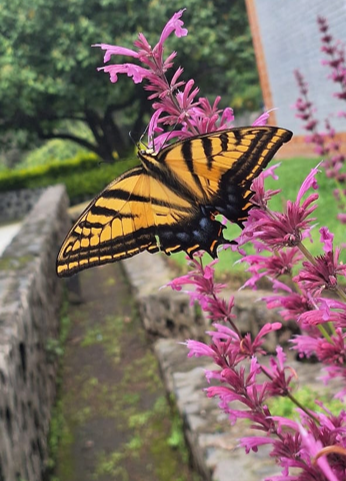
The study of floral biology is essential for identifying key species to be used in urban gardens. Agastache mexicana (Lamiaceae) is a perennial species native to Mexico, widely studied for its medicinal properties. To evaluate its ecological potential, we characterized its floral biology and recorded the taxonomic and functional diversity of visitors (pollinators, nectar robbers and contact species) in a recently implemented pollinator garden. Over 276 hours of observation, 860 visits were recorded from 66 morpho species, distributed across 12 taxonomic orders. Of these, 57% of the records corresponded to nectar robbers, 26% to pollinators, and 17% to contact species (i.e., animals using the plants for predation, mating, nesting, etc.). A GLMM showed positive effect of ambient temperature and contrasting effects of co-flowering species depending on their location within or between patches, respectively. Visits by pollinators and nectar robbers may be related to the presence of long-lasting inflorescences composed of large tubular nectar rewarding flowers in A. mexicana. According to our results A. mexicana contributes to the attraction of high taxonomic and functional diversity, including mutualistic and antagonistic interactions, highlighting its value for implementation in the design of urban gardens focused on pollinator conservation.
References
Arizmendi MC, H Berlanga. (2014) Colibríes de México y Norteamérica. Hummingbirds of Mexico and North America. México: CONABIO.
Baldock KCR (2020) Opportunities and threats for pollinator conservation in global towns and cities. Current Opinion in Insect Science 38:63–71.
Bates AJ, Sadler JP, Fairbrass AJ, Falk S, Hale JD, Matthews TJ (2011) Changing bee and hoverfly pollinator assemblages along an urban-rural gradient. PloS One 6:e23459.
Berthon K, Thomas F, Bekessy S (2021) The role of ‘nativeness’ in urban greening to support animal biodiversity. Landscape and Urban Planning 205:103959.
Brooks Mollie E, Kristensen Kasper, Koen J, van Benthem, Magnusson Arni, Berg Casper W, Nielsen Anders, Skaug Hans J Maechler Martin, Bolker Benjamin M (2017) glmmTMB Balances Speed and Flexibility Among Packages for Zero-inflated Generalized Linear Mixed Modeling. The R Journal 9:378-400
Burghardt KT, Tallamy DW, Gregory Shriver W (2009). Impact of native plants on bird and butterfly biodiversity in suburban landscapes. Conservation Biology 23:219-224.
Cameron SA, Lozier JD, Strange JP, Koch JB, Cordes N, Solter LF. Griswold TL (2011) Patterns of widespread decline in North American bumble bees. Proceedings of the National Academy of Sciences of the United States of America. 108:662–667.
Caponio I, Torres SC, Andersson G, Norrmann GA (2016) Aspectos de la biología reproductiva de Stevia rebaudiana (Asteraceae). Bonplandia 25:59-71. https://www.jstor.org/stable/26413102
Carmona-Castro G, Estrada-Soto S, Arellano-García J, Arias-Duran L, Valencia-Díaz S, Perea-Arango I (2019) High accumulation of tilianin in in-vitro cultures of Agastache mexicana and its potential vasorelaxant action. Molecular Biology Reports 46:1107-1115.
Caruso CM (1999) Pollination of Ipomopsis aggregata (Polemoniaceae): effects of intra‐vs. interspecific competition. American Journal of Botany 86:663-668.
Cruden RW (1977) Pollen-Ovule Ratios: A conservative indicator of breeding systems in flowering plants. Evolution 31: 32-46.
Cuevas E, Rosas-Guerrero V (2015) Spatio-temporal variation of nectar robbing in Salvia gesneriflora and its effects on nectar production and legitimate visitors. Plant Biology 18:9-14.
Cuevas-García E, Alcalá-Guerra A, Baños-Bravo YE, Flores-Palacios A (2013) Biología reproductiva y robo de néctar en Salvia gesneriflora (Lamiaceae) y sus consecuencias en el éxito reproductivo. Botanical Sciences 91:357-362.
De Barros Ruas R, Costa LMS, Bered F (2022) Urbanization driving changes in plant species and communities–A global view. Global Ecology and Conservation 38:e02243.
Descamps C, Jambrek A, Quinet M, Jacquemart AL (2021) Warm temperatures reduce flower attractiveness and bumblebee foraging. Insects 12:493.
Dri GF, Fontana CS, de Sales Dambros C (2021) Estimating the impacts of habitat loss induced by urbanization on bird local extinctions. Biological Conservation 256:109064.
Dukas R, Morse DH (2003) Crab spiders affect flower visitation by bees. Oikos 101:157-163.
Erickson E, Junker RR, Ali JG, McCartney N, Patch HM, Grozinger CM (2022). Complex floral traits shape pollinator attraction to ornamental plants. Annals of Botany 130:561-577.
Erickson E, Patch HM, Grozinger CM (2021) Herbaceous perennial ornamental plants can support complex pollinator communities. Scientific Reports 11:17352.
Franzén M, Francioli Y, Askling J, Kindvall O, Johansson V, Forsman A (2022) Differences in phenology, daily timing of activity, and associations of temperature utilization with survival in three threatened butterflies. Scientific Reports 12:7534.
Ghazoul J (2006) Floral diversity and the facilitation of pollination. Journal of Ecology 94: 295-304. https://www.jstor.org/stable/3599633
Glassberg J (2017) A swift guide to butterflies of North America. New Jersey: Princeton University Press.
Goulson D (2003) Why do pollinators visit proportionally fewer flowers in large patches? Oikos. 91:485-492.
Hald-Mortensen C (2023) The main drivers of biodiversity loss: a brief overview. Journal of Ecology and Natural Resources 7:000346.
Hartig F (2024). DHARMa: Residual Diagnostics for Hierarchical (Multi-Level / Mixed) Regression Models. https://doi:10.32614/CRAN.package.DHARMa
Hernández-Abreu O, Castillo-España P, León-Rivera I, Ibarra-Barajas M, Villalobos-Molina R, González-Christen J, Estrada-Soto S (2009) Antihypertensive and vasorelaxant effects of tilianin isolated from Agastache mexicana are mediated by NO/cGMP pathway and potassium channel opening. Biochemical Pharmacology 78:54-61.
Hristov P, Neov B, Shumkova R, Palova N (2020) Significance of Apoidea as main pollinators: Ecological and economic impact and implications for human nutrition. Diversity 12 (7):280.
Hung KLJ, Kingston JM, Albrecht M, Holway DA, Kohn, JR (2018) The worldwide importance of honey bees as pollinators in natural habitats. Proceedings of the Royal Society B: Biological Sciences. 285:20172140.
Inouye DW (1980) The terminology of floral larceny. Ecology. 61:1251-1253.
Irwin RE, Bronstein JL, Manson JS, Richardson L (2010) Nectar robbing: Ecological and evolutionary perspectives. Annual Review Ecology Evolution Systematics 41:271-292.
Jacobs J, Beenaerts N, Artois T (2023) Green roofs and pollinators, useful green spots for some wild bee species (Hymenoptera: Anthophila), but not so much for hoverflies (Diptera: Syrphidae). Scientific Reports 13:1449.
Jorge A, Loureiro J, Castro S (2015) Flower biology and breeding system of Salvia sclareoides Brot. (Lamiaceae). Plant Systematics and Evolution. 301:1485-1497.
Kakui H, Yamazaki M, Hamaya NB, Shimizu KK (2020) Pollen grain counting using a cell counter. In Pollen and Pollen Tube Biology: Methods and Protocols.New York, NY: Springer US, pp 1-11.
Katumo DM, Liang H, Ochola AC, Lv M, Wang QF, Yang CF (2022) Pollinator diversity benefits natural and agricultural ecosystems, environmental health, and human welfare. Plant Diversity. 44:429-435.
Kim W, Gilet T, Bush JW (2011) Optimal concentrations in nectar feeding. Proceedings of the National Academy of Sciences, 108:16618-16621.
Lenth R, Piaskowski J (2026). _emmeans: Estimated Marginal Means, aka Least-Squares Means. https://doi:10.32614/CRAN.package.emmeans
Levé M, Baudry E, Bessa-Gomes C (2019) Domestic gardens as favorable pollinator habitats in impervious landscapes. Science of the Total Environment 647:420-430.
Liang H, He YD, Theodorou P, Yang CF (2023) The effects of urbanization on pollinators and pollination: A meta-analysis. Ecology Letters 26:1629-1642.
Lucke-Lawrence S, Hazlehurst J (2023) Hummingbird foraging preferences during extreme heat events. Ecology and Evolution. 13: e10053.
Maloof JE (2001) The effects of a bumble bee nectar robber on plant reproductive success and pollinator behavior. American Journal of Botany 88:1960-1965.
Maloof JE, Inouye DW (2000) Are nectar robbers cheaters or mutualists? Ecology 81:2651-2661.
Martínez-Gordillo MJ, Fragoso-Martínez I, García-Peña MR, Montiel O (2013) Géneros de Lamiaceae de México, diversidad y endemismo. Revista Mexicana de Biodiversidad. 84:30-86.
Mayett-Moreno Y, Popp JS, Sabogal-Salamanca M, Rodríguez-Piñeros S, Salomé-Castañeda E, Flores-Alonso DA (2018) Consumers’ and retailers’ attitudes towards a Mexican native species of Aztec Lily as an ornamental plant. Sustainability 10:224.
Memmott J, Waser NM (2002) Integration of alien plants into a native flower–pollinator visitation web. Proceedings of the Royal Society of London. Series B: Biological Sciences, 269:2395-2399.
Mesgaran MB, Bouhours J, Lewis MA, Cousens RD (2017) How to be a good neighbour: facilitation and competition between two co-flowering species. Journal of Theoretical Biology 422:72-83.
Nath R, Singh H, Mukherjee S (2023) Insect pollinators decline: an emerging concern of Anthropocene epoch. Journal of Apicultural Research 62:23-38.
Nechita MA, Toiu A, Benedec D, Hanganu D, Ielciu I, Oniga O, Oniga I (2023) Agastache species: a comprehensive review on phytochemical composition and therapeutic properties. Plants 12:2937.
Ollerton J (2021) Pollinators & pollination: Nature and society. Pelagic Publishing: United Kingdom
Osborn NM, Kevan PG, Lane M (1988) Pollination biology of Opuntia polyacantha and Opuntia phaeacantha (Cactaceae) in southern Colorado. Plant Systematics and Evolution 159:85–94.
Palma-Tenango M, Sánchez-Fernández RE, Soto-Hernández M (2021) A systematic approach to Agastache mexicana research: biology, agronomy, phytochemistry, and bioactivity. Molecules 26:3751.
Pereira FW, Carneiro L, Gonçalves RB (2021) More losses than gains in ground-nesting bees over 60 years of urbanization. Urban Ecosystems 24:233-242.
Potts SG, Biesmeijer JC, Kremen C, Neumann P, Schweiger O, Kunin WE (2010) Global pollinator declines: trends, impacts and drivers. Trends in Ecology and Evolution 25:345-353.
R Core Team (2020) R: A language and environment for statistical computing. R Foundation for Statistical Computing, Vienna, Austria. URL https://www.R-project.org/
Rader R, Cunningham SA, Howlett BG, Inouye DW (2020) Non-bee insects as visitors and pollinators of crops: Biology, ecology, and management. Annual Review of Entomology. 65:391-407.
Rohitash R (2017) Floral contrivances, pollination and breeding system of Clerodendrum inerme (L.) Gaertn. (Lamiaceae). The International Journal of Plant Reproductive Biology 9:115-124.
Salisbury A, Armitage J, Bostock H, Perry J, Tatchell M, Thompson K (2015) Enhancing gardens as habitats for flower-visiting aerial insects (pollinators): should we plant native or exotic species? Journal of Applied Ecology 52:1156-1164.
Senapathi D, Biesmeijer JC, Breeze TD, Kleijin D, Potts SG & Carvalheiro LG (2015) Pollinator conservation — the difference between managing for pollination services and preserving pollinator diversity. Current Opinion in Insect Science 12: 93-101
Tamburini G, Pereira-Peixoto MH, Borth J, Lotz S, Wintermantel D, Allan MJ, Klein AM (2021) Fungicide and insecticide exposure adversely impacts bumblebees and pollination services under semi-field conditions. Environment International 157:106813.
Thompson JD (1988) Effects of variation in inflorescence size and floral rewards on the visitation rates of traplining pollinators of Aralia hispida Evolutionay Ecology 2:65–76.
Vaz S, Manes S, Khattar G, Mendes M, Silveira L, Mendes E, Paiva PC (2023) Global meta-analysis of urbanization stressors on insect abundance, richness, and traits. Science of the Total Environment 903:165967.
Verano J, González-Trujano ME, Déciga-Campos M, Ventura-Martínez R, Pellicer F (2013) Ursolic acid from Agastache mexicana aerial parts produces antinociceptive activity involving TRPV1 receptors, cGMP and a serotonergic synergism. Pharmacology Biochemistry and Behavior 110:255-264.
Verweij F, Biesmeijer K, Klumpers S (2025) Differences in visitation of honeybees and bumblebees to ornamental plant varieties can be explained by floral traits. Journal of Pollination Ecology 38:36-57. https://orcid.org/0000-0002-1275-7727
Villegas SG, Alcalá RE (2025) Network of interactions in a recently implemented urban pollinator garden. Urban Ecosystems 28:229.
Vogelmann JE (1983) A biosystematic study of Agastache section Agastache (Labiatae) Ph. D. Dissertation, Indiana University, Bloomington, Indiana, USA.
Wei N, Kaczorowski RL, Arceo-Gómez G, O’Neill EM, Hayes RA, Ashman TL (2021) Pollinators contribute to the maintenance of flowering plant diversity. Nature 597:688-692.
Zhang YW, Robert GW, Wang Y, Guo YH (2007) Nectar robbing of a carpenter bee and its effects on the reproductive fitness of Glechoma longituba (Lamiaceae). Plant Ecology 193:1-13.
Zielińska S, Matkowski A (2014) Phytochemistry and bioactivity of aromatic and medicinal plants from the genus Agastache (Lamiaceae). Phytochemistry Reviews 13: 391-416.
Downloads
Published
How to Cite
Issue
Section
License
Copyright (c) 2026 Zaira Carbajal-Velázquez, Sara G. Villegas, Raúl E. Alcalá

This work is licensed under a Creative Commons Attribution 4.0 International License.