
Pollen limitation and dependence on cross-pollination in borage (Borago officinalis L.) in the Pampas region of Argentina
DOI:
https://doi.org/10.26786/1920-7603(2026)908Keywords:
oil crop, crop yield, Reproductive biology, pollen limitationAbstract
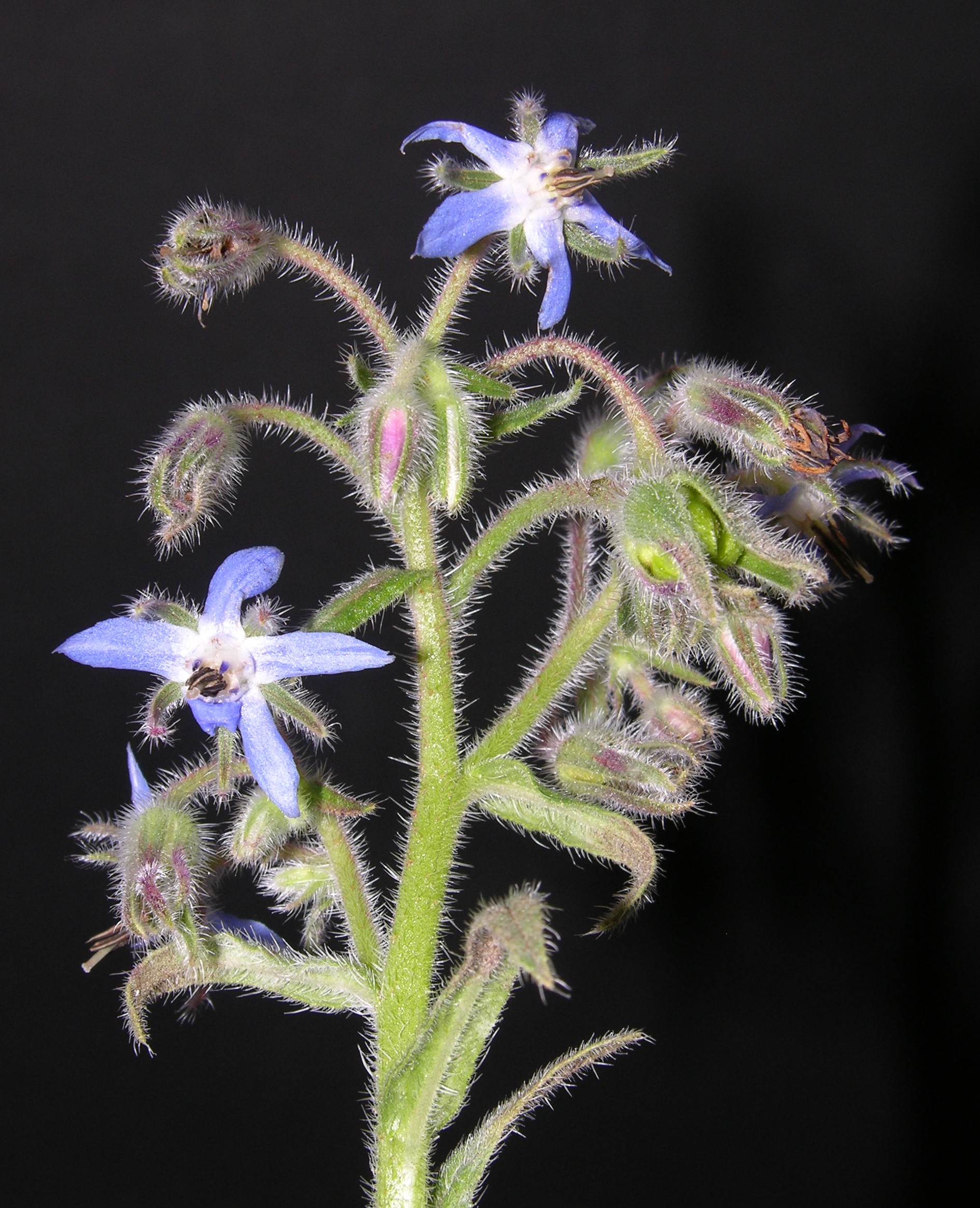
Borago officinalis L. is an insect-pollinated crop valued for its seed oil. While described as self-compatible, the extent to which its reproductive success depends on pollinator-mediated cross-pollination and whether it experiences pollen limitation in agricultural settings remain key questions for its sustainable cultivation. We experimentally evaluated the effect of five pollination treatments (natural pollination, autonomous self-pollination, artificial cross-pollination, anemophily, and apomixis) on fruit set and nutlet number in a borage experimental population in the Pampas region of Argentina. Artificial cross-pollination yielded the highest reproductive output, while autonomous self-pollination (including possible geitonogamous pollen transfer) and anemophily produced intermediate and similar results. Artificial cross‑pollination increased fruit set by 284% and nutlet number per fruit by 338% compared to natural pollination, demonstrating strong pollen limitation despite the presence of managed honeybees. Apomixis was negligible. Our findings demonstrate that B. officinalis relies on cross-pollination to maximize reproductive success and that even in the presence of managed honeybees, pollen limitation can significantly reduce yield. This highlights the need to ensure adequate pollinator services for the cultivation of this species.
References
Asadi-Samani M, Bahmani M, Rafieian-Kopaei M (2014) The chemical composition, botanical characteristic and biological activities of Borago officinalis: A review. Asian Pacific Journal of Tropical Medicine 7(Suppl 1):S22-S28.
Bartoń K (2025) MuMIn: Multi-Model Inference. R package version 1.48.11.
Berti M, Wilckens R, Fischer S, Araos R (2002) Borage: A new crop for southern Chile. In: Janick J, Whipkey A (eds) Trends in new crops and new uses. ASHS Press, Alexandria, pp 601-604.
Bishop J, Garratt MPD, Breeze TD (2020) Yield benefits of additional pollination to faba bean vary with cultivar, scale, yield parameter and experimental method. Scientific Reports 10:2102.
Bommarco R, Marini L, Vaissière BE (2012) Insect pollination enhances seed yield, quality, and market value in oilseed rape. Oecologia 169(4):1025-1032.
Brooks ME, Kristensen K, van Benthem KJ, Magnusson A, Berg CW, Nielsen A, Skaug HJ, Maechler M, Bolker BM (2017) glmmTMB balances speed and flexibility among packages for zero-inflated generalized linear mixed modeling. The R Journal 9(2):378-400.
Chiroque-Reyes T, Santisteban-Rojas O, Fuertes-Ruitón C, Reátegui-Sánchez S, Pizarro-Cabrera R (2024) Elaboración de un filtrante de hojas secas de Borago officinalis L. "borraja", determinación de su contenido de polifenoles y capacidad antioxidante. Agroindustrial Science 14(3):195-205.
Cunningham SA, Fournier A, Neave MJ, Le Feuvre D (2016) Improving spatial arrangement of honeybee colonies to avoid pollination shortfall and depressed fruit set. Journal of Applied Ecology 53(2):350–359.
Dafni A, Kevan PG, Husband BC (2005) Practical pollination biology. Enviroquest, Ltd., Cambridge.
Descamps C, Quinet M, Baijot A, Jacquemart A (2018) Temperature and water stress affect plant-pollinator interactions in Borago officinalis (Boraginaceae). Ecology and Evolution 8(6):3443-3456.
Falasca SL, Bernabé MA (2012) El cultivo de la borraja (Borago officinalis) en Argentina como suplemento dietético o productora de aceite para uso industrial. Revista Geográfica (151):71-81.
Garibaldi LA, Carvalheiro LG, Leonhardt SD, Aizen MA, Blaauw BR, Isaacs R, Kuhlmann M, Kleijn D, Klein AM, Kremen C, Morandin L, Scheper J, Winfree R (2014) From research to action: enhancing crop yield through wild pollinators. Frontiers in Ecology and the Environment 12(8):439-447.
Giménez C, González Vera AL (2020) La borraja (Borago officinalis L.): Una planta emblemática de Aragón. Institución Fernando el Católico, Zaragoza.
Graves S, Piepho H-P, Selzer L (2026) multcompView: Visualizations of paired comparisons. R package version 0.1-11.
Hartig F (2024) DHARMa: Residual diagnostics for hierarchical (multi-level / mixed) regression models. R package version 0.4.7.
Hothorn T, Bretz F, Westfall P (2008) Simultaneous inference in general parametric models. Biometrical Journal 50(3):346-363.
Jilo KR, Edeo MA, Hunde TA, Aboye BM (2025) Fatty acid composition, oil yield, and oil content of sunflower (Helianthus annuus L.) across different pollination treatments. Journal of Biosciences 50(22).
Kearns CA, Inouye DW (1993) Techniques for pollination biologists. University Press of Colorado, Niwot.
Kennedy CM, Lonsdorf E, Neel MC, Williams NM, Ricketts TH, Winfree R, Bommarco R, Brittain C, Burley AL, Cariveau D, Carvalheiro LG, Chacoff NP, Cunningham SA, Danforth BN, Dudenhöffer JH, Elle E, Gaines HR, Garibaldi LA, Gratton C, Holzschuh A, Isaacs R, Javorek SK, Jha S, Klein AM, Krewenka K, Mandelik Y, Mayfield MM, Morandin L, Neame LA, Otieno M, Park M, Potts SG, Rundlöf M, Saez A, Steffan-Dewenter I, Taki H, Viana BF, Westphal C, Wilson JK, Greenleaf SS, Kremen C (2013) A global quantitative synthesis of local and landscape effects on wild bee pollinators in agroecosystems. Ecology Letters 16(5):584-599.
Leach CR, Renfrey A, Mayo O (1993) Quantitatively determined self-incompatibility. IV. Pollination and seed set in Borago officinalis. Theoretical and Applied Genetics 85(6-7):755-760.
Lenth RV, Piaskowski J (2026) emmeans: Estimated marginal means, aka least-squares means. R package version 2.0.2.
Montaner C, Floris E, Álvarez JM (2000) Is self-compatibility the main breeding system in borage (Borago officinalis L.)? Theoretical and Applied Genetics 101(1-2):185-189.
Montaner C, Floris E, Alvarez JM (2001) Geitonogamy: a mechanism responsible for high selfing rates in borage (Borago officinalis L.). Theoretical and Applied Genetics 102(2):375-378.
Montaner C, Floris E, Álvarez JM (2002) La semilla de borraja como fuente de ácido gamma-linolénico. Revisión de los procesos de producción y recolección de la semilla en la especie. Información Técnica Económica Agraria (ITEA) 98V(2):119-126.
Nakagawa S, Schielzeth H (2013) A general and simple method for obtaining R² from generalized linear mixed-effects models. Methods in Ecology and Evolution 4(2):133-142.
National Non-Food Crops Centre (NNFCC) (2008) Borage (Borago officinalis) crop fact sheet. [online] URL: https://www.stem.org.uk/resources/library/resource/29482/borage. Accessed: Nov 2025.
Osborne JL (1999) Borage. Bee World 80(1):33-36.
Petanidou T, Kallimanis A, Tzanopoulos J, Sgardelis S, Pantis J (2008) Long-term observation of a pollination network: Fluctuation in species and interactions, relative invariance of network structure and implications for estimates of specialization. Ecology Letters 11(6):564-575.
R Core Team (2024) R: A language and environment for statistical computing (Version 4.5.1). R Foundation for Statistical Computing, Vienna. URL: https://www.R-project.org/
Sáez A, Morales JM, Morales CL, Harder LD, Aizen MA (2018) Costs and benefits of pollinator dependence: Empirical simulations predict raspberry fruit quality. Ecological Applications 28(4):1215-1222.
Stawiarz E, Wróblewska A, Masierowska M, Sadowska D (2020) Flowering, forage value, and insect pollination in borage (Borago officinalis L.) cultivated in SE Poland. Journal of Apicultural Science 64(1):77-89.
Downloads
Published
How to Cite
Issue
Section
License
Copyright (c) 2026 Martina Matos, Mariano Devoto

This work is licensed under a Creative Commons Attribution 4.0 International License.