
Utilizing natural history collections and data mining to assess flower associations and phenology of North American bees in the genus Andrena (Hymenoptera: Andrenidae) subgenus Plastandrena
DOI:
https://doi.org/10.26786/1920-7603(2026)899Keywords:
Polylectic, Andrena, Plastandrena, Diversity, phenology, floral preferencesAbstract
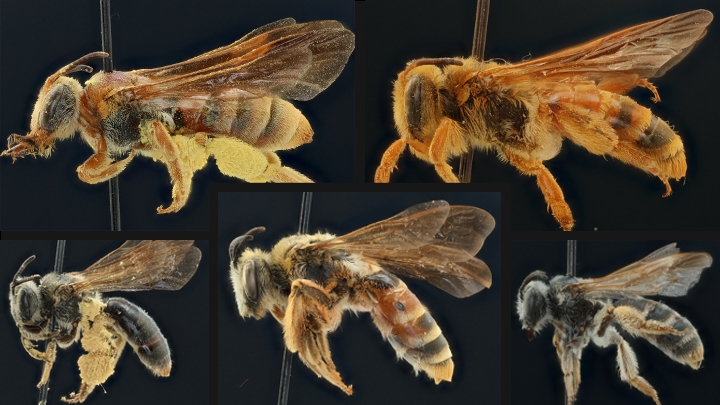
Even though bees are the most frequently discussed and important pollinators, most native species’ fundamental ecology including phenology and flower preferences is not known. This is especially true within the mega diverse bee genus Andrena Fabricius, 1775 where only a small percentage of species floral associations have been assessed. Here, using label data with associated floral records and collection event dates, the phenology and flower visitations of North American bees in the Andrena subgenus Plastandrena Heidicke, 1933 is assessed. Results of Shannon–Wiener index, Simpson’s diversity index, and occurrences on plant genera, families, and orders demonstrate Andrena argemonis, Andrena mellea are polylectic, while Andrena crataegi, Andrena fracta, and Andrena prunorum are broad polylectic. Plant-pollinator network analyses demonstrated the degree of polylecty within the subgenus, with Andrena argemonis being the most specialized towards Argemone and Andrena mellea being the most generalized. Collection event dates demonstrate all species phenology except A. mellea have a unimodal peak. However, the bimodal peaks in A. mellea may be due to geographic variation or sampling bias. Each species has peak records at varying times, showing some species are spring associated and others summer associated. This study provides an in-depth update of floral and phenological data of these understudied bee species, providing evidence that these bees may be important native pollinators that require more attention.
References
Ascher JS, Pickering J (2025). Discover life bee species guides and world checklist (Hymenoptera: Apoidea: Anthophila).[online] URL: https://www.discoverlife.org/mp/20q?guide=Apoidea_species&flags=HAS (accessed 16 July 2025).
Bacab-Perez AI, Ramírez-Arriaga E, Canto A (2024) Melissopalynology of pot-pollen and pot-honey of the Mayan stingless bee Melipona beecheii Bennett, 1831 (Apidae, Meliponini) in Yucatan, Mexico. Apidologie, 55(2): 22.
Bell KL, Fowler J, Burgess KS, Dobbs EK, Gruenewald D, Lawley B, Morozumi C, Brosi BJ (2017) Applying pollen DNA metabarcoding to the study of plant–pollinator interactions. Applications in plant sciences 5(6): 1600124.
Bossert S, Hung KLJ, Neff JL (2024) Evolutionary history and ecology of Andrena (Foveoandrena) androfovea: a new nearctic mining bee (Hymenoptera, Andrenidae) species and subgenus. Ecology and Evolution 14(11): e70453.
Bouseman JK, LaBerge WE (1978) A revision of the bees of the genus Andrena of the Western Hemisphere. Part IX. Subgenus Melandrena. Transactions of the American Entomological Society (1890-), 104(3/4): 275-389.
Cane JH (2018) Co-dependency between a specialist Andrena bee and its death camas host, Toxicoscordion paniculatum. Arthropod-Plant Interactions 12(5):657-662.
Cane JH (2021) A brief review of monolecty in bees and benefits of a broadened definition. Apidologie 52, 17–22.
Cane, J. H., & Sipes, S. (2006). Floral specialization by bees: analytical methods and a revised lexicon for oligolecty. Plant-Pollinator Interactions, pp. 99-122. University of Chicago Press, Chicago, IL,
Chamberlain S, Barve V, Mcglinn D, Oldoni D, Desmet P, Geffert L, Ram K (2025) rgbif: Interface to the Global Biodiversity Information Facility API. R package version 3.8.2. https://CRAN.R-project.org/package=rgbif.
Chamberlain S, Szocs E (2013) taxize – taxonomic search and retrieval in R. F1000Research 2:191.
Chamberlain S, Szoecs E, Foster Z, Arendsee Z, Boettiger C, Ram K, Bartomeus I, Baumgartner J, O'Donnell J, Oksanen J, Greshake Tzovaras B, Marchand P, Tran V, Salmon M, Li G, Grenié M (2020) taxize: Taxonomic information from around the web. R package version 0.9.98. https://github.com/ropensci/taxize
Cockerell TDA (1896) The bees of the genus Andrena found in New Mexico. Annals and Magazine of Natural History 18(103):78-92. https://digitalcommons.usu.edu/bee_lab_ca/203
Cresson ET (1868) Catalogue of a small collection of Hymenoptera made in New Mexico during the summer of 1867. Transactions of the American Entomological Society (1867-1877), 1: 375-396.
Danforth B (2007) Bees. Current Biology 17(5): 156-161.
Dormann C, Gruber B, Fruend J (2008) Introducing the bipartite Package: Analysing Ecological Networks. R News 8(2): 8-11.
Fang Q, Wu J, Zhang T, Ba S, Zhao C, Dai P (2024) Flower visits and pollinator pollen load networks reveal the effects of pollinator sharing on heterospecific pollen transfer in a subalpine plant community. Ecology and Evolution, 14(4):e11244.
Gautam RK, Uniyal VP, Wood TJ (2024) A critical revision of the Andrena Fabricius, 1775 of India, with the description of two new species (Hymenoptera: Andrenidae) from Uttarakhand. European journal of taxonomy 948:1-59.
GBIF.org (2025a) GBIF Occurrence Download. [online] URL: https://doi.org/10.15468/dl.43d5ac (accessed 05 July 2025)
GBIF.org (2025b) GBIF Occurrence Download. [online] URL: https://doi.org/10.15468/dl.2mg8q5 (accessed 25 July 2025)
Gous A, Swanevelder DZ, Eardley CD, Willows‐Munro S (2019) Plant–pollinator interactions over time: Pollen metabarcoding from bees in a historic collection. Evolutionary applications 12(2): 187-197.
Gusenleitner F, Schwarz M (2002) Weltweite Checkliste der Bienengattung Andrena mit Bemerkungen und Ergänzungen zu paläarktischen Arten (Hymenoptera, Apidae, Andreninae, Andrena). Entomofauna Supplement 10: 1–1280.
Hedicke H (1933) Beiträge zur Systematik der Gattung Andrena F. (Hym. Apid.). Mitteilungen aus dem Zoologischen Museum in Berlin 19: 199–220.
Hortal J, De Bello F, Diniz-Filho JAF, Lewinsohn TM, Lobo JM, Ladle RJ (2015) Seven shortfalls that beset large-scale knowledge of biodiversity. Annual review of ecology, evolution, and systematics 46(1):523-549.
Integrated Taxonomic Information System (ITIS) (2025) Integrated Taxonomic Information System. [online] URL: https://www.itis.gov (accessed 5 July 2025).
LaBerge WE (1969) A revision of the bees of the genus Andrena of the Western Hemisphere. Part II. Plastandrena, Aporandrena, Charitandrena. Transactions of the American Entomological Society (1890-) 95(1): 1-47.
Larkin LL, Neff JL, Simpson BB (2008) The evolution of a pollen diet: host choice and diet breadth of Andrena bees (Hymenoptera: Andrenidae). Apidologie 39(1):133-145.
Larsson M, Franzén M (2007) Critical resource levels of pollen for the declining bee Andrena hattorfiana (Hymenoptera, Andrenidae). Biological Conservation 134(3):405-414.
Marshall L, Leclercq N, Carvalheiro LG, Dathe HH, Jacobi B, Kuhlmann M, Potts SG, Rasmont P, Roberts RPM, Vereecken NJ (2024) Understanding and addressing shortfalls in European wild bee data. Biological Conservation 290:110455.
Meena LK, Dey D (2019) Taxonomic revisionary studies on subgenus Plastandrena (Andrena: Andrenidae: Hymenoptera) of India. Journal of Entomology and Zoology Studies: 7(1):1223-1231.
Neff JL, Simpson BB (1997) Nesting and Foraging Behavior of Andrena (Callandrena) rudbeckiae Robertson (Hymenoptera: Apoidea: Andrenidae) in Texas. Journal of the Kansas Entomological Society 70(2):100–113.
Oksanen J, Simpson G, Blanchet F, Kindt R, Legendre P, Minchin P, O'Hara R, Solymos P, Stevens M, Szoecs E, Wagner H, Barbour M, Bedward M, Bolker B, Borcard D, Borman T, Carvalho G, Chirico M, De Caceres M, Durand S, Evangelista H, FitzJohn R, Friendly M, Furneaux B, Hannigan G, Hill M, Lahti L, Martino C, McGlinn D, Ouellette M, Ribeiro Cunha E, Smith T, Stier A, Ter Braak C, Weedon J (2025) vegan: Community Ecology Package. R package version 2.7-1.
Ollerton J, Winfree R, Tarrant S (2011) How many flowering plants are pollinated by animals?. Oikos, 120(3): 321-326.
Park MG, Raguso RA, Losey JE, Danforth BN (2016). Per-visit pollinator performance and regional importance of wild Bombus and Andrena (Melandrena) compared to the managed honey bee in New York apple orchards. Apidologie 47(2):145-160.
Pisanty G, Richter R, Martin T, Dettman J, Cardinal S (2022) Molecular phylogeny, historical biogeography and revised classification of andrenine bees (Hymenoptera: Andrenidae). Molecular phylogenetics and Evolution: 170:107151.
Potts SG, Biesmeijer JC, Kremen C, Neumann P, Schweiger O, Kunin WE (2010) Global pollinator declines: trends, impacts and drivers. Trends in ecology & evolution 25(6):345-353.
R Core Team (2025) R: A language and environment for statistical computing. R Foundation for Statistical Computing. https://www.R-project.org
Ribble DW (1968) A new subgenus, Belandrena, of the genus Andrena (Hymenoptera: Apoidea). Journal of the Kansas Entomological Society 41(2):220-236.
Robertson C (1893) Notes on bees, with descriptions of new species. Transactions of the American Entomological Society (1890-) 20(4):273-276.
Robertson C (1925) Heteroptropic bees. Ecology 6 412– 436.
Saunders ME (2018) Insect pollinators collect pollen from wind‐pollinated plants: implications for pollination ecology and sustainable agriculture. Insect conservation and diversity 11(1):13-31.
Smith C, Bachelder N, Russell AL, Morales V, Mosher AR, Seltmann KC (2025) Pollen specialist bee species are accurately predicted from visitation, occurrence, and phylogenetic data. Oecologia 207(1): 13.
Szczepko-Morawiec K, Wiśniowski B, Motyka E, Celary W, Kruk A (2024) Ecological amplitude and indication potential of mining bees (Andrena spp.): a case study from the post-agricultural area of the Kampinos National Park (Poland). Scientific Reports 14(1):9738.
Tang J, Quan Q-M, Chen J-Z, Wu T, Huang S-Q (2019) Pollinator effectiveness and importance between female and male mining bee (Andrena). Biology Letters 15(10): 20190479. http://dx.doi.org/10.1098/rsbl.2019.0479
Tong ZY, Wu LY, Feng HH, Zhang M, Armbruster WS, Renner SS, HuangSQ (2023) New calculations indicate that 90% of flowering plant species are animal-pollinated. National Science Review, 10(10): nwad219.
Traveset A, Tur C, Eguíluz VM (2017) Plant survival and keystone pollinator species in stochastic coextinction models: role of intrinsic dependence on animal-pollination. Scientific reports 7(1):6915.
Viereck HL (1926) Descriptions of seven andrenids in the collection of the California Academy of Sciences. Proceedings of the California Academy of Sciences 4(15):399-408
Wickham H (2025). ggplot2: Elegant Graphics for Data Analysis. R package version 3.5.2. https://cran.r-project.org/web/packages/ggplot2/index.html
Wizenberg SB, Newburn LR, Pepinelli M, Conflitti IM, Richardson RT, Hoover SE, Currie RW, Giovenazzo P, Zayed A (2023) Validating a multi-locus metabarcoding approach for characterizing mixed-pollen samples. Plant Methods 19(1): 120.
Wood TJ (2025) Additions, corrections, and other changes to the hyper-diverse bee genus Andrena Fabricius, 1775 (Hymenoptera: Andrenidae). Animal Taxonomy and Ecology 71(2):143-316.
Wood TJ, Roberts SP (2017) An assessment of historical and contemporary diet breadth in polylectic Andrena bee species. Biological Conservation 215:72-80.
Xu HL, Tadauchi O (2011) A revision of the subgenus Plastandrena of the genus Andrena of eastern Asia (Hymenoptera: Apoidea: Andrenidae). Journal of Faculty of Agriculture Kyusha University 56(1):63-66.
Yang M, Wan T, Dai C, Zou XC, Liu F, Gong YB (2021) Modern honey bees disrupt the pollination of an ancient gymnosperm, Gnetum luofuense. Ecology 102(12): 1-4.
Zabinski WJ (2024) Andrena nimigracilis, a new species (Hymenoptera: Andrenidae) from México. Journal of Melittology 118:1-9.
Downloads
Published
How to Cite
Issue
Section
License
Copyright (c) 2026 Wyatt Zabinski

This work is licensed under a Creative Commons Attribution 4.0 International License.