
Detecting Bees in Cherry Flowers Using Timelapse Images and Foundational Models
DOI:
https://doi.org/10.26786/1920-7603(2026)897Keywords:
Bee detection, Computer vision, Image analysis, Pollinator detection, Timelapse photography, Prunus AviumAbstract
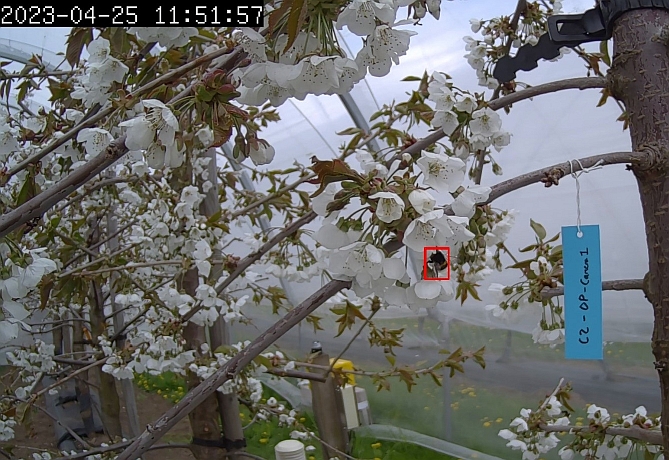
Bees perform important pollination services in fruit crops such as sweet cherry (Prunus avium). Growers will often introduce managed bees to supplement natural pollinators. Monitoring pollinating insects is important to understand the impact augmenting pollinators has on fruit yield, particularly in relation to June drop which is a major cause of yield instability in the cherry industry. Timelapse cameras allow for continuous monitoring of flowers, but manual analysis of the generated footage is very time consuming. Timelapse imaging combined with automated image processing methods, is a valuable tool in studying the role bee pollination plays in fruit production.
We have developed a novel method for detecting bees in time lapse images, called BeeSAM2. This exploits both the zero-shot detector Grounding DINO and the foundational model Segment Anything 2. Promising results are achieved with the method being capable of detecting the bumblebee Bombus terrestris in images with a recall of 0.959 and precision of 0.991. These results are sufficiently accurate to deploy our method to quantify bee activity in cherry plantations, advancing the ability of researchers to monitor flower-pollinator interaction, and saving a significant amount of time during video processing.
References
Bjerge K, Alison J, Dyrmann M, Frigaard CE, Mann HM, Høye TT (2023a) Accurate detection and identification of insects from camera trap images with deep learning. PLOS Sustainability and Transformation 2:e0000051
Bjerge K, Frigaard CE, Karstoft H (2023b) Object detection of small insects in time-lapse camera recordings. Sensors 23:7242
Breeze TD, Bailey AP, Balcombe KG, Brereton T, Comont R, Edwards M, Garratt MP, Harvey M, Hawes C, Isaac N (2021) Pollinator monitoring more than pays for itself. Journal of Applied Ecology 58:44-57
Gatti G (2024) Investigating the causes of late fruit drop in ‘Regina’sweet cherry (Prunus avium). [Dissertation thesis], Alma Mater Studiorum Università di Bologna. https://doi.org/10.48676/unibo/amsdottorato/11144
Getz MP, Best LR, Melathopoulos AP, Warren TL (2024) The establishment and potential spread of Osmia cornuta (Hymenoptera: Megachilidae) in North America. Environmental Entomology 53:1147-1156
Gill RJ, Baldock KC, Brown MJ, Cresswell JE, Dicks LV, Fountain MT, Garratt MP, Gough LA, Heard MS, Holland JM (2016) Protecting an ecosystem service: approaches to understanding and mitigating threats to wild insect pollinators. Advances in ecological research, vol 54. Elsevier, pp 135-206
Hinterstoisser S, Lepetit V, Wohlhart P, Konolige K (2018) On pre-trained image features and synthetic images for deep learning Proceedings of the European Conference on Computer Vision (ECCV) Workshops, pp 0-0
Howard SR, Nisal Ratnayake M, Dyer AG, Garcia JE, Dorin A (2021) Towards precision apiculture: Traditional and technological insect monitoring methods in strawberry and raspberry crop polytunnels tell different pollination stories. PLoS One 16:e0251572
Høye TT, Montagna M, Oteman B, Roy DB (2025) Emerging technologies for pollinator monitoring. Current Opinion in Insect Science:101367
Jain A, Cunha F, Bunsen M, Pasi L, Viklund A, Larrivée M, Rolnick D (2024) A machine learning pipeline for automated insect monitoring. arXiv preprint arXiv:2406.13031
Jocher G, Stoken A, Borovec J, Changyu L, Hogan A, Diaconu L, Poznanski J, Yu L, Rai P, Ferriday R (2020) ultralytics/yolov5: v3. 0. Zenodo
Johnson MD, Katz AD, Davis MA, Tetzlaff S, Edlund D, Tomczyk S, Molano‐Flores B, Wilder T, Sperry JH (2023) Environmental DNA metabarcoding from flowers reveals arthropod pollinators, plant pests, parasites, and potential predator–prey interactions while revealing more arthropod diversity than camera traps. Environmental DNA 5:551-569
Kirillov A, Mintun E, Ravi N, Mao H, Rolland C, Gustafson L, Xiao T, Whitehead S, Berg AC, Lo W-Y (2023) Segment anything. arXiv preprint arXiv:2304.02643
Klein A-M, Vaissière BE, Cane JH, Steffan-Dewenter I, Cunningham SA, Kremen C, Tscharntke T (2007) Importance of pollinators in changing landscapes for world crops. Proceedings of the royal society B: biological sciences 274:303-313
Liu S, Zeng Z, Ren T, Li F, Zhang H, Yang J, Jiang Q, Li C, Yang J, Su H (2024) Grounding dino: Marrying dino with grounded pre-training for open-set object detection European Conference on Computer Vision. Springer, pp 38-55
Mir MM, Mir M, Iqbal U, Mushtaq I, Rehman MU, Iqbal R, Parveze MU, Khan SQ, Rather GH, Banday SA (2025) The Impact of Pollination Requirements in Sweet Cherry: A Systemic Review. Journal of Plant Growth Regulation:1-19
Mullins CC, Esau TJ, Zaman QU, Toombs CL, Hennessy PJ (2024) Leveraging Zero-Shot Detection Mechanisms to Accelerate Image Annotation for Machine Learning in Wild Blueberry (Vaccinium angustifolium Ait.). Agronomy 14:2830
Ngo TN, Rustia DJA, Yang E-C, Lin T-T (2021) Automated monitoring and analyses of honey bee pollen foraging behavior using a deep learning-based imaging system. Computers and Electronics in Agriculture 187:106239
Potts SG, Imperatriz-Fonseca V, Ngo HT, Aizen MA, Biesmeijer JC, Breeze TD, Dicks LV, Garibaldi LA, Hill R, Settele J (2016) Safeguarding pollinators and their values to human well-being. Nature 540:220-229
Ratnayake MN, Dyer AG, Dorin A (2021) Towards computer vision and deep learning facilitated pollination monitoring for agriculture Proceedings of the IEEE/CVF conference on computer vision and pattern recognition, pp 2921-2930
Ravi N, Gabeur V, Hu Y-T, Hu R, Ryali C, Ma T, Khedr H, Rädle R, Rolland C, Gustafson L (2024) Sam 2: Segment anything in images and videos. arXiv preprint arXiv:2408.00714
Redmon J, Farhadi A (2018) Yolov3: An incremental improvement. arXiv preprint arXiv:1804.02767
Ren T, Liu S, Zeng A, Lin J, Li K, Cao H, Chen J, Huang X, Chen Y, Yan F (2024) Grounded sam: Assembling open-world models for diverse visual tasks. arXiv preprint arXiv:2401.14159
Schneider S, Taylor GW, Kremer SC, Fryxell JM (2023) Getting the bugs out of AI: Advancing ecological research on arthropods through computer vision. Ecology letters 26:1247-1258
Sengupta S, Chakrabarty S, Soni R (2025) Is SAM 2 better than SAM in medical image segmentation? Medical Imaging 2025: Image Processing, vol. 13406. SPIE, pp 666-672
Shirali H, Hübner J, Both R, Raupach M, Reischl M, Schmidt S, Pylatiuk C (2024) Image-based recognition of parasitoid wasps using advanced neural networks. Invertebrate Systematics 38
Steen R (2017) Diel activity, frequency and visit duration of pollinators in focal plants: in situ automatic camera monitoring and data processing. Methods in Ecology and Evolution 8:203-213
Ștefan V, Stark T, Wurm M, Taubenböck H, Knight TM (2025) Successes and limitations of pretrained YOLO detectors applied to unseen time-lapse images for automated pollinator monitoring. Scientific Reports 15:30671
Ștefan V, Workman A, Cobain JC, Rakosy D, Knight TM (2024) Utilising affordable smartphones and open-source time-lapse photography for pollinator image collection and annotation. Journal of Pollination Ecology 37:1-21
Van Klink R, Sheard JK, Høye TT, Roslin T, Do Nascimento LA, Bauer S (2024) Towards a toolkit for global insect biodiversity monitoring, vol. 379. The Royal Society, p 20230101
Williams D, Macfarlane F, Britten A (2024) Leaf only SAM: A segment anything pipeline for zero-shot automated leaf segmentation. Smart Agricultural Technology 8:100515
Zhu J, Hamdi A, Qi Y, Jin Y, Wu J (2024) Medical sam 2: Segment medical images as video via segment anything model 2. arXiv preprint arXiv:2408.00874. https://doi.org/10.48550/arXiv.2408.00874
Downloads
Published
How to Cite
Issue
Section
License
Copyright (c) 2026 Jane Devlin, Fraser MacFarlane, Alison Karley, Fabio Manfredini, Dominic Williams

This work is licensed under a Creative Commons Attribution 4.0 International License.