
Assessment of pollination ecology of two understudied native mustards and the potential for interference from invasive garlic mustard
DOI:
https://doi.org/10.26786/1920-7603(2026)895Keywords:
pollination ecology, pollinator behaviour, species invasionAbstract
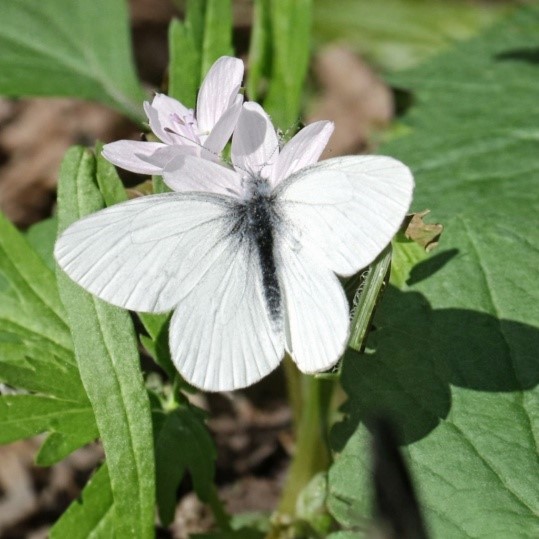
The family Brassicaceae is agriculturally and economically important. However, ecological knowledge gaps persist for some wild species, even in parts of the world that have broadly well-studied flora, like eastern North America. Knowledge gaps for two eastern North American species, Cardamine concatenata and C. diphylla, are concerning for two reasons. First, these species have known associations with rare, specialist insects. Second, the threat posed by the introduction and spread of noxious invasive confamilial garlic mustard (Alliaria petiolata) within their shared native range. Because C. concatenata and C. diphylla have a short phenological window for seasonal development and reproduction they are at increased risk for mutualism disruption via global change pressures. We aim to evaluate the potential for pollination interference by A. petiolata. We compared pollinator visitation and floral phenology in sympatric wild populations of C. concatenata, C. diphylla, and A. petiolata in northeast Ohio. Pollinator counts and morphotype identifications were recorded during in situ pollinator observations. To supplement morphotype identifications, we collected pollinator specimens and identified them to genus or family in the lab. We found overlap in flowering phenology between A. petiolata and C. diphylla. Fourteen pollinator taxa were observed visiting at least one of the focal plant species; of these, seven taxa were recorded visiting all three plant species. Alliaria petiolata is likely disrupting pollination for the native C. diphylla in our sites because flowering phenology overlaps and pollinator taxa are shared. Future studies should focus on range-wide phenological observation and modelling for all three plant species, and pollen load analysis of native plant stigmas in invaded habitats.
References
Arceo-Gómez G, Ashman T-L (2016) Invasion status and phylogenetic relatedness predict cost of heterospecific pollen receipt: implications for native biodiversity decline. Journal of Ecology 104:1003–1008.
Aslan CE, Zavaleta ES, Tershy B, & Croll D (2013) Mutualism disruption threatens global plant biodiversity: a systematic review. PloS one 8(6):e66993.
Biota of North America (2025) [online] URL: http://www.bonap.org/.
Brandenburg D (2010) Field Guide to Wildflowers of North America. Union Square & Co.
Brooks ME, Kristensen K, van Benthem KJ, Magnusson A, Berg CW, Nielsen A, Skaug HJ, Maechler M, & Bolker BM (2017) glmmTMB Balances Speed and Flexibility Among Packages for Zero-inflated Generalized Linear Mixed Modeling. The R Journal, 9(2), 378-400.
Brown B, Mitchell R, Graham S (2002) Competition for Pollination Between an Invasive Species (Purple Loosestrife) and a Native Congener. Ecology 83:2328–2336.
Campbell DR (1985) Pollinator Sharing and Seed Set of Stellaria pubera: Competition for Pollination. Ecology 66:544–553.
Carlsen T, Bleeker W, Hurka H, Elven R, Brochmann C (2009) Biogeography and Phylogeny of Cardamine (Brassicaceae)1. Annals of the Missouri Botanical Garden 96:215–236.
Davis SL (2015) Evaluating threats to the rare butterfly, Pieris virginiensis. [Doctoral dissertation, Wright State University]. OhioLINK Electronic Theses and Dissertations Center. http://rave.ohiolink.edu/etdc/view?acc_num=wright1431882480
Dawson-Glass E, Schiafo R, Miller CN, Kuebbing SE, Stuble KL (2025) Toward a comprehensive understanding of the phenological responses of non-native plants to climate warming: a review. Annals of Botany:mcaf008.
de Freitas Costa E, Schneider S, Carlotto GB, Cabalheiro T, de Oliveira Júnior MR (2021) Zero-inflated-censored Weibull and gamma regression models to estimate wild boar population dispersal distance. Japanese Journal of Statistics and Data Science 4:1133–1155.
Doyle T, Hawkes WLS, Massy R, Powney GD, Menz MHM, Wotton KR (2020) Pollination by hoverflies in the Anthropocene. Proceedings of the Royal Society B: Biological Sciences 287:20200508.
Flora of North America (2025) [online] URL: https://floranorthamerica.org/Main_Page
Franzke A, Lysak MA, Al-Shehbaz IA, Koch MA, Mummenhoff K (2011) Cabbage family affairs: the evolutionary history of Brassicaceae. Trends in Plant Science 16:108–116.
Gallagher MK, Campbell DR (2020) Pollinator visitation rate and effectiveness vary with flowering phenology. American Journal of Botany 107:445–455.
Global Biodiversity Information Facility (2025) [online] URL: https://www.gbif.org/
Hale AN, Tonsor SJ, Kalisz S (2011) Testing the mutualism disruption hypothesis: physiological mechanisms for invasion of intact perennial plant communities. Ecosphere 2:art110.
Hassall C, Owen J, Gilbert F (2017) Phenological shifts in hoverflies (Diptera: Syrphidae): linking measurement and mechanism. Ecography 40:853–863.
Heberling JM, McDonough MacKenzie C, Fridley JD, Kalisz S, Primack RB (2019) Phenological mismatch with trees reduces wildflower carbon budgets. Ecology Letters 22:616–623.
Hicks KL, Tahvanainen JO (1974) Niche Differentiation by Crucifer-Feeding Flea Beetles (Coleoptera: Chrysomelidae). The American Midland Naturalist 91:406–423.
Hothorn T, Bretz F, Westfall P (2008) Simultaneous Inference in General Parametric Models. Biometrical Journal 50(3):346-363.
Kehrberger S, Holzschuh A (2019) How does timing of flowering affect competition for pollinators, flower visitation and seed set in an early spring grassland plant? Scientific Reports 9:15593.
Kudo G, Cooper EJ (2019) When spring ephemerals fail to meet pollinators: mechanism of phenological mismatch and its impact on plant reproduction. Proceedings of the Royal Society B: Biological Sciences 286:20190573.
Kudo G, Ida TY, Tani T (2008) Linkages Between Phenology, Pollination, Photosynthesis, and Reproduction in Deciduous Forest Understory Plants. Ecology 89:321–331.
Lee AH, Zhao Y, Yau KKW, Xiang L (2010) How to analyze longitudinal multilevel physical activity data with many zeros? Preventive Medicine 51:476–481.
Masters JA, Emery SM (2015) The showy invasive plant Ranunculus ficaria facilitates pollinator activity, pollen deposition, but not always seed production for two native spring ephemeral plants. Biological Invasions 17:2329–2337.
Montaut S, Bleeker RS (2013) Review on Cardamine diphylla (Michx.) A. wood (Brassicaceae): Ethnobotany and glucosinolate chemistry. Journal of Ethnopharmacology 149:401–408.
Montgomery FH (1955) Preliminary Studies in the Genus Dentaria in Eastern North America. Rhodora 57:161–173.
NatureServe Explorer (2025) [online] URL: https://explorer.natureserve.org/Taxon/ELEMENT_GLOBAL.2.135105/Cardamine_clematitis.
Parker AJ, Williams NM, Thomson JD (2018) Geographic patterns and pollination ecotypes in Claytonia virginica. Evolution 72:202–210.
Petrauski L, Owen SF, Constantz GD, Anderson JT (2019) Changes in flowering phenology of Cardamine concatenata and Erythronium americanum over 111 years in the Central Appalachians. Plant Ecology 220:817–828.
Powell KI, Krakos KN, Knight TM (2011) Comparing the reproductive success and pollination biology of an invasive plant to its rare and common native congeners: a case study in the genus Cirsium (Asteraceae). Biological Invasions 13:905–917.
Prati D, Bossdorf O (2004) Allelopathic inhibition of germination by Alliaria petiolata (Brassicaceae). American Journal of Botany 91:285–288.
R Core Team (2020) R: A language and environment for statistical computing. R Foundation for Statistical Computing, Vienna, Austria. [online] URL: https://www.R-project.org/
Renner SS, Zohner CM (2018) Climate Change and Phenological Mismatch in Trophic Interactions Among Plants, Insects, and Vertebrates. Annual Review of Ecology, Evolution, and Systematics 49:165–182.
Ribble DW (1974) A Revision of the Bees of the Genus Andrena of the Western Hemisphere Subgenus Scaphandrena. Transactions of the American Entomological Society (1890-) 100:101–189.
Robertson C (1929) Phenology of Oligolectic Bees and Favorite Flowers. Psyche: A Journal of Entomology 36:072735.
Rodgers VL, Scanga SE, Kolozsvary MB, Garneau DE, Kilgore JS, Anderson LJ, Hopfensperger KN, Aguilera AG, Urban RA, Juneau KJ (2022) Where Is Garlic Mustard? Understanding the Ecological Context for Invasions of Alliaria petiolata. BioScience 72:521–537.
Rodgers VL, Stinson KA, Finzi AC (2008) Ready or Not, Garlic Mustard Is Moving In: Alliaria petiolata as a Member of Eastern North American Forests. BioScience 58:426–436.
Schweiger O, Biesmeijer JC, Bommarco R, Hickler T, Hulme PE, Klotz S, Kühn I, Moora M, Nielsen A, Ohlemüller R, Petanidou T, Potts SG, Pyšek P, Stout JC, Sykes MT, Tscheulin T, Vilà M, Walther G-R, Westphal C, Winter M, Zobel M, Settele J (2010) Multiple stressors on biotic interactions: how climate change and alien species interact to affect pollination. Biological Reviews of the Cambridge Philosophical Society 85:777–795.
Spooner DM (1984) Reproductive Features of Dentaria laciniata and D. diphylla (Cruciferae), and the Implications in the Taxonomy of the Eastern North American Dentaria Complex. American Journal of Botany 71:999–1005.
Stinson KA, Campbell SA, Powell JR, Wolfe BE, Callaway RM, Thelen GC, Hallett SG, Prati D, Klironomos JN (2006) Invasive Plant Suppresses the Growth of Native Tree Seedlings by Disrupting Belowground Mutualisms. PLOS Biology 4:e140.
Sweeney PW, Price RA (2000) Polyphyly of the Genus Dentaria (Brassicaceae): Evidence from trnL Intron and ndhF Sequence Data. Systematic Botany 25:468–478.
Sweeney PW, Price RA (2001) A multivariate morphological analysis of the Cardamine concatenata alliance (Brassicaceae). Brittonia 53:82–95.
Ustinova EN, Lysenkov SN (2020) Comparative study of the insect community visiting flowers of invasive goldenrods (Solidago canadensis and S. gigantea). Arthropod-Plant Interactions 14:825–837.
Wang X-P, Fu X, Shi M-M, Zhao Z-T, Li S-J, Tu T-Y (2023) Invasive Asteraceae plants can enhance community stability by changing pollination network structure, yet cause intense pollen disturbance to native plants in an oceanic island community. Biological Invasions 25:3603-3618.
Waser NM (1978) Interspecific pollen transfer and competition between co-occurring plant species. Oecologia 36:223–236.
WeatherUnderground (2025) [online] URL: https://www.wunderground.com/
Wilhelm G, Rericha L (2017) Flora of the Chicago Region: A Floristic and Ecological Synthesis. Indiana Academy of Science.
Yancy AJ, Lee BR, Kuebbing SE, Neufeld HS, Spicer ME, Heberling JM (2024) Evaluating the definition and distribution of spring ephemeral wildflowers in eastern North America. American Journal of Botany 111:e16323.
Zozomova-Lihova J, Marhold K (2006) Phylogenetic and diversity patterns in Cardamine (Brassicaceae) – a genus with conspicuous polyploid and reticulate evolution. In: Sharma AK, Sharma A (eds) Plant genome: biodiversity and evolution, vol. 1C. Science Publishers, Inc., Enfield, NH, pp 149-186.
Zych M, Goldstein J, Roguz K, Stpiczyńska M (2013) The most effective pollinator revisited: pollen dynamics in a spring-flowering herb. Arthropod-Plant Interactions 7:315–322.
Downloads
Published
How to Cite
Issue
Section
License
Copyright (c) 2026 Stephanie Wilhelm, Chelsea Miller

This work is licensed under a Creative Commons Attribution 4.0 International License.