
Mail-order solitary bee cocoons as a gateway for biological invasion
DOI:
https://doi.org/10.26786/1920-7603(2025)888Keywords:
crop pollination, solitary bees, biological invasion, OsmiaAbstract
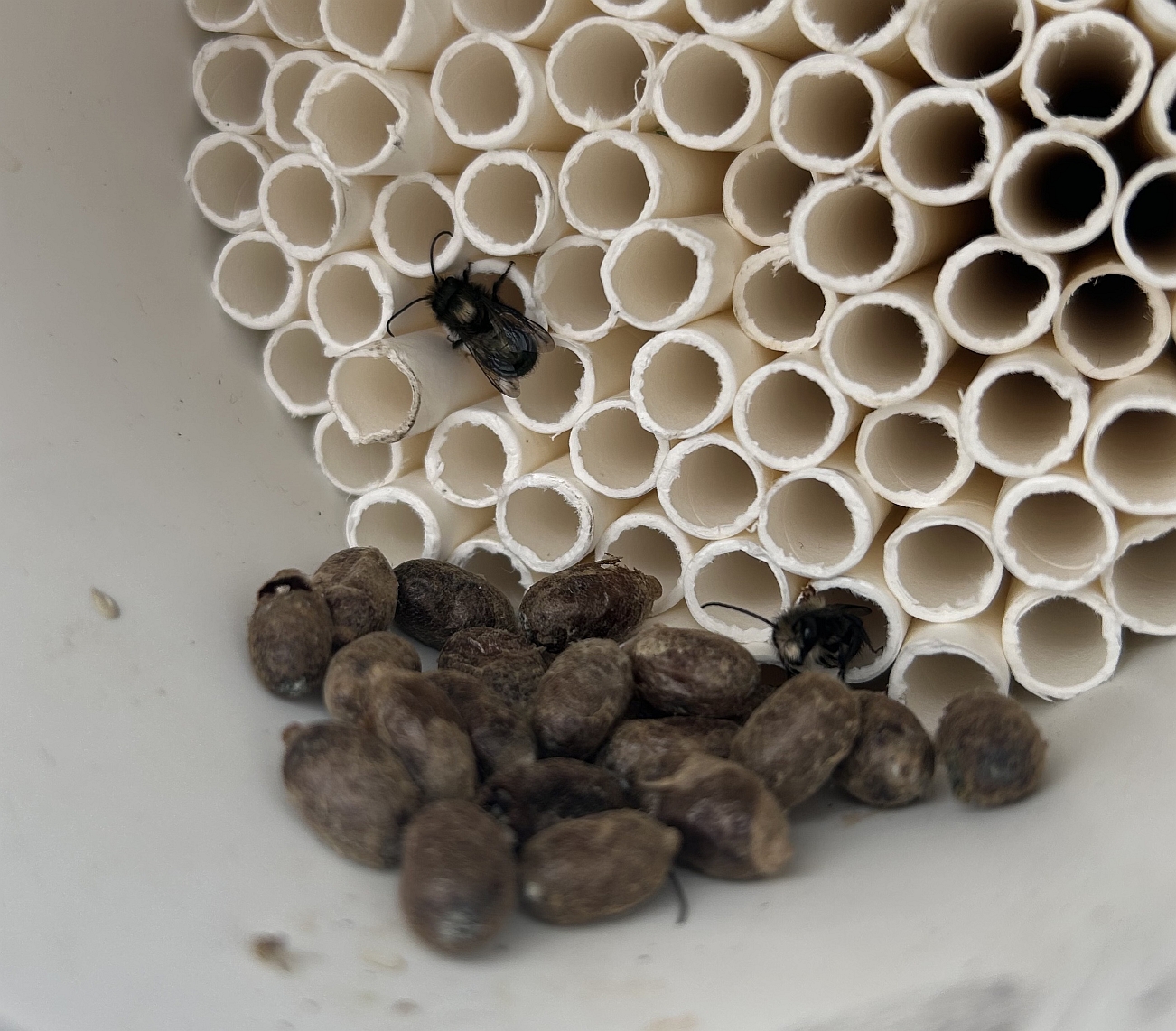
The unregulated online trade of solitary bee cocoons, particularly mason bees (Osmia spp.), poses growing risks to biodiversity. Marketed as tools to enhance pollination, these mail-order cocoons can include non-native species, including invasive ones that are difficult to distinguish from native bees. Such introductions can displace native bees and spread parasites and pathogens, undermining the stability of wild bee communities. Existing regulations in Canada and the U.S. remain fragmented and insufficient to address these threats. We recommend extending regulatory oversight, enforcing species-specific trade restrictions, and supporting local suppliers to safeguard native pollinators from unintended ecological consequences.
References
Bartomeus I, Molina FP, Hidalgo‐Galiana A, Ortego J (2020) Safeguarding the genetic integrity of native pollinators requires stronger regulations on commercial lines. Ecological Solutions and Evidence 1:e12012.
Bosch J, Kemp WP (2002) Developing and establishing bee species as crop pollinators: the example of Osmia spp. (Hymenoptera: Megachilidae) and fruit trees. Bulletin of entomological research: 92(1), 3-16.
Canadian Food Inspection Agency (2021) Directive D-12-02: Import requirements for non-Apis pollinating insects. Available from https://inspection.canada.ca (accessed 7 May 2025).
Delphia CM, Gnojewski KR (2025). New state records for the introduced bee species Osmia taurus Smith, 1873 and Osmia cornifrons (Radoszkowski, 1887)(Hymenoptera: Megachilidae) in western North America. The Pan-Pacific Entomologist: 101(2), 117-124.
Garibaldi LA, Steffan-Dewenter I, Winfree R, Aizen MA, Bommarco R, Cunningham SA, Kremen C, Carvalheiro LG, Harder LD, Afik O, Bartomeus I, Benjamin F, Boreux V, Cariveau D, Chacoff NP, Dudenhöffer JH, Freitas BM, Ghazoul J, Greenleaf S, Hipólito J, Holzschuh A, Howlett B, Isaacs R, Javorek SK, Kennedy CM, Krewenka KM, Krishnan S, Mandelik Y, Mayfield MM, Motzke I, Munyuli T, Nault BA, Otieno M, Petersen J, Pisanty G, Potts SG, Rader R, Ricketts TH, Rundlöf M, Seymour CL, Schüepp C, Szentgyörgyi H, Taki H, Tscharntke T, Vergara CH, Viana BF, Wanger TC, Westphal C, Williams N, Klein AM (2013) Wild Pollinators Enhance Fruit Set of Crops Regardless of Honey Bee Abundance. Science 339:1608–1611.
Getz MP, Best LR, Melathopoulos AP, Warren TL. (2024) The establishment and potential spread of Osmia cornuta (Hymenoptera: Megachilidae) in North America. Environmental Entomology 53:1147-1156.
Hedtke SM, Blitzer EJ, Montgomery GA, Danforth BN (2015). Introduction of non-native pollinators can lead to trans-continental movement of bee-associated fungi. PLoS One: 10(6), e0130560.
LeCroy KA, Krichilsky E, Grab HL, Roulston TAH, Danforth BN. (2023) Spillover of chalkbrood fungi to native solitary bee species from non‐native congeners. Journal of Applied Ecology 60:1067-1076.
LeCroy KA, Savoy-Burke G, Carr DE, Delaney DA, Roulston TAH. (2020) Decline of six native mason bee species following the arrival of an exotic congener. Scientific Reports 10:18745.
Lenda M, Skórka P, Knops JM, Moroń D, Sutherland WJ, Kuszewska K, Woyciechowski M. (2014) Effect of the internet commerce on dispersal modes of invasive alien species. PLoS one. 9:e99786.
MacIvor JS, de Keyzer CW, Marshall MS, Thurston GS, Onuferko TM. (2022) Establishment of the non-native horned-face bee Osmia cornifrons and the taurus mason bee Osmia taurus in Canada. PeerJ 10:e14216.
Mader E, Spivak M, Evans E. (2010) Managing alternative pollinators. NRAES, Ithaca, NY.
McKinney MI, Park YL. (2013) Distribution of Chaetodactylus krombeini (Acari: Chaetodactylidae) within Osmia cornifrons (Hymenoptera: Megachilidae) nests: implications for population management. Experimental and Applied Acarology 60:153-161.
Russo L, de Keyzer CW, Harmon-Threatt AN, LeCroy KA, MacIvor JS. (2021) The managed-to-invasive species continuum in social and solitary bees and impacts on native bee conservation. Current Opinions in Insect Science 46:43-49.
Rust RW (1974) The systematics and biology of the genus Osmia, subgenera Osmia, Chalcosmia, and Cephalosmia (Hymenoptera: Megachilidae). The Wasmann Journal of Biology 32(1):1–93.
Sampson BJ, Stringer SJ, Cane JH, Spiers JM (2004). Screenhouse evaluations of a mason bee Osmia ribifloris (Hymenoptera: Megachilidae) as a pollinator for blueberries in the southeastern United States. Small Fruits Review: 3(3-4), 381-392.
Torchio PF, Asensio E, Thorp RW. (1987) Introduction of the European bee, Osmia cornuta, into California almond orchards (Hymenoptera: Megachilidae). Environmental Entomology 16:664-667.
USDA APHIS (2023) Requirements for the Importation of Bees Other Than Honey Bees from Canada. Available from https://www.aphis.usda.gov (accessed 7 May 2025).
Wyoming Legislature (2024) Wyoming Statutes Title 11, Chapter 7, Article 4 – §11-7-404: Importation restrictions. Cheyenne (WY): Wyoming Legislature. Available from: https://wyoleg.gov/statutes/compress/title11.pdf. (accessed 7 May 2025).
Downloads
Published
How to Cite
Issue
Section
License
Copyright (c) 2025 Scott MacIvor, Sisley Irwin

This work is licensed under a Creative Commons Attribution 4.0 International License.