
FIT for purpose? Sampling Bees in Flowering Canopies with Flight Interception Traps (FITs)
DOI:
https://doi.org/10.26786/1920-7603(2026)877Keywords:
Apoidea, Hymenoptera, Aculeata, tree canopy, window trap, aerial Malaise trapAbstract
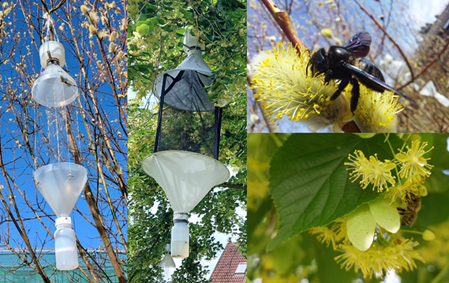
Depending on species and season, tree canopies can provide floral resources in abundance. However, researchers often do not consider these resources when sampling bee communities, because they are difficult to access. While observer-based methods, such as hand-netting along transects, are often used for collecting bees from near-ground resources like wildflower strips, flight interception traps (FITs), such as aerial Malaise traps (AMTs) and window interception traps (WITs), can be used for collecting bees from elevated resources like flowering canopies. We assessed the suitability of WITs and AMTs for sampling bees from flowering canopies. We sampled canopies of four different tree taxa (Salix, Malus, Robinia, Tilia) in Braunschweig, Germany, between March and June 2024. In total, we collected 395 bee individuals, including 247 honeybees. Sampled communities comprised ten genera and showed marked differences in the ratio of honeybee and wild bee individuals. In Salix trees, wild bees were more abundant than honeybees, whereas in Tilia trees and especially Robinia trees, honeybees outnumbered wild bees. The collectors above the interception surface of both WITs and AMTs collected no bees. This was surprising, because we expected bees to move upwards upon flight interception, as they do in ground-based Malaise traps. We conducted a systematic literature search in the WoS to compare our findings to previous studies using WITs and AMTs for sampling bees. To our knowledge, our study is the first to show that collectors above the interception surface are generally inefficient when sampling bees with WITs and AMTs. Our study provides methodological advice for future researchers seeking to sample pollinators in tree canopies.
References
Anderson MJ (2001) A new method for non-parametric multivariate analysis of variance. Austral Ecology 26: 32–46.
Anderson MJ, Gorley RN, Clarke KR (2008) PERMANOVA+ for PRIMER: guide to software and statistical methods. Plymouth, UK.
Ayers AC, Rehan SM (2021) Supporting Bees in Cities: How Bees Are Influenced by Local and Landscape Features. Insects 12.
Barrett M, Fischer B, Buchmann S (2023) Informing policy and practice on insect pollinator declines: Tensions between conservation and animal welfare. Frontiers in Ecology and Evolution 10: 1071251.
Bartoń K (2022) MuMIn. Multi-Model Inference. https://cran.r-project.org/package=MuMIn
Basset Y (1988) A composit interception trap for sampling arthropods in tree canpopies. Journal of the Australian Entomological Society 27: 213–219.
Bogusch P, Schlaghamersky J (2010) Aphid secretions as an Alternative Glycid source for Cuckoobee species of the genus Sphecodes (Hymenoptera. Halictidae). Entomologia Generalis 32: 237–241.
Borges PA, Lamelas-Lopez L, Stuben PE, Ros-Prieto A, Gabriel R, Boieiro M, Tsafack N, Ferreira MT (2022) SLAM Project-Long Term Ecological Study of the Impacts of Climate Change in the Natural Forest of Azores: II-A survey of exotic arthropods in disturbed forest habitats. Biodiversity Data Journal 10: e81410.
Brooks ME, Kristensen K, van Benthem KJ, Magnusson A, Berg CW, Nielsen A, Skaug HJ, Mächler M, Bolker BM (2017) glmmTMB Balances Speed and Flexibility Among Packages for Zero-inflated Generalized Linear Mixed Modeling. The R Journal 9: 378.
Carrel JE (2002) A novel aerial-interception trap for arthropod sampling. Florida Entomologist 85: 656–657.
Clarke KR, Gorley RN (2015) PRIMER v7: User Manual/Tutorial, Plymouth, UK.
Cranmer L, McCollin D, Ollerton J (2012) Landscape structure influences pollinator movements and directly affects plant reproductive success. Oikos 121: 562–568.
Dorey JB, Davies OK, Magnacca KN, Schwarz MP, Gilpin A-M, Ramage T, Tuiwawa M, Groom SVC, Stevens MI, Parslow BA (2024) Canopy specialist Hylaeus bees highlight sampling biases and resolve Michener’s mystery. Frontiers in Ecology and Evolution 12.
Dorow WHO, Münch W, Saure C (2019) Die Waldbindung der Stechimmen (Hymenoptera: Aculeata) Deutschlands. In: Dorow WHO, Blick T, Pauls SU, Schneider A (eds) Waldbindung ausgewählter Tiergruppen Deutschlands. Bundesamt für Naturschutz, Bonn, pp. 218-336.
Duelli P, Obrist MK, Schmatz DR (1999) Biodiversity evaluation in agricultural landscapes: above-ground insects. Agriculture, Ecosystems & Environment 74: 33–64.
Gibbs J, Joshi NK, Wilson JK, Rothwell NL, Powers K, Haas M, Gut L, Biddinger DJ, Isaacs R (2017) Does Passive Sampling Accurately Reflect the Bee (Apoidea: Anthophila) Communities Pollinating Apple and Sour Cherry Orchards? Environmental Entomology 46: 579–588.
Hartig F (2022) DHARMa. Residual Diagnostics for Hierarchical (Multi-Level / Mixed) Regression Models. https://florianhartig.github.io/DHARMa/
Hines JW, Heikkenen HJ (1977) Beetles Attracted to Severed Virginia Pine (Pinus virginiana Mill.). Environmental Entomology 6: 123–127.
Howlett BG, Walker MK, Le Newstrom-Lloyd, Donovan BJ, Teulon DA (2009) Window traps and direct observations record similar arthropod flower visitor assemblages in two mass flowering crops. Journal of Applied Entomology 133: 553–564.
Inari N (2002) Window traps. Biodiversity research methods. IBOY in Western Pacific and Asia (ed. by T Nakashizuka) Kyoto Univ. Press, Kyoto.
Inari N, Hiura T, Toda MJ, Kudo G (2012) Pollination linkage between canopy flowering, bumble bee abundance and seed production of understorey plants in a cool temperate forest. Journal of Ecology 100: 1534–1543.
Inari N, Nagamitsu T, Kenta T, Goka K, Hiura T (2005) Spatial and temporal pattern of introduced Bombus terrestris abundance in Hokkaido, Japan, and its potential impact on native bumblebees. Population Ecology 47: 77–82.
Juillet JA (1963) A comparison of four types of traps used for capturing flying insects. Canadian Journal of Zoology 41: 219–233.
Kassambra A (2022) ggpubr. 'ggplot2' Based Publication Ready Plots.
Kay S, Kühn E, Albrecht M, Sutter L, Szerencsits E, Herzog F (2020) Agroforestry can enhance foraging and nesting resources for pollinators with focus on solitary bees at the landscape scale. Agroforestry Systems 94: 379–387.
Knuff AK, Winiger N, Klein AM, Segelbacher G, Staab M (2019) Optimizing sampling of flying insects using a modified window trap. Methods in Ecology and Evolution 10: 1820–1825.
Koch EB, Silva PS, Arnhold A, Ferraz EC, Leponce M, Mariano CD, Delabie JH (2024) Contribution of Omnidirectional Flight Traps to Assess the Ant (Hymenoptera: Formicidae) Diversity in an Agroforestry System. Sociobiology 71.
Krahner A, Dietzsch AC (2025) Dataset: FIT for purpose? Sampling Bees in Flowering Canopies with Flight Interception Traps.
Krahner A, Dietzsch AC, Jütte T, Pistorius J, Everaars J (2024) Standardising bee sampling: A systematic review of pan trapping and associated floral surveys. Ecology and Evolution 14: e11157.
Krahner A, Dietzsch AC, Klaus F (2025) The impact of pan trap diameter on sampled bee communities and bycatch weight. Journal of Insect Conservation 29: 1–8.
Krahner A, Schmidt J, Maixner M, Porten M, Schmitt T (2021) Evaluation of four different methods for assessing bee diversity as ecological indicators of agro-ecosystems. Ecological Indicators 125: 107573.
Lau P, Bryant V, Ellis JD, Huang ZY, Sullivan J, Schmehl DR, Cabrera AR, Rangel J (2019) Seasonal variation of pollen collected by honey bees (Apis mellifera) in developed areas across four regions in the United States. PLOS ONE 14: e0217294.
Lenth RV (2022) emmeans. Estimated Marginal Means, aka Least-Squares Means. https://rvlenth.github.io/emmeans/
Li H, Orr MC, Luo A, Dou F, Kou R, Hu F, Zhu C, Huang D (2021) Relationships between wild bee abundance and fruit set of Camellia oleifera Abel. Journal of Applied Entomology 145: 277–285.
Malaise R (1937) A new insect trap. Entomologisk Tidskrift 58: 148–160.
Masner L, Goulet H (1981) A new model of flight-interception trap for some hymenopterous insects. Entomological News 92: 199–202.
Müller J, Bußler H, Goßner M, Gruppe, Axel, Jarzabek-Müller A, Preis M, Rettelbach T (2007) Forest edges in the mixed-montane zone of the Bavarian Forest Nationalpark — hot spots of biodiversity. Silva Gabreta 13: 1–27.
Müller J, Bussler H, Gossner M, Rettelbach T, Duelli P (2008) The European spruce bark beetle Ips typographus in a national park: from pest to keystone species. Biodiversity and Conservation 17: 2979–3001.
Muñoz AE, Amouroux P, Zaviezo T (2021) Native flowering shrubs promote beneficial insects in avocado orchards. Agricultural and Forest Entomology 23: 463–472.
Nagamitsu T, Kenta T, Inari N, Kato E, Hiura T (2007) Abundance, body size, and morphology of bumblebees in an area where an exotic species, Bombus terrestris, has colonized in Japan. Ecological Research 22: 331–341.
Nagamitsu T, Yamagishi H, Kenta T, Inari N, Kato E (2010) Competitive effects of the exotic Bombus terrestris on native bumble bees revealed by a field removal experiment. Population Ecology 52: 123–136.
Noordijk J, Morssinkhof R, Boer P, Schaffers AP, Heijerman T, Sykora KV (2008) How ants find each other; temporal and spatial patterns in nuptial flights. Insectes Sociaux 55: 266–273.
Nuttman CV, Otieno M, Kwapong PK, Combey R, Willmer P, Potts SG (2011) The Utility of Aerial Pan-Trapping for Assessing Insect Pollinators Across Vertical Strata. Journal of the Kansas Entomological Society 84: 260–270.
Ortiz-Sanchez FJ, Aguirre-Segura A (1993) Efecto del color sobre las capturas de abejas mediante trampas de “Moericke” en el Sur de España (Hymenoptera, Apoidea). Graellsia 49: 63–71.
Page MJ, McKenzie JE, Bossuyt PM, Boutron I, Hoffmann TC, Mulrow CD, Shamseer L, Tetzlaff JM, Akl EA, Brennan SE, Chou R, Glanville J, Grimshaw JM, Hróbjartsson A, Lalu MM, Li T, Loder EW, Mayo-Wilson E, McDonald S, McGuinness LA, Stewart LA, Thomas J, Tricco AC, Welch VA, Whiting P, Moher D (2021) The PRISMA 2020 statement: an updated guideline for reporting systematic reviews. BMJ (Clinical research ed.) 372: n71.
Portman ZM, Bruninga-Socolar B, Cariveau DP (2020) The State of Bee Monitoring in the United States: A Call to Refocus Away From Bowl Traps and Towards More Effective Methods. Annals of the Entomological Society of America 113: 337–342.
Prendergast KS, Hogendoorn K (2021) FORUM: Methodological shortcomings and lack of taxonomic effort beleaguer Australian bee studies. Austral Ecology 46: 880–884.
QGIS.org (2022) QGIS Geographic Information System. QGIS Association. https://qgis.org/
R Core Team (2022) R: A language and environment for statistical computing. R Foundation for Statistical Computing, Vienna. https://www.R-project.org
Robert KA, am Dimovski, Robert JA, Griffiths SR (2021) Low-Cost Automated Flight Intercept Trap for the Temporal Sub-Sampling of Flying Insects Attracted to Artificial Light at Night. Journal of Visualized Experiments: e63156.
Rubene D, Schroeder M, Ranius T (2015) Estimating bee and wasp (Hymenoptera: Aculeata) diversity on clear-cuts in forest landscapes - an evaluation of sampling methods. Insect Conservation and Diversity 8: 261–271.
Samkov MN, Tshernyshev WB (1983) Window traps and possibilities of their utilization in entomology. Zoologichesky Zhurnal 62: 1571–1574.
Scheuchl E, Schwenninger HR, Burger R, Diestelhorst O, Kuhlmann M, Saure C, Schmid-Egger C, Silló N (2023) Die Wildbienenarten Deutschlands – Kritisches Verzeichnis und aktualisierte Checkliste der Wildbienen Deutschlands (Hymenoptera, Anthophila). Anthophila 1: 25–138.
Shi XY, Fu DM, Xiao HJ, Hodgson JA, Yan DY, Zou Y (2022) Comparison between window traps and pan traps in monitoring flower-visiting insects in agricultural fields. Bulletin of Entomological Research 112: 691–696.
Shi XY, Orr M, Luo AR, Wang MQ, Guo PF, Zhou QS, Niu ZQ, Qiao HJ, Zou Y, Zhu CD (2023) Optimizing low-cost sampling of pollinator insects in oilseed rape fields. Frontiers in Sustainable Food Systems 7.
Simon SJ, Keefover-Ring K, Park Y-L, Wimp G, Grady J, DiFazio SP (2021) Characterization of Salix nigra floral insect community and activity of three native Andrena bees. Ecology and Evolution 11: 4688–4700.
Sobek S, Tscharntke T, Scherber C, Schiele S, Steffan-Dewenter I (2009) Canopy vs. understory: Does tree diversity affect bee and wasp communities and their natural enemies across forest strata? Forest Ecology and Management 258: 609–615.
Springate ND, Basset Y (1996) Diel activity of arboreal arthropods associated with Papua New Guinean trees. Journal of Natural History 30: 101–112.
Steinert M, Eldegard K, Sydenham MA, Moe SR (2021) Bumble bee communities in power-line clearings: Effects of experimental management practices. Insect Conservation and Diversity 14: 377–392.
Thompson A, Frenzel M, Schweiger O, Musche M, Groth T, Roberts SP, Kuhlmann M, Knight TM (2021) Pollinator sampling methods influence community patterns assessments by capturing species with different traits and at different abundances. Ecological Indicators 132: 108284.
Townes H (1962) Design for a Malaise trap. Proceedings of the Entomological Society of Washington 64: 253–262.
Ulyshen MD, Horn S, Hanula JL (2020) Effects of Chinese Privet on Bees and Their Vertical Distribution in Riparian Forests. Forest Science 66: 416–423.
Ulyshen MD, Soon V, Hanula JL (2010) On the vertical distribution of bees in a temperate deciduous forest. Insect Conservation and Diversity 3: 222–228.
Urban-Mead KR, Muñiz P, Gillung J, Espinoza A, Fordyce R, van Dyke M, McArt SH, Danforth BN (2021) Bees in the trees: Diverse spring fauna in temperate forest edge canopies. Forest Ecology and Management 482: 118903.
Urban‐Mead KR, van Dyke M, Muñiz P, Young AD, Danforth BN, McArt SH (2023) Early spring orchard pollinators spill over from resource‐rich adjacent forest patches. Journal of Applied Ecology 60: 553–564.
Ushimaru A, Ishida C, Sakai S, Shibata M, Tanaka H, Niiyama K, Nakashizuka T (2008) The effects of human management on spatial distribution of two bumble bee species in a traditional agro-forestry Satoyama landscape. Journal of Apicultural Research 47: 296–303.
Uzman D, Reineke A, Entling MH, Leyer I (2020) Habitat area and connectivity support cavity-nesting bees in vineyards more than organic management. Biological Conservation 242: 108419.
Vance CC, Smith SM, Malcolm, JR, Huber J, Bellocq MI (2007) Differences between forest type and vertical strata in the diversity and composition of hymenpteran families and mymarid genera in northeastern temperate forests. Environmental Entomology 36: 1073–1083.
Weber M, Diekötter T, Dietzsch AC, Erler S, Greil H, Jütte T, Krahner A, Pistorius J (2023) Urban wild bees benefit from flower-rich anthropogenic land use depending on bee trait and scale. Landscape Ecology 38: 2981–2999.
Wells W, Decker T (2006) A comparison of three types of insect traps for collecting non-formicidae Hymenopera on the island of Dominica. Southwestern Entomologist 31: 59–68.
Wickham H (2016) ggplot2. Elegant graphics for data analysis. Springer, New York.
Wickham H, François R, Henry L, Müller K, Vaughan D (2023) dplyr: A Grammar of Data Manipulation. https://dplyr.tidyverse.org/
Wildermuth B, Seifert CL, Husemann M, Schuldt A (2023) Metabarcoding reveals that mixed forests mitigate negative effects of non-native trees on canopy arthropod diversity. Ecological Applications 33.
Wilkening AJ, Foltz JL, Atkinson TH, Connor MD (1981) An omnidirectional flight trap for ascending and descending insects. The Canadian Entomologist 113: 453–455.
Published
How to Cite
Issue
Section
License
Copyright (c) 2026 André Krahner, Anke C. Dietzsch, Jens Pistorius

This work is licensed under a Creative Commons Attribution 4.0 International License.