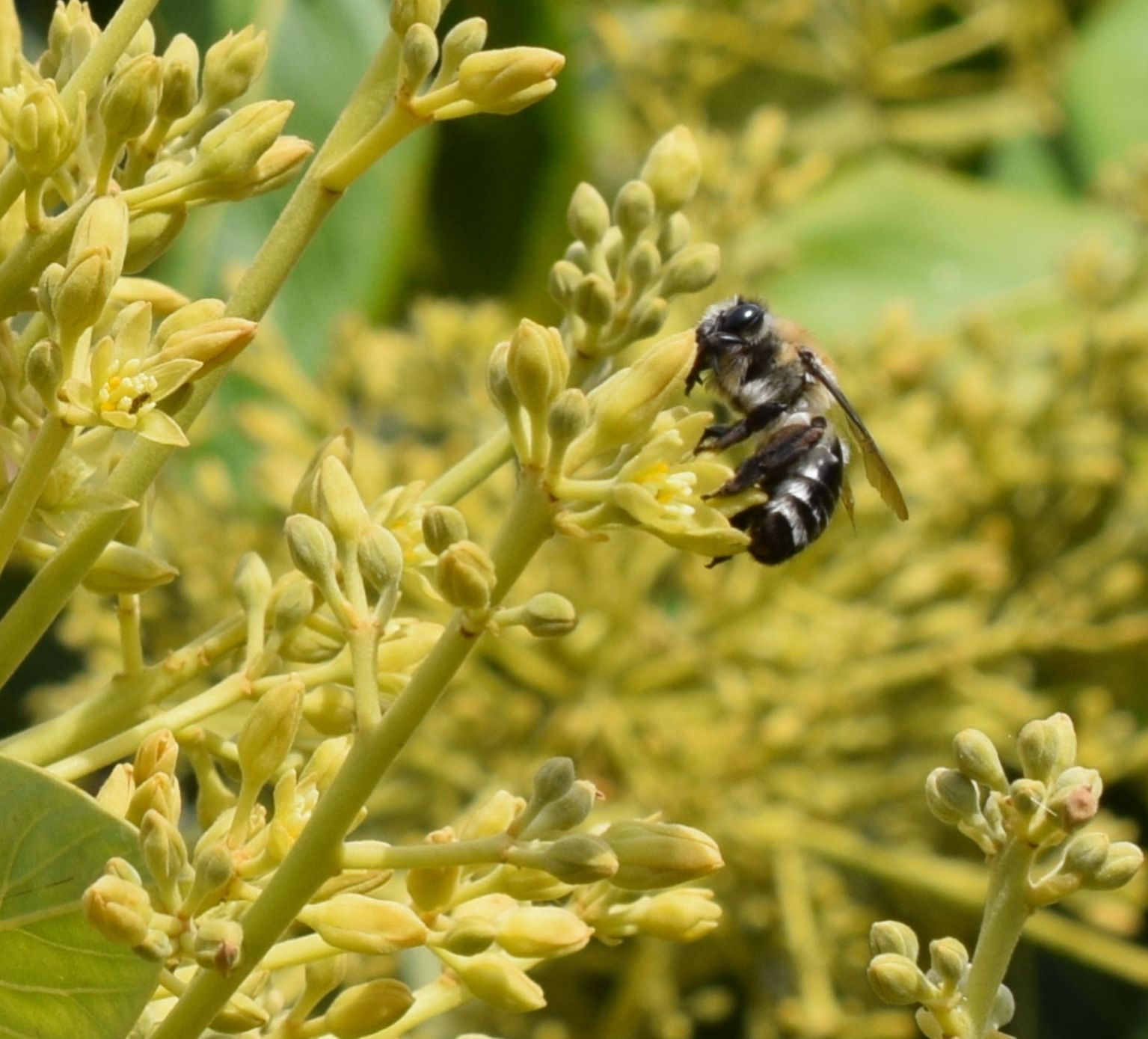
The Ecological and functional value of nativebees in Avocado (Persea americana) pollination.
DOI:
https://doi.org/10.26786/1920-7603(2026)869Keywords:
Functional groups, Fruit set, Pollination service, Visitation rate, pollen transfer potential, bee sizeAbstract
Although bees provide essential ecosystem services, the contribution of native bee functional groups to avocado pollination remains poorly quantified. We aimed to (1) evaluate the effect of distance from semi-natural vegetation on native bee visitation rates and (2) compare pollen transfer potential and fruit production among native bee functional groups. We surveyed bee visitation along a 6–72 m gradient from semi-natural vegetation in two commercial Hass avocado (Persea americana Mill.) orchards in central Chile (20 trees each; 2018). We conducted pollinator exclusion experiments in one orchard during 2018 and 2019. Visitation frequencies, pollen load, and exclusion data were combined to quantify pollen transfer potential (Ept), fruit production, and Pollination Service Index (PSI). Generalized additive models showed no significant effect of distance on visitation frequency or pollen transfer potential, suggesting the gradient lies within typical foraging distances. However, functional groups differed. Medium- and small-sized bees showed higher pollen transfer potential than large bees, driven mainly by greater per-capita pollen load rather than visitation. Self-pollination and medium-sized bees sustained fruit number closest to open control (highest PSI) but showed no advantage in fruit weight, whereas small bees produced the heaviest fruit despite the largest reduction in fruit number, though this pattern varied between seasons. No single treatment excelled across all metrics, revealing a partial decoupling between pollen transfer potential and fruit development highlighting the multidimensional nature of pollination services. A functionally diverse pollinator assemblage serves best to sustain both fruit quantity and quality. Conserving semi-natural habitats and native pollinator diversity may help sustain pollination services and avocado productivity.
References
Aizen MA, Aguiar S, Biesmeijer JC, Garibaldi LA, Inouye DW, Jung C, et al. (2019) Global agricultural productivity is threatened by increasing pollinator dependence without a parallel increase in crop diversification. Global Change Biology 25: 3516–3527. DOI: https://doi.org/10.1111/gcb.14736
Albrecht M, Schmid B, Hautier Y, Müller CB (2012) Diverse pollinator communities enhance plant reproductive success. Proceedings of the Royal Society B: Biological Sciences 279:4845-4852. DOI: https://doi.org/10.1098/rspb.2012.1621
Alcaraz ML, Hormaza JI (2011) Influence of physical distance between cultivars on yield, outcrossing rate and selective fruit drop in avocado (Persea americana, Lauraceae). Annals of Applied Biology 158:354-361. DOI: https://doi.org/10.1111/j.1744-7348.2011.00469.x
Ashman TL, Knight TM, Steets JA, Amarasekare P, Burd M, Campbell DR, Dudash MR, Johnston MO, Mazer SJ, Mitchell RJ, Morgan MT, Wilson WG (2004) Pollen limitation of plant reproduction: ecological and evolutionary causes and consequences. Ecology 85:2408-2421. DOI: https://doi.org/10.1890/03-8024
Bartomeus I, Garratt MPD, Park MG, Reitan T, Steffan-Dewenter I, Winfree R (2016) On the inconsistency of pollinator species traits for predicting either response to agricultural intensification or functional contribution. Oikos 125:721-731. DOI: https://doi.org/10.1101/072132
Bartomeus I, Potts SG, Steffan-Dewenter I, Vaissière BE, Woyciechowski M, Krewenka KM, et al. (2014) Contribution of insect pollinators to crop yield and quality varies with agricultural intensification. PeerJ 2:e328. DOI: https://doi.org/10.7717/peerj.328
Blüthgen N, Klein AM (2011) Functional complementarity and specialisation: the role of biodiversity in plant–pollinator interactions. Basic and Applied Ecology 12:282-291. DOI: https://doi.org/10.1016/j.baae.2010.11.001
Can-Alonzo C, Quezada-Euán JJG, Xiu-Ancona P, Moo-Valle H, Valdovinos Núñez GR, Medina-Peralta S (2005) Pollination of 'criollo' avocados (Persea americana) and the behaviour of associated bees in subtropical Mexico. Journal of Apicultural Research 44:3-8. DOI: https://doi.org/10.1080/00218839.2005.11101138
Capera-Aragones P, Cartar R, Foxall E, Tyson RC (2024) How can we enhance crops with flowers to increase pollination services and stop bee decline? Agriculture, Ecosystems & Environment 367:108964. DOI: https://doi.org/10.1016/j.agee.2024.108964
Dainese M, Martin EA, Aizen MA, Albrecht M, Bartomeus I, Bommarco R, Carvalheiro LG, Chaplin-Kramer R, Gagic V, Garibaldi LA, Ghazoul J, Grab H, Jonsson M, Karp DS, Kennedy CM, Kleijn D, Kremen C, Landis DA, Letourneau DK, et al. (2019) A global synthesis reveals biodiversity-mediated benefits for crop production. Science Advances 5:eaax0121. DOI: https://doi.org/10.1126/sciadv.aax0121
Davenport TL (1992) Pollination habit of avocado cultivars in South Florida. In: Lovatt CJ, Holthe PA, Arpaia ML (eds) Proceedings of the Second World Avocado Congress. University of California, Riverside and California Avocado Society, pp 169–172.
Davenport TL (2019) Cross- vs. self-pollination in 'Hass' avocados growing in coastal and inland orchards of Southern California. Scientia Horticulturae 246:307-316. DOI: https://doi.org/10.1016/j.scienta.2018.10.051
Delaplane KS, Dag A, Danka RG, Freitas BM, Garibaldi LA, Goodwin RM, Hormaza JI (2013) Standard methods for pollination research with Apis mellifera. Journal of Apicultural Research 52:1-28. DOI: https://doi.org/10.3896/IBRA.1.52.4.12
Devkota K, dos Santos CF, Blochtein B (2021) Higher richness and abundance of flower-visiting insects close to natural vegetation provide contrasting effects on mustard yields. Journal of Insect Conservation 25:1-11. DOI: https://doi.org/10.1007/s10841-020-00279-3
Dicks LV, Breeze TD, Ngo HT, Senapathi D, An J, Aizen MA, Basu P, Buchori D, Galetto L, Garibaldi LA, Gemmill-Herren B, Howlett BG, Imperatriz-Fonseca V, Johnson SD, Kovács-Hostyánszki A, Kwon YJ, Lattorff HMG, Lungharwo T, Seymour CL, et al. (2021) A global-scale expert assessment of drivers and risks associated with pollinator decline. Nature Ecology & Evolution 5:1453-1461. DOI: https://doi.org/10.1038/s41559-021-01534-9
Eilers EJ, Kremen C, Smith Greenleaf S, Garber AK, Klein AM (2011) Contribution of pollinator-mediated crops to nutrients in the human food supply. PLoS ONE 6:e21363. DOI: https://doi.org/10.1371/journal.pone.0021363
Fahrig L, Baudry J, Brotons L, Burel FG, Crist TO, Fuller RJ, Martin JL (2011) Functional landscape heterogeneity and animal biodiversity in agricultural landscapes. Ecology Letters 14:101-112. DOI: https://doi.org/10.1111/j.1461-0248.2010.01559.x
Földesi R, Howlett BG, Grass I, Batáry P (2020) Larger pollinators deposit more pollen on stigmas across multiple plant species – a meta-analysis 58: 699–707. Journal of Applied Ecology. DOI: https://doi.org/10.1111/1365-2664.13798
Fründ J, Dormann CF, Holzschuh A, Tscharntke T (2013) Bee diversity effects on pollination depend on functional complementarity and niche shifts. Ecology 94:2042-2054. DOI: https://doi.org/10.1890/12-1620.1
Garibaldi LA, Steffan-Dewenter I, Kremen C, Morales JM, Bommarco R, Cunningham SA, et al. (2011) Stability of pollination services decreases with isolation from natural areas despite honey bee visits. Ecology Letters 14:1062-1072. DOI: https://doi.org/10.1111/j.1461-0248.2011.01669.x
Garibaldi LA, Steffan-Dewenter I, Winfree R, Aizen MA, Bommarco R, Cunningham SA, et al. (2013) Wild pollinators enhance fruit set of crops regardless of honey bee abundance. Science 339:1608-1611. DOI: https://doi.org/10.1126/science.1230200
Grab H, Blitzer EJ, Danforth B, Loeb G, Poveda K (2017) Temporally dependent pollinator competition and facilitation with mass flowering crops affects yield in co-blooming crops. Scientific Reports 7:45296. DOI: https://doi.org/10.1038/srep45296
Greenop A, Woodcock B, Pywell R (2023) Using functional traits to predict pollination services: a review. Journal of Pollination Ecology 35:194-206. DOI: https://doi.org/10.26786/1920-7603(2023)735
Hapuarachchi NS, Kämper W, Hosseini Bai S, Ogbourne SM, Nichols J, Wallace HM, Trueman SJ (2024) Selective retention of cross-fertilised fruitlets during premature fruit drop of Hass avocado. Horticulturae 10:591. DOI: https://doi.org/10.3390/horticulturae10060591
Harder LD, Barrett SCH (1996) Pollen dispersal and mating patterns in animal-pollinated plants. In: Lloyd DG, Barrett SCH (eds) Floral biology: studies on floral evolution in animal-pollinated plants. Chapman & Hall, New York, pp 140-190. DOI: https://doi.org/10.1007/978-1-4613-1165-2_6
Hoehn P, Tscharntke T, Tylianakis JM, Steffan-Dewenter I (2008) Functional group diversity of bee pollinators increases crop yield. Proceedings of the Royal Society B: Biological Sciences 275:2283-2291. DOI: https://doi.org/10.1098/rspb.2008.0405
Jaboor SK, Buke da Silva CR, Kellermann V (2022) The effect of environmental temperature on bee activity at strawberry farms. Austral Ecology 47:1470-1479. DOI: https://doi.org/10.1111/aec.13228
Junker RR, Blüthgen N, Brehm T, Binkenstein J, Paulus J, Schaefer HM, Stang M (2013) Specialization on traits as basis for the niche-breadth of flower visitors and as structuring mechanism of ecological networks. Functional Ecology 27:329-341. DOI: https://doi.org/10.1111/1365-2435.12005
Kämper W, Ogbourne SM, Hawkes D, Trueman SJ (2021) SNP markers reveal relationships between fruit paternity, fruit quality and distance from a cross-pollen source in avocado orchards. Scientific Reports 11:20043. DOI: https://doi.org/10.1038/s41598-021-99394-7
Kennedy CM, Lonsdorf E, Neel MC, Williams NM, Ricketts TH, Winfree R, et al. (2013) A global quantitative synthesis of local and landscape effects on wild bee pollinators in agroecosystems. Ecology Letters 16:584-599. DOI: https://doi.org/10.1111/ele.12082
Khalifa SAM, Elshafiey EH, Shetaia AA, El-Wahed AAA, Algethami AF, Musharraf SG, AlAjmi MF, Zhao C, Masry SHD, Abdel-Daim MM, Halabi MF, Kai G, Al Naggar Y, Bishr M, Diab MAM, El-Seedi HR (2021) Overview of bee pollination and its economic value for crop production. Insects 12:688. DOI: https://doi.org/10.3390/insects12080688
King C, Ballantyne G, Willmer PG (2013) Why flower visitation is a poor proxy for pollination: measuring single-visit pollen deposition, with implications for pollination networks and conservation. Methods in Ecology and Evolution 4:811-818. DOI: https://doi.org/10.1111/2041-210X.12074
Klatt BK, Holzschuh A, Westphal C, Clough Y, Smit I, Pawelzik E, Tscharntke T (2014) Bee pollination improves crop quality, shelf life and commercial value. Proceedings of the Royal Society B: Biological Sciences 281:20132440. DOI: https://doi.org/10.1098/rspb.2013.2440
Kleijn D, Winfree R, Bartomeus I, Carvalheiro LG, Henry M, Isaacs R, Klein AM, Kremen C, M'Gonigle LK, Rader R, Ricketts TH, Williams NM, Adamson NL, Ascher JS, Báldi A, Batáry P, Benjamin F, Biesmeijer JC, Blitzer EJ, Bommarco R, Brand MR, Bretagnolle V, Button L, et al. (2015) Delivery of crop pollination services is an insufficient argument for wild pollinator conservation. Nature Communications 6:7414. DOI: https://doi.org/10.1038/ncomms8414
Klein AM, Boreux V, Fornoff F, Mupepele AC, Pufal G (2018) Relevance of wild and managed bees for human well-being. Current Opinion in Insect Science 26:82-88. DOI: https://doi.org/10.1016/j.cois.2018.02.011
Klein AM, Vaissière BE, Cane JH, Steffan-Dewenter I, Cunningham SA, Kremen C, Tscharntke T (2007) Importance of pollinators in changing landscapes for world crops. Proceedings of the Royal Society B: Biological Sciences 274:303-313. DOI: https://doi.org/10.1098/rspb.2006.3721
Kremen C (2018) The value of pollinator species diversity. Science 359:741-742. DOI: https://doi.org/10.1126/science.aar7614
Lattorff HMG (2022) Increased stress levels in caged honeybee (Apis mellifera) (Hymenoptera: Apidae) workers. Stresses 2:373-383. DOI: https://doi.org/10.3390/stresses2040026
Lavín U, Martinez-Harms MJ, Celis-Diez JL, Francois JP, Aguirre Y, Martínez-Harms J (2024) Modelling pollination maps in agroecosystems of a Chilean biodiversity hotspot. Ecosystems and People 20:2358471. DOI: https://doi.org/10.1080/26395916.2024.2358471
Lavorel S, Garnier E (2002) Predicting changes in community composition and ecosystem functioning from plant traits: revisiting the Holy Grail. Functional Ecology 16:545-556. DOI: https://doi.org/10.1046/j.1365-2435.2002.00664.x
Layek U, Kundu A, Bisui S, Karmakar P (2021) Impact of managed stingless bee and western honey bee colonies on native pollinators and yield of watermelon: a comparative study. Annals of Agricultural Sciences. 66: 38-45. DOI: https://doi.org/10.1016/j.aoas.2021.02.004
Lázaro A, Alomar D (2019) Landscape heterogeneity increases the spatial stability of pollination services to almond trees through the stability of pollinator visits Agriculture, Ecosystems & Environment 279: 149-155. DOI: https://doi.org/10.1016/j.agee.2019.02.009
Liu R, Chen D, Luo S, Xu S, Xu H, Shi X, Zou Y (2020) Quantifying pollination efficiency of flower-visiting insects and its application in estimating pollination services for common buckwheat. Agriculture, Ecosystems & Environment 301:107011. DOI: https://doi.org/10.1016/j.agee.2020.107011
Martins KT, Gonzalez A, Lechowicz MJ (2015) Pollination services are mediated by bee functional diversity and landscape context. Agriculture, Ecosystems & Environment 200:12-20. DOI: https://doi.org/10.1016/j.agee.2014.10.018
Monzón VH, Avendaño-Soto P, Araujo RO, Garrido R, Mesquita-Neto JN (2020) Avocado crops as a floral resource for native bees of Chile. Revista Chilena de Historia Natural 93. DOI: https://doi.org/10.1186/s40693-020-00092-x
Ne'eman G, Jürgens A, Newstrom-Lloyd L, Potts SG, Dafni A (2010) A framework for comparing pollinator performance: effectiveness and efficiency. Biological Reviews. 85: 435-451. DOI: https://doi.org/10.1111/j.1469-185X.2009.00108.x
Ospina-Torres R, Montoya-Pfeiffer PM, Parra-H A, Solarte V, Otero JT (2015) Interaction networks and the use of floral resources by male orchid bees (Hymenoptera: Apidae: Euglossini) in a primary rain forests of the Chocó Region (Colombia). Revista de Biología Tropical 63(3):647–658. ISSN 2215-2075 DOI: https://doi.org/10.15517/rbt.v63i3.15507
Page ML, Minahan N, González-Varo JP, et al. (2021) A meta-analysis of single-visit pollination effectiveness comparing bees and other pollinators. American Journal of Botany 108:1-17. DOI: https://doi.org/10.1002/ajb2.1764
Rader R, Bartomeus I, Garibaldi LA, Garratt MPD, Howlett BG, Winfree R, Cunningham SA, Mayfield MM, Arthur AD, Andersson GKS, Bommarco R, Brittain C, Carvalheiro LG, Chacoff NP, Entling MH, Foully B, Freitas BM, Gemmill-Herren B, Ghazoul J, et al. (2016) Non-bee insects are important contributors to global crop pollination. Proceedings of the National Academy of Sciences 113:146-151. DOI: https://doi.org/10.1073/pnas.1517092112
Reese MA, Wilson RS, Nichols J, Trueman SJ (2025) Declining outcrossing rates inside orchard blocks of 'Maluma' and 'Shepard' avocado (Persea americana Mill.) trees: effects on fruit yield and quality. Plants 14:1218. DOI: https://doi.org/10.3390/plants14081218
Requier F, Pérez-Méndez N, Andersson GKS, Blareau E, Merle I, Garibaldi LA (2023) Bee and non-bee pollinator importance for local food security. Trends in Ecology & Evolution 38:196-205. DOI: https://doi.org/10.1016/j.tree.2022.10.006
Ricketts TH, Regetz J, Steffan-Dewenter I, Cunningham SA, Kremen C, Bogdanski A, et al. (2008) Landscape effects on crop pollination services: are there general patterns? Ecology Letters 11:499-515. DOI: https://doi.org/10.1111/j.1461-0248.2008.01157.x
Robinson SV, Cartar RV, Pernal SF, Waytes R, Hoover SE (2023) Bee visitation, pollination service, and crop yield in commodity and hybrid seed canola. Agriculture, Ecosystems & Environment 347:108396. DOI: https://doi.org/10.1016/j.agee.2023.108396
Rodríguez S, Pérez-Giraldo LC, Vergara PM, Carvajal MA, Alaniz AJ (2021) Native bees in Mediterranean semi-arid agroecosystems: unravelling the effects of biophysical habitat, floral resource, and honeybees. Agriculture, Ecosystems & Environment 307:107188. DOI: https://doi.org/10.1016/j.agee.2020.107188
Ryan IC, Shutt JD, Dicks LV (2023) The importance of multi-year studies and commercial yield metrics in measuring pollinator dependence ratios: a case study in UK raspberries Rubus idaeus L. Ecology and Evolution 13:e10044. DOI: https://doi.org/10.1002/ece3.10044
Sagwe RN, Peters MK, Dubois T, Steffan-Dewenter I, Lattorff HMG (2022) Pollinator efficiency of avocado (Persea americana) flower insect visitors. Ecological Solutions and Evidence 3:e12178. DOI: https://doi.org/10.1002/2688-8319.12178
Stephenson AG (1981) Flower and fruit abortion: proximate causes and ultimate functions. Annual Review of Ecology and Systematics 12:253-279. DOI: https://doi.org/10.1146/annurev.es.12.110181.001345
Trueman SJ, Nichols J, Farrar MB, Wallace HM, Hosseini Bai S (2024) Outcrossing rate and fruit yield of Hass avocado trees decline at increasing distance from a polliniser cultivar. Agronomy 14:122. DOI: https://doi.org/10.3390/agronomy14010122
Tscharntke T, Tylianakis JM, Rand TA, Didham RK, Fahrig L, Batáry P, Bengtsson J, Clough Y, Crist TO, Dormann CF, Ewers RM, Fründ J, Holt RD, Holzschuh A, Klein AM, Kleijn D, Kremen C, Landis DA, Laurance W, et al. (2012) Landscape moderation of biodiversity patterns and processes – eight hypotheses. Biological Reviews 87:661-685. DOI: https://doi.org/10.1111/j.1469-185X.2011.00216.x
Turley NE, Biddinger DJ, Joshi NK, López-Uribe MM (2022) Six years of wild bee monitoring shows changes in biodiversity within and across years and declines in abundance. Ecology and Evolution 12:e9190. DOI: https://doi.org/10.1002/ece3.9190
Winfree R, Reilly JR, Bartomeus I, Cariveau DP, Williams NM, Gibbs J (2018) Species turnover promotes the importance of bee diversity for crop pollination at regional scales. Science 359:791-793. DOI: https://doi.org/10.1126/science.aao2117
Zhang KY, Li YY, Bao JY, He XN, Chen LF, Guo LL, Guo DL, Song CW, He CL, Hou XG (2025) Bee-mediated pollination enhances fruit set and seed yield in Paeonia ostii 'Fengdan': insights into physiological and molecular mechanisms. Horticulture Research 12:uhaf224. DOI: https://doi.org/10.1093/hr/uhaf224
Zou Y, Xiao H, Bianchi FJJA, Jauker F, Luo S, van der Werf W (2017) Wild pollinators enhance oilseed rape yield in small-holder farming systems in China. BMC Ecology 17, 6. DOI: https://doi.org/10.1186/s12898-017-0116-1
Downloads
Published
How to Cite
Issue
Section
License
Copyright (c) 2026 Laura C. Pérez-Giraldo, José M. Cerda-Paredes, Sharon Rodríguez

This work is licensed under a Creative Commons Attribution 4.0 International License.