
Management matters: Bee communities in open and degenerate heathlands in Nordhordland UNESCO Biosphere Reserve
DOI:
https://doi.org/10.26786/1920-7603(2026)860Keywords:
Bombus spp, Calluna vulgaris,, coastal heathlands, secondary succession, cultural landscapes, degenerate heathlandsAbstract
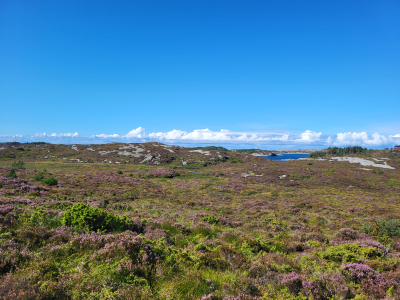
Land-use changes and agricultural intensification have been attributed as the main anthropogenic drivers of declines in insect pollinators. Anthropogenic coastal heathlands are one of the ecosystems that have suffered the most from these intensifications, as traditional management practices have discontinued and only 10% of last century´s coastal heathlands remain. We collected data during the field season of 2022 on pollinator communities with emphasis on bumblebees, in two different habitat types: open and degenerate heathlands in an UNESCO Biosphere Reserve in Western Norway. Here, we aim to get an insight into how pollinator communities may change as more heathlands are left without active management practices like prescribed burning and livestock grazing. Species composition varied between the two habitat types. Degenerate heathlands typically had a higher abundance of some relatively common species in Norway, like B. pratorum, while the red-listed species B. muscorum was recorded exclusively in open heathlands. B. jonellus was more abundant in degenerate sites despite being known to forage on Ericaceae. This may be due to an additional floral diversity and nesting/over-wintering sites here compared to the open sites. Further research should explore potential impacts of landscape characteristics like fragmentation and land-use change on the abundance and diversity of pollinators in heathlands.
References
Aerts R, Heil GW (1993) Heathlands, patterns and processes in a changing environment. Kluwer Academic Publishers, Dordrecht.
Artsdatabanken (2021) Norsk rødliste for arter 2021. Available at: https://artsdatabanken.no/lister/rodlisteforarter/2021?Name=bombus&SortBy=ScientificName&Meta=Visited&IsCheck=Area&IsCheck=Insects&Redlisted=false&Endangered=false&PresumedExtinct=false&Page=2 (Accessed: 8 March 2023).
Artsdatabanken (2025) Norsk rødliste for naturtyper 2025. Available at: https://lister.artsdatabanken.no/naturtyper/2025 (Accessed: 22.03.2026)
Bąk-Badowska J, Wojciechowska A, Czerwik-Marcinkowska J (2021) Effects of Open and Forest Habitats on Distribution and Diversity of Bumblebees (Bombus) in the Małopolska Upland (Southern Poland): Case Study. Biology 10(12): 1266.
Balvanera P, Kremen C, Martínez-Ramos M (2005) Applying Community Structure Analysis to Ecosystem Function: Examples from Pollination and Carbon Storage. Ecological Applications 15(1): 360–375.
Banaszak J (1995) Changes in Fauna of Wild Bees in Europe. Pedagogical University, Bydgoszcz, Poland.
Banaszak J, Ratyńska H (2014) Local changes in communities of wild bees (Hymenoptera: Apoidea, Apiformes): 30 years later. Polish Journal of Entomology 83(4): 325–351.
Banaszak J, Szefer J (2014) Diversity partitioning of wild bee assemblages (Hymenoptera: Apoidea, Apiformes) and species preferences for three types of refuge habitats in an agricultural landscape in Poland. Polish Journal of Entomology 83: 235–257
Bargmann T, Hatteland BA, Grytnes J-A (2015) Effects of prescribed burning on carabid beetle diversity in coastal anthropogenic heathlands. Biodiversity and Conservation 24(10), pp. 2565–2581.
Bargmann T, Heegaard E, Hatteland BA, Chipperfield JD, Grytnes J-A (2016) Species trait selection along a prescribed fire chronosequence. Insect Conservation and Diversity 9(5): 446-455.
Bartoń K (2025). MuMIn: Multi-Model Inference. R package version 1.48.11, https://CRAN.R-project.org/package=MuMIn
Bengtson R, Røsok Ø (2019) Rødlistede humler i Norge. Fauna 72(1–4): 2–35.
Biesmeijer JC, Roberts SPM, Reemer M, Ohlemüller R, Edwards M, Peeters T, Schaffers AP, Potts SG, Kleukers R, Thomas CD, Settele J, Kunin WE (2006) Parallel Declines in Pollinators and Insect-Pollinated Plants in Britain and the Netherlands. Science 313(5785): 351–354.
Bommarco R, Lundin O, Smith HG, Rundlöf M (2011) Drastic historic shifts in bumble-bee community composition in Sweden. Proceedings of the Royal Society B: Biological Sciences 279(1727): 309–315.
Britton AJ, Pakeman RJ, Carey PD, Marrs RH (2001) Impacts of climate, management and nitrogen deposition on the dynamics of lowland heath. Journal of Vegetation Science 12: 797-806.
Byriel, DB, Ro-Poulsen H, Kepfer-Rojas S, Hansen AK, Hansen RR, Justesen MJ, Kristensen E, Møller CB, Schmidt IK (2023) Contrasting responses of multiple insect taxa to common heathland management regimes and old-growth successional stages. Biodiversity and Conservation 32: 545–565.
Darvill B, Ellis JS, Lye GC, Goulson D (2006) Population structure and inbreeding in a rare and declining bumblebee, Bombus muscorum (Hymenoptera: Apidae). Molecular Ecology 15(3): 601-611.
Descamps C, Moquet L, Migon M, Jacquemart A. (2015) Diversity of the Insect Visitors on Calluna vulgaris (Ericaceae) in Southern France Heathlands. Journal of Insect Science 15(1): 130.
Diaz Forero I, Kuusemets V, Mänd M, Liivamägi A, Kaart T, Luig J (2011) Effects of Forest Habitats on the Local Abundance of Bumblebee Species: a Landscape-scale Study. Baltic Forestry 17: 235–242.
Dicks LV, Breeze TD, Ngo HT, Senapathi D, An J, Aizen MA, Basu P, Buchori D, Galetto L, Garibaldi LA, Gemmil-Herren B, Howlett BG, Imperatriz-Fonseca VL, Johnson SD, Kovacs-Hostyanszki A, Kwon YJ, Lattorff HMG, Lungharwo T, Seymour C L, Vanbergen AJ, Potts SG (2021) A global-scale expert assessment of drivers and risks associated with pollinator decline. Nature Ecology & Evolution 5: 1453-1461.
Diemont WH (1996) Survival of Dutch heathlands. Agricultural University, Wageningen, The Netherlands.
Diemont WH, Heijman WJM, Siepel H, Webb NR (2013) Economy and ecology of heathlands. KNNV Publishing, Zeist.
Exeler N, Kratochwil A, Hochkirch A (2010) Does recent habitat fragmentation affect the population genetics of a heathland specialist, Andrena fuscipes (Hymenoptera: Andrenidae)? Conservation Genetics 11: 1679–1687.
Fagúndez J (2013) Heathlands confronting global change: drivers of biodiversity loss from past to future scenarios. Annals of Botany 111(2): 151–172,
Falk S, Lewington R (2016) Field Guide to the Bees of Great Britain and Ireland. Bloomsbury Wildlife, London.
Gimingham CH (1972) Ecology of heathlands. Chapman and Hall, London.
Goulson D, Hanley ME, Darvill B, Ellis JS (2006) Biotope Associations and the Decline of Bumblebees (Bombus spp.). Journal of Insect Conservation 10: 95–103.
Goulson D, Hanley ME, Darvill B, Ellis JS, Knight ME (2005) Causes of rarity in bumblebees. Biological Conservation 122(1): 1–8.
Goulson D, Lye GC, Darvill B (2008) Decline and Conservation of Bumble Bees. Annual Review of Entomology 53(1): 191–208.
Goulson D, Nicholls E, Botias C, Rotheray EL (2015) Bee declines driven by combined stress from parasites, pesticides, and lack of flowers. Science 347(6229): 1255957.
Grab H, Branstetter MG, Amon N, Urban-Mead KR, Park MG, Gibbs J, Blitzer EJ, Poveda K, Loeb G, Danforth BN (2019) Agriculturally dominated landscapes reduce bee phylogenetic diversity and pollination services. Science 363: 282-284.
Graham JR, Campbell J, Tsalickis A, Stanley-Stahr C, Ellis J. D (2023) Observing bees and wasps: Why surveys and monitoring programs are critical and they can improve our understanding of these beneficial hymenopterans. Journal of Pollination Ecology 33:139-169.
Hansen RR, Nielsen KE, Offenberg J, Damgaard C, Byriel DB, Schmidt IK, Sørensen PB, Kjær C, Strandberg MT (2020) Implications of heathland management for ant species composition and diversity—is heathland management causing biotic homogenization? Biological Conservation 242:108422.
Hatteland BA, Hauge E, Kirkendall LR, Solhøy T (2003) Diversity and habitat preferences of ground beetles (Coleoptera, Carabidae) in a coastal area of North Trøndelag, Central Norway. Fauna Norvegica 24: 31-35.
Heinrich B (1979) “Majoring" and “Minoring” by Foraging Bumblebees, Bombus vagans: An Experimental Analysis. Ecology 60(2): 245-255.
Herbertsson L, Khalaf R, Johnson K, Bygebjerg R, Blomqvist S, Persson AS (2021) Long-term data shows increasing dominance of Bombus terrestris with climate warming. Basic and Applied Ecology 53: 116-123.
Herrera CM, Núñez A, Aguado LO & Alonso C (2023) Seasonality of pollinators in montane habitats: Cool-blooded bees for early-blooming plants. Ecological Monographs 93(2): e1570.
Hovstad KA, Johansen L, Arnesen A, Svalheim E, Velle LG (2018) Kystlynghei, Semi-naturlig. Norsk rødliste for naturtyper 2018. Artsdatabanken, Trondheim. https://artsdatabanken.no/RLN2018/74 Accessed (26.09.24)
IPBES (2016) The assessment report of the Intergovernmental Science-Policy Platform on Biodiversity and Ecosystem Services on pollinators, pollination and food production. Zenodo.
Kaland PE (1986) The origin and management of Norwegian coastal heaths as reflected in pollen analysis. In: Behre KE (ed) Anthropogenic indicators in pollen diagrams. A.A. Belkema, Rotterdam, pp 37-52.
Kaland PE, Kvamme M (2013) Kystlyngheiene i Norge – kunnskapsstatus og beskrivelse av 23 referanseomrader. Miljødirektoratet, Trondheim.
Keller LF, Waller DM (2002) Inbreeding effects in wild populations. Trends in Ecology & Evolution 17:
Kerdoncuff M, Måren IE, Eycott AE (2023) Traditional prescribed burning of coastal heathland provides niches for xerophilous and sun-loving beetles. Biodiversity and Conservation 32: 4083–4109.
Kleijn D, Raemakers I (2008) A Retrospective Analysis of Pollen Host Plant Use by Stable and Declining Bumble Bee Species. Ecology 89(7): 1811–1823.
Koh I, Lonsdorf EV, Williams NM, Brittain C, Isaacs R, Gibbs J, Ricketts T. H (2016) Modeling the status, trends, and impacts of wild bee abundance in the United States. PNAS 113(1): 140-145.
Kosior A, Celary W, Olejniczak P, Fijał J, Król W, Solarz W, Płonka P (2007) The status, threats and protection of the bumble bees and cuckoo bees (Bombini, Apidae) of selected countries of Western and Central Europe. Oryx 41: 79-88.
Krahner A, Dietzsch AC, Jütte T, Pistorius J, Everaars J (2024) Standardising bee sampling: A systematic review of pan trapping and associated floral surveys. Ecology and Evolution, 14(3): e11157.
Kreyer D, Oed A, Walther-Hellwig K, Frankl R (2004) Are forests potential landscape barriers for foraging bumblebees? Landscape scale experiments with Bombus terrestris agg. and Bombus pascuorum (Hymenoptera, Apidae). Biological Conservation, 116(1): 111–118.
Kuhlmann M, Else GR, Dawson A, Quicke DL (2007) Molecular, biogeographical and phenological evidence for the existence of three western European sibling species in the Colletes succinctus group (Hymenoptera: Apidae). Organisms Diversity & Evolution, 7(2): 155-165.
Løken A (1985) Norske Insekttabeller, nr. 9 Humler. Norsk Entomologisk Forening, Ås.
Mahy G, Sloover J, Jacquemart AL (2011) The generalist pollination system and reproductive success of Calluna vulgaris in the Upper Ardenne. Canadian Journal of Botany 76: 1843–1851.
Måren IE (2009) Effects of Management on Heathland Vegetation in Western Norway. PhD Thesis, Department of Biology, University of Bergen, Norway.
Miles J (1979) Vegetation Dynamics. Springer, Netherlands.
Millard J, Outhwaite CL, Kinnersley R, Freeman R, Gregory RD, Adedoja O, Gavini S, Kioko E, Kuhlmann M, Ollerton J, Ren Z-X, Newbold T (2021) Global effects of land-use intensity on local pollinator biodiversity. Nature Communications 12(2902): 1-11.
Moen A (1998) Nasjonalatlas for Norge: vegetasjon.Statens kartverk, Hønefoss.
Moquet L, Bacchetta R, Laurent E, Jacquemart A (2017) Spatial and temporal variations in floral resource availability affect bumblebee communities in heathlands. Biodiversity and Conservation 26: 687–702.
Moquet L, Vanderplack M, Moerman R, Quinet M, Roger N, Michez D, Jacquemart A (2017) Bumblebees depend on ericaceous species to survive in temperate heathlands. Insect Conservation and Diversity, 10(1): 78–93.
Murray TE, Fitzpatrick U, Brown MJF, Paxton RJ (2008) Cryptic species diversity in a widespread bumble bee complex revealed using mitochondrial DNA RFLPs. Conservation Genetics 9: 653–666.
Nagy L, Kreyling J, Gellesch E, Beierkuhnlein C, Jentsch A (2013) Recurring weather extremes alter the flowering phenology of two common temperate shrubs. International Journal of Biometeorology 57(4): 579-88.
Novotny JL, Reeher P, Varvato M, Lybbert A, Smith J, Mitchell RJ, Goodell K (2021) Bumble bee species distributions and habitat associations in the Midwestern USA, a region of declining diversity. Biodiversity and Conservation 30(3): 865–887.
NRC (2007) Status of Pollinators in North America. National Academies Press, Washington, D.C.
O'Connor RS, Kunin WE, Garratt MPD, Potts SG, Roy HE, Andrews C, Jones CM, Peyton JM, Savage J, Harvey MC, Morris RKA, Roberts SPM, Wright I, Vanbergen AJ, and Carvell C. (2019) Monitoring insect pollinators and flower visitation: The effectiveness and feasibility of different survey methods. Methods in Ecology and Evolution 10: 2129-2140.
Ødegaard F, Staverløkk A, Gjershaug JA, Bengston R, Mjelde A (2015) Humler i Norge: kjennetegn, utbredelse og levesett. Norsk Institutt for Naturforskning (NINA), Trondheim.
Oksanen J, Simpson GL, Blanchet FG, Kindt R, Legendre P, Minchin PR, O'Hara RB, Solymos PM, Stevens HH, Szoecs E, Wagner H, Barbour M, Bedward M, Bolker B, Borcard D, Carvalho G, Chirico M, De Caceres, M, Durand S, Antoniazi Evangelista HB, FitzJohn R, Friendly M, Furneaux B, Hannigan G, Hill MO, Lahti L, McGlinn D, Ouellette M, Cunha ER, Smith T, Stier A, Ter Braak, CJF, Weedon J (2022) vegan: Community Ecology Package. R package version 2.6-4, https://CRAN.R-project.org/package=vegan
Olsen L, Sunesen J (2004) Smådyr i hus og hage. (ed. Sømme, L.), pp. 75. Narayana Press, Denmark.
Pakeman RJ, Hulme PD, Torvell L, Fisher JM (2003) Rehabilitation of degraded dry heather (Calluna vulgaris) Biological Conservation 114: 389-400.
Pauw A (2007) Collapse of a Pollination Web in Small Conservation Areas. Ecology 88(7): 1759–1769.
Plowright CMS, Plowright RC, Williams PH (1997) Replacement of Bombus muscorum by Bombus pascuorum in Northern Britain, The Canadian Entomologist 129(6): 985–990.
Potapov GS, Kolosova Y (2020) Bombus (Pyrobombus) jonellus (Kirby, 1802) in the north-western Russian Plain: its distribution and ecology. Arctic Environmental Research 20(1): 1–9.
Potts SG, Biesmeijer JC, Kremen C, Neumann P, Schweiger O, Kunin WE (2010) Global pollinator declines: trends, impacts and drivers. Trends in Ecology & Evolution 25(6): 345–353.
Prøsch-Danielsen L, Simonsen A (2000) A. Palaeoecological investigations towards the reconstruction of the history of forest clearances and coastal heathlands in south-western Norway. Vegetation History and Archaeological Botany 9: 189-204.
R Core Team (2022) R: A language and environment for statistical computing. R Foundation for Statistical Computing, Vienna, Austria. https://www.R-project.org/
Sánchez-Bayo F & Wyckhuys KA (2019) Worldwide decline of the entomofauna: A review of its drivers. Biological Conservation 232: 8-27.
Saure HI, Vandvik V, Hassel K, Vetaas OR (2013) Effects of invasion by introduced versus native conifers on coastal heathland vegetation. Journal of Vegetation Science 24: 744-754.
Saure HI, Vandvik V, Hassel K, Vetaas OR (2014) Do vascular plants and bryophytes respond differently to coniferous invasion of coastal heathlands? Biological Invasions 16: 775-791.
Somme L, Vanderplanck M, Michez D, Lombaerde I, Moerman R, Wathelet B, Wattiez R, Lognay G, Jacquemart A (2015) Pollen and nectar quality drive the major and minor floral choices of bumble bees. Apidologie 46: 92–106.
Soroye P, Newbold T, Kerr JT (2020) Climate change contributes to widespread declines among bumble bees across continents. Science 367: 685-688.
Usher MB (1992) Management and diversity of arthropods in Calluna heathland. Biodiversity and Conservation 1: 63–79.
Velle LG, Haugum SV, Telford RJ, Thorvaldsen P, Vandvik V (2023) Prescribed burning can promote recovery of Atlantic coastal heathlands suffering dieback after extreme drought events. Applied Vegetation Science 26: e12760.
Vikane JH, Vandvik V, Vetaas OR (2013) Invasion of Calluna heath by native and non-native conifers: the role of succession, disturbance and allelopathy. Plant Ecology 214: 975–985.
VKM, Nielsen A, Hatteland BA, Hermansen JS, Kirkendall L, Rasmussen C, Seljetun KO, Sydenham M, Sørum H, Berg PR, Bryn A, Hindar K, Kausrud K, Mo TA, Nilsen EB, Sandercock BK, Thorstad E, Velle G (2024) Risks posed by managed honey bees (Apis mellifera) to wild pollinators in Norway. Scientific Opinion of the Panel on Biodiversity of the Norwegian Scientific Committee for Food and Environment. Norwegian Scientific Committee for Food and Environment (VKM), Oslo, Norway.
WallisDeVries MF, Noordijk J, Colijn EO, Smit JT, Veling K (2016) Contrasting responses of insect communities to grazing intensity in lowland heathlands. Agriculture, Ecosystems and Environment 234:72–80.
Walther-Hellwig K, Frankl R (2000) Foraging Distances of Bombus muscorum, Bombus lapidarius, and Bombus terrestris (Hymenoptera, Apidae). Journal of Insect Behavior 13(2): 239–246.
Watt AS (1947) Pattern and process in the plant community. Journal of Ecology 35: 1-22.
Webb NR (1998) The traditional management of European heathlands. Journal of Applied Ecology 35: 987-990
Westerberg L, Berglund H-L, Jonason D, Milberg P (2020) Color pan traps often catch less when there are more flowers around. Ecology and Evolution 11(9): 3830-3840.
Wickham H. (2016) ggplot2: Elegant Graphics for Data Analysis. Springer cham, New York.
Williams P (2005) Does specialization explain rarity and decline among British bumblebees? A response to Goulson et al. Biological Conservation 122(1): 33–43.
Published
How to Cite
Issue
Section
License
Copyright (c) 2026 Susanne Zazzera, Bjørn Arild Hatteland, Silje Maria Midthjell Høydal, Ieva Rozite-Arina, Inger Elisabeth Måren

This work is licensed under a Creative Commons Attribution 4.0 International License.