
Bee diversity in apple orchards of the Lower Himalaya: research synthesis, a new field study, and future needs
DOI:
https://doi.org/10.26786/1920-7603(2025)857Keywords:
bees, diversity, abundance, elevation, apple, pollination deficitAbstract
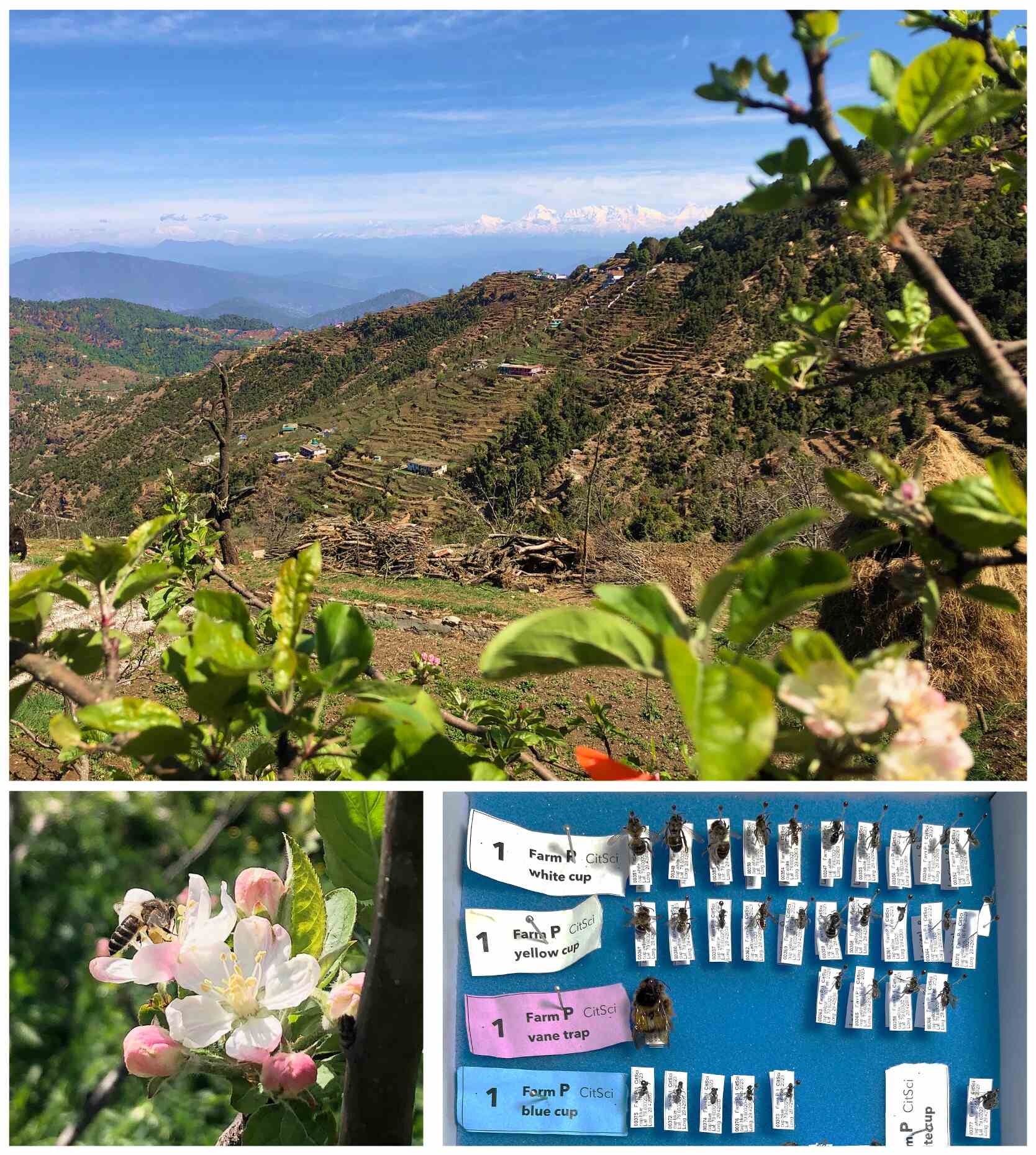
In northern India and surrounding countries of the Lower Himalaya, apple is an important cash crop that contributes significantly to state economies and farmer livelihoods. Apple cultivation is shifting to higher elevations to counter declining fruit yields associated with climate change. Pollinator scarcity is another factor linked to declines in fruit yield and quality. To advance understanding of bee diversity and pollination ecology in apples for this region, we compiled a taxonomically updated list of bee taxa associated with apple orchards using records from existing literature and a new field study. Our list includes 25 bee genera, 75 named species, and numerous morphospecies. Common genera also feature prominently in apple studies elsewhere in the world. Apis cerana and A. mellifera were the most frequently reported visitors to apple flowers; Bombus, Ceratina, Lasioglossum, and Syrphidae flies were the most common non-Apis floral visitors. Bee species richness was inversely correlated with elevation and pollination deficit whereas bee abundance was not. Therefore, apples grown at higher elevations may experience more favourable growing conditions but also incur greater pollination deficits that are linked to reduced bee richness. This underscores the importance of conserving bee diversity to safeguard pollination services and farmer livelihoods in the region. Our literature review further highlights the need for more tools to identify the regional bee fauna, more thoroughly documented and standardised study methods to build capacity within the research community and aid comparative studies, and more expansive cataloguing and monitoring of pollinator communities to better understand the diversity, roles, and status of bees throughout this under-studied region.
References
Abrol D (1993) Insect pollination and crop production in Jammu and Kashmir. Current Science 65:265–269.
Adit A, Singh VK, Tandon R, Shivanna KR (2024) Pollination research in India: current status, future vision and conservation implications. Integrative Conservation 3:330–341.
Allen-Wardell G, Bernhardt P, Bitner R, Burquez A, Buchmann S, Cane J, Cox PA, Dalton V, Feinsinger P, Ingram M, Inouye D, Jones CE, Kennedy K, Kevan P, Koopowitz H, Medellin R, Medellin-Morales S, Nabhan GP, Pavlik B, Tepedino V, Torchio P, Walker S (1998) The potential consequences of pollinator declines on the conservation of biodiversity and stability of food crop yields. Conservation Biology 12:8–17.
Arya D, Goswami D, Yadav R, Bisht M, Arya G, Kaushal BR (2022) Diversity and abundance of insect pollinators in orchards and agricultural ecosystems in Paharpani Nainital, Uttarakhand, India. 24 International Journal of Zoological Investigations 8:24–31.
Arya MK, Badoni A (2023) Insect pollinator assemblage on temperate fruits crops in Kumaun Himalaya. Indian Journal of Entomology:1–7.
Bartomeus I, Park MG, Gibbs J, Danforth BN, Lakso AN, Winfree R (2013) Biodiversity ensures plant-pollinator phenological synchrony against climate change. Ecology Letters 16:1331–1338.
Batra SWT (1977) Bees of India (Apoidea), their behaviour, management and a key to the genera. Oriental Insects 11:289–324.
Batra SWT (1997) Fruit-pollinating bees of the Garwhal Himalaya, U.P., India Richards KW (ed). Acta Horticulturae 437:325–328.
Bauer DM, Sue Wing I (2010) Economic consequences of pollinator declines: a synthesis. Agricultural and Resource Economics Review 39:368–383.
Bell C, Tronstad L, Hotaling S (2023) Tailoring your bee sampling protocol: Comparing three methods reveals the best approaches to capturing bees. Agricultural and Forest Entomology 25:477–488.
Bhat MS, Lone FA, Shafiq MU, Rather JA (2021) Evaluation of long term trends in apple cultivation and its productivity in Jammu and Kashmir from 1975 to 2015. GeoJournal 86:1193–1202.
Blitzer EJ, Gibbs J, Park MG, Danforth BN (2016) Pollination services for apple are dependent on diverse wild bee communities. Agriculture, Ecosystems & Environment 221:1–7.
Burrows S, Ritner C, Christman M, Spears L, Smith-Pardo A, Price S, Ramirez R, Griswold T, Redford A (2021) Exotic bee ID: key to Apis species. [online] URL: https://idtools.org/tools/1078/index.cfm?pageID=2944 (accessed 18 July 2024).
Cameron SA, Lozier JD, Strange JP, Koch JB, Cordes N, Solter LF, Griswold TL (2011) Patterns of widespread decline in North American bumble bees. Proceedings of the National Academy of Sciences 108:662–667.
Cameron SA, Sadd BM (2020) Global trends in bumble bee health. Annual Review of Entomology 65:209–232.
Cane J (1987) Estimation of bee size using intertegular span (Apoidea). Journal of the Kansas Entomological Society 60:145–147.
Cane JH, Minckley RL, Kervin LJ (2000) Sampling bees (Hymenoptera: Apiformes) for pollinator community studies: pitfalls of pan-trapping. Journal of the Kansas Entomological Society 73:225–231.
Cely-Santos M, Lu F (2019) Intersections between rural livelihood security and animal pollination in Anolaima, Colombia. Geoforum 104:13–24.
Chamorro FJ, Faria CMA, Araújo FS, Freitas BM (2023) Elevated pan traps optimise the sampling of bees, including when the availability of floral resources is high. Insect Conservation and Diversity 16:16–32.
Chatterjee P, Singh N (2025) Understanding the role of moths (Insecta: Lepidoptera) as pollinators of apple (Malus domestica). New Zealand Journal of Zoology 0:1–15.
Chauhan M, Uniyal VP, Chandra A, Thakur P, Mehrwar V (2021) Preliminary assessment and conservation of insect pollinators through community participation in the Lahaul and Spiti district of Himachal Pradesh, India. Current Science 120:883–887.
Dashad S, Sharma J (1993) Relative abundance of insect visitors on blooms of certain cultivars of apple (Malus domestica Borkh). Crop Research 6:491–498.
Devi M, Sharma PL, Verma G, Rana DrK, Thakur M (2024) Evaluation of pollinator diversity and relative abundance of native insect pollinators in apple orchards of Seraj valley in Himachal Pradesh: A preliminary study. International Journal of Research in Agronomy 7:93–98.
Dorji K, Marshall L, Tashi S, Biesmeijer K (2022) Farmers’ perception on pollinators and apple pollination in Western Bhutan. Bhutan Journal of Natural Resources and Development 9:1–12.
Dorji K, Tashi S, Biesmeijer JC, Leclercq N, Vereecken NJ, Marshall L (2022) Pollinators and crops in Bhutan: insect abundance improves fruit quality in Himalayan apple orchards. Journal of Pollination Ecology 31:39–52.
Droege S, Engler JD, Sellers E, O’Brien LE (2016) U.S. national protocol framework for the inventory and monitoring of bees. National Wildlife Refuge System, U.S. Fish and Wildlife Service, Fort Collins, Colorado. [online] URL: http://ecos.fws.gov/ServCatFiles/reference/holding/47682
Földesi R, Kovács-Hostyánszki A, Kőrösi Á, Somay L, Elek Z, Markó V, Sárospataki M, Bakos R, Varga Á, Nyisztor K, Báldi A (2016) Relationships between wild bees, hoverflies and pollination success in apple orchards with different landscape contexts. Agricultural and Forest Entomology 18:68–75.
Fraser AM, Allington GRH, Luthra A, Virkar P, Rana S, Suyal R, Rawat A, Ratna A, Cunningham K, Raikwal N, Pandey A, Singh V (2024) Pollination deficit in apples increases with elevation. Agriculture, Ecosystems & Environment 371:109068.
Ganie MA, Pal AK, Ahmed N (2014) Assessment of relative abundance and diversity of native insect pollinators in apple orchards of Kashmir Himalaya. Asian Journal of Agriculture and Biology 2:34–43.
Garibaldi LA, Carvalheiro LG, Leonhardt SD, Aizen MA, Blaauw BR, Isaacs R, Kuhlmann M, Kleijn D, Klein AM, Kremen C, Morandin L, Scheper J, Winfree R (2014) From research to action: enhancing crop yield through wild pollinators. Frontiers in Ecology and the Environment 12:439–447.
Garibaldi LA, Steffan-Dewenter I, Winfree R, Aizen MA, Bommarco R, Cunningham SA, Kremen C, Carvalheiro LG, Harder LD, Afik O, Bartomeus I, Benjamin F, Boreux V, Cariveau D, Chacoff NP, Dudenhoffer JH, Freitas BM, Ghazoul J, Greenleaf S, Hipolito J, Holzschuh A, Howlett B, Isaacs R, Javorek SK, Kennedy CM, Krewenka KM, Krishnan S, Mandelik Y, Mayfield MM, Motzke I, Munyuli T, Nault BA, Otieno M, Petersen J, Pisanty G, Potts SG, Rader R, Ricketts TH, Rundlof M, Seymour CL, Schuepp C, Szentgyorgyi H, Taki H, Tscharntke T, Vergara CH, Viana BF, Wanger TC, Westphal C, Williams N, Klein AM (2013) Wild pollinators enhance fruit set of crops regardless of honey bee abundance. Science 339:1608–1611.
Garratt MPD, Breeze TD, Jenner N, Polce C, Biesmeijer JC, Potts SG (2014) Avoiding a bad apple: insect pollination enhances fruit quality and economic value. Agriculture, Ecosystems & Environment 184:34–40.
Gautam D, Sharma G, Jindal K (2004) Fruit setting problems of apples under changing climatic scenario of North-Western Himalayas of India. Acta Horticulturae 662:435–441.
Gibbs J, Joshi NK, Wilson JK, Rothwell NL, Powers K, Haas M, Gut L, Biddinger DJ, Isaacs R (2017) Does passive sampling accurately reflect the bee (Apoidea: Anthophila) communities pollinating apple and sour cherry orchards? Environmental Entomology 46:579–588.
Goulson D (2009) Bumblebees: behaviour, ecology, and conservation, 2nd edn. Oxford University Press, Oxford.
Goulson D, Lye GC, Darvill B (2008) Decline and conservation of bumble bees. Annual Review of Entomology 53:191–208.
Goulson D, Nicholls E, Botías C, Rotheray EL (2015) Bee declines driven by combined stress from parasites, pesticides, and lack of flowers. Science 347:1435.
Hall M (2018) Blue and yellow vane traps differ in their sampling effectiveness for wild bees in both open and wooded habitats. Agricultural and Forest Entomology 20:487–495.
Hodkinson ID (2005) Terrestrial insects along elevation gradients: species and community responses to altitude. Biological Reviews 80:489–513.
Hoehn P, Tscharntke T, Tylianakis JM, Steffan-Dewenter I (2008) Functional group diversity of bee pollinators increases crop yield. Proceedings of the Royal Society B: Biological Sciences 275:2283–2291.
Hoiss B, Krauss J, Potts SG, Roberts S, Steffan-Dewenter I (2012) Altitude acts as an environmental filter on phylogenetic composition, traits and diversity in bee communities. Proceedings of the Royal Society B: Biological Sciences 279:4447–4456.
Hussain A, Rahim KM, Ghffar A, Alia H, Jamil A (2012) The hymenopterous pollinators of Himalayan foot hills of Pakistan (distributional diversity). African Journal of Biotechnology 11:7263–7269.
Jha S, Kremen C (2013) Resource diversity and landscape-level homogeneity drive native bee foraging. Proceedings of the National Academy of Sciences 110:555–558.
Joshi NC, Joshi P, Kumar S, Nath P, Singh V, Mansotra D (2016) Entomofaunal diversity in fruit orchards along the altitudinal gradients of district Nainital, Uttarakhand (India). International Journal of Fauna and Biological Studies 3:113–120.
Joshi NK, Leslie T, Rajotte EG, Kammerer MA, Otieno M, Biddinger DJ (2015) Comparative trapping efficiency to characterize bee abundance, diversity, and community composition in apple orchards. Annals of the Entomological Society of America 108:785–799.
Joshi P, Joshi N (2010) Status of insect pollinators in the orchards of apple, peach, pears and citrus in Mukteshwar area of district Nainital. Department of Zoology & Environmental Sciences, Gurukula Kangri University, Haridwar, Uttarakhand, Dehradun.
Joshi PC, Kumar K, Arya M (2008) Assessment of insect diversity along an altitudinal gradient in Pinderi forests of Western Himalaya, India. Journal of Asia-Pacific Entomology 11:5–11.
Joshi RA, Sarkar S (2017) Apple production in India: progress, challenges, and government initiatives. In: Mallik R, Chaudhury SK, Sarkar S (eds) Indian Agriculture. S.K. Book Agency, New Delhi, pp 143–150.
Jugran AK, Joshi RK, Bhatt ID, Rawal RS, Palni LMS (2019) The relationship of visiting insect diversity and density of Valeriana jatamansi with increasing altitude in Western Himalaya. Proceedings of the National Academy of Sciences, India Section B: Biological Sciences 89:371–378.
Kammerer M, Goslee SC, Douglas MR, Tooker JF, Grozinger CM (2021) Wild bees as winners and losers: relative impacts of landscape composition, quality, and climate. Global Change Biology 27:1250–1265.
Kapkoti B, Joshi RK, Rawal RS (2016a) Variations in the abundance and diversity of insects in apple orchards of Kumaun, Western Himalaya, India. Current Science 110:438–443.
Kapkoti B, Joshi RK, Rawal RS (2016b) Thistle (Cirsium verutum): an important forage for pollinators in Kumaun, West Himalaya. National Academy Science Letters 39:395–399.
Kapkoti B, Rawal RS, Joshi RK (2016) Insect Pollinators of Brassica campestris in Kumaun, West Himalaya: Influence of Crop Composition, Altitude and Flowering Phenology. National Academy Science Letters 39:389–394.
Katumo DM, Liang H, Ochola AC, Lv M, Wang Q-F, Yang C-F (2022) Pollinator diversity benefits natural and agricultural ecosystems, environmental health, and human welfare. Plant Diversity 44:429–435.
Kaundil P, Thakur RK (2020) A preliminary study on insect pollinators in apple crop in different geographical zones of Himachal Pradesh. International Journal of Current Microbiology and Applied Sciences 9:325–331.
Kaundil P, Thakur RK, Thakur M, Sharma HK, Chauhan S, Rani P, Sood K, Singh S (2022) Pollinator’s diversity and their abundance on apple bloom from Solan, Himachal Pradesh, India. The Pharma Innovation Journal SP-11:365–373.
Kendall LK, Rader R, Gagic V, Cariveau DP, Albrecht M, Baldock KCR, Freitas BM, Hall M, Holzschuh A, Molina FP, Morten JM, Pereira JS, Portman ZM, Roberts SPM, Rodriguez J, Russo L, Sutter L, Vereecken NJ, Bartomeus I (2019) Pollinator size and its consequences: Robust estimates of body size in pollinating insects. Ecology and Evolution 9:1702–1714.
Khan A, Haque SM, Biswas B (2023) Altitudinal shifting of apple orchards with adaption of changing climate in the alpine Himalaya. Journal of the Indian Society of Remote Sensing 51:1135–1155.
Klaus F, Ayasse M, Classen A, Dauber J, Diekötter T, Everaars J, Fornoff F, Greil H, Hendriksma HP, Jütte T, Klein AM, Krahner A, Leonhardt SD, Lüken DJ, Paxton RJ, Schmid-Egger C, Steffan-Dewenter I, Thiele J, Tscharntke T, Erler S, Pistorius J (2024) Improving wild bee monitoring, sampling methods, and conservation. Basic and Applied Ecology 75:2–11.
Klein A-M, Vaissière BE, Cane JH, Steffan-Dewenter I, Cunningham SA, Kremen C, Tscharntke T (2007) Importance of pollinators in changing landscapes for world crops. Proceedings of the Royal Society B: Biological Sciences 274:303–313.
Krahner A, Dietzsch AC, Jütte T, Pistorius J, Everaars J (2024) Standardising bee sampling: a systematic review of pan trapping and associated floral surveys. Ecology and Evolution 14
Kremen C, Williams NM, Aizen MA, Gemmill‐Herren B, LeBuhn G, Minckley R, Packer L, Potts SG, Roulston T, Steffan‐Dewenter I, Vázquez DP, Winfree R, Adams L, Crone EE, Greenleaf SS, Keitt TH, Klein A-M, Regetz J, Ricketts TH (2007) Pollination and other ecosystem services produced by mobile organisms: a conceptual framework for the effects of land-use change. Ecology Letters 10:299–314.
Kuhlman MP, Burrows S, Mummey DL, Ramsey PW, Hahn PG (2021) Relative bee abundance varies by collection method and flowering richness: implications for understanding patterns in bee community data. Ecological Solutions and Evidence 2:e12071.
Kumar J (1988) Insect pollinators in temperate fruit during bloom. Journal of Tree Sciences 7:38–40.
Lebuhn G, Droege S, Connor EF, Gemmill-Herren B, Potts SG, Minckley RL, Griswold T, Jean R, Kula E, Roubik DW, Cane J, Wright KW, Frankie G, Parker F (2013) Detecting insect pollinator declines on regional and global scales. Conservation Biology 27:113–120.
LeBuhn G, Griswold T, Minckley R, Droege S, Roulston T, Cane J, Parker F, Buchmann S, Tepedino V, Williams N, Kremen C, Messenger O (2003) A standardized method for monitoring bee populations – the Bee Inventory (BI) Plot. [online] URL: https://www.nativebeemonitoring.org/resources (accessed 28 November 2022).
Leclercq N, Marshall L, Weekers T, Basu P, Benda D, Bevk D, Bhattacharya R, Bogusch P, Bontšutšnaja A, Bortolotti L, Cabirol N, Calderón-Uraga E, Carvalho R, Castro S, Chatterjee S, De La Cruz Alquicira M, De Miranda JR, Dirilgen T, Dorchin A, Dorji K, Drepper B, Flaminio S, Gailis J, Galloni M, Gaspar H, Gikungu MW, Hatteland BA, Hinojosa-Diaz I, Hostinská L, Howlett BG, Hung K-LJ, Hutchinson L, Jesus RO, Karklina N, Khan MS, Loureiro J, Men X, Molenberg J-M, Mudri-Stojnić S, Nikolic P, Normandin E, Osterman J, Ouyang F, Oygarden AS, Ozolina-Pole L, Ozols N, Parra Saldivar A, Paxton RJ, Pitts-Singer T, Poveda K, Prendergast K, Quaranta M, Read SFJ, Reinhardt S, Rojas-Oropeza M, Ruiz C, Rundlöf M, Sade A, Sandberg C, Sgolastra F, Shah SF, Shebl MA, Soon V, Stanley DA, Straka J, Theodorou P, Tobajas E, Vaca-Uribe JL, Vera A, Villagra CA, Williams M-K, Wolowski M, Wood TJ, Yan Z, Zhang Q, Vereecken NJ (2023) Global taxonomic, functional, and phylogenetic diversity of bees in apple orchards. Science of The Total Environment 901:165933.
Mallinger RE, Gratton C (2015) Species richness of wild bees, but not the use of managed honeybees, increases fruit set of a pollinator-dependent crop. Journal of Applied Ecology 52:323–330.
Martins KT, Gonzalez A, Lechowicz MJ (2015) Pollination services are mediated by bee functional diversity and landscape context. Agriculture, Ecosystems & Environment 200:12–20.
Mattu V, Nirala D (2016) Diversity, distribution and relative abundance of insect pollinators on apple crop in Shimla Hills of Western Himalaya India. International Journal of Science and Research 5:2087–2091.
Mattu VK, Bhagat T (2015) Effect of changing landscapes on diversity, distribution and relative abundance of insect pollinators on apple crop in northwest Himalayas. International Journal of Science and Research 4:1762–1767.
McCabe LM, Cobb NS (2021) From bees to flies: global shift in pollinator communities along elevation gradients. Frontiers in Ecology and Evolution 8
Mushtaq T, Bilal S, Aziz MA (2018) Diversity and seasonal activity of insect pollinators visiting apple bloom in relation to weather parameters. International Journal of Pure & Applied Bioscience 6:1281–1290.
O’Connor RS, Kunin WE, Garratt MPD, Potts SG, Roy HE, Andrews C, Jones CM, Peyton JM, Savage J, Harvey MC, Morris RKA, Roberts SPM, Wright I, Vanbergen AJ, Carvell C (2019) Monitoring insect pollinators and flower visitation: the effectiveness and feasibility of different survey methods. Methods in Ecology and Evolution 10:2129–2140.
Olhnuud A, Liu Y, Makowski D, Tscharntke T, Westphal C, Wu P, Wang M, van der Werf W (2022) Pollination deficits and contributions of pollinators in apple production: a global meta-analysis. Journal of Applied Ecology 59:2911–2921.
Orr M, Ascher J, Bai M, Chesters D, Zhu C-D (2020) Three questions: how can taxonomists survive and thrive worldwide? Megataxa 1:19–27.
Packer L, Monckton SK, Onuferko TM, Ferrari RR (2018) Validating taxonomic identifications in entomological research. Insect Conservation and Diversity 11:1–12.
Paray MA, Parey SH, Rather ZA (2014) The pollinators of apple orchards of Kashmir valley (India) (distributional diversity). Ecology, Environment and Conservation 20:S471–S477.
Pardo A, Borges PAV (2020) Worldwide importance of insect pollination in apple orchards: a review. Agriculture, Ecosystems & Environment 293:106839.
Partap T, Partap U (2004) Apple pollination issues in the Hindu Kush Himalayan region. Acta Horticulturae 662:443–450.
Partap U, Partap T (2002) Warning signals from the apple valleys of the Hindu Kush Himalayas: productivity and pollination problems. ICIMOD, Kathmandu.
Perillo LN, Neves F de S, Antonini Y, Martins RP (2017) Compositional changes in bee and wasp communities along Neotropical mountain altitudinal gradient. PLOS ONE 12:e0182054.
Portman ZM, Bruninga-Socolar B, Cariveau DP (2020) The state of bee monitoring in the United States: a call to refocus away from bowl traps and towards more effective methods. Annals of the Entomological Society of America 113:337–342.
Potts SG, Biesmeijer JC, Kremen C, Neumann P, Schweiger O, Kunin WE (2010) Global pollinator declines: trends, impacts and drivers. Trends in Ecology & Evolution 25:345–353.
Pramanick JJ, Jindal K, Kashyap P, Shukla A, Sharma Y, Watpade S (2014) Impact of changing climate on apple productivity. Journal of Tree Sciences 33:68–77.
Prendergast KS, Menz MHM, Dixon KW, Bateman PW (2020) The relative performance of sampling methods for native bees: an empirical test and review of the literature. Ecosphere 11
Rahimzadeh A (2017) Political ecology of climate change: shifting orchards and a temporary landscape of opportunity. World Development Perspectives 6:25–31.
Raj H, Mattu V (2014) Diversity and distribution of insect pollinators on various temperate fruit crops in Himachal Himalaya, India. International Journal of Science and Nature 5:616–631.
Raj H, Mattu V, Thakur M (2012) Pollinator diversity and relative abundance of insect visitors on apple crop in Shimla Hills of Western Himalaya, India. International Journal of Nature and Science 3:507–513.
Rana RS, Bhagat RM, Kalia V, Lal H (2011) The impact of climate change on a shift of the apple belt in Himachal Pradesh. In: Dubash N (ed) Handbook of climate change and India: development, politics and governance. Routledge, New Delhi, pp 51–62.
Rather GH, Paray MA, Javid R, Khursheed R, Yaqoob M, Rehman MU, Majid F (2017) Pollination problems in apple of Kashmir Himalaya. International Journal of Pure & Applied Bioscience 5:817–823.
Reilly JR, Artz DR, Biddinger D, Bobiwash K, Boyle NK, Brittain C, Brokaw J, Campbell JW, Daniels J, Elle E, Ellis JD, Fleischer SJ, Gibbs J, Gillespie RL, Gundersen KB, Gut L, Hoffman G, Joshi N, Lundin O, Mason K, McGrady CM, Peterson SS, Pitts-Singer TL, Rao S, Rothwell N, Rowe L, Ward KL, Williams NM, Wilson JK, Isaacs R, Winfree R (2020) Crop production in the USA is frequently limited by a lack of pollinators. Proceedings of the Royal Society B: Biological Sciences 287:20200922.
Roquer-Beni L, Arnan X, Rodrigo A, Bosch J (2022) What makes a good pollinator? Relationship between pollinator traits and pollination effectiveness in apple flowers. Entomologia Generalis 42:875–882.
Roulston TH, Smith SA, Brewster AL (2007) A comparison of pan trap and intensive net sampling techniques for documenting a bee (Hymenoptera: Apiformes) fauna. Journal of the Kansas Entomological Society 80:179–181.
Russo L, Park M, Gibbs J, Danforth B (2015) The challenge of accurately documenting bee species richness in agroecosystems: bee diversity in eastern apple orchards. Ecology and Evolution 5:3531–3540.
Saharan V, Abrol DP (2023) The diversity and abundance of insect pollinators visiting apple flowers. Environment and Ecology 41:2955–2959.
Sahu N, Saini A, Behera SK, Sayama T, Sahu L, Nguyen V-T-V, Takara K (2020) Why apple orchards are shifting to the higher altitudes of the Himalayas? PLOS ONE 15:e0235041.
Sharma R, Gupta JK (2010) Effect of changing landscapes on the density and diversity of insect pollinators on apple crop in Kullu valley of Himachal Pradesh. Pest Management and Economic Zoology 18:277–280.
Sharma RM, Mitra B (2012) A preliminary study on insect pollinators of temperate fruit crops in Himachal Pradesh. Records of the Zoological Survey of India 111:103–110.
Singh N, Sharma DP, Chand H (2016) Impact of climate change on apple production in India: a review. Current World Environment 11:251–259.
Sircom J, Arul Jothi G, Pinksen J (2018) Monitoring bee populations: are eusocial bees attracted to different colours of pan trap than other bees? Journal of Insect Conservation 22:433–441.
Thakur B, Mattu VK (2014) Diversity and distribution of pollinators of temperate fruit crops of Shimla hills in Himachal Pradesh. Asian Journal of Advanced Basic Sciences 3:151–163.
Thompson A, Frenzel M, Schweiger O, Musche M, Groth T, Roberts SPM, Kuhlmann M, Knight TM (2021) Pollinator sampling methods influence community patterns assessments by capturing species with different traits and at different abundances. Ecological Indicators 132
Tronstad L, Bell C, Crawford M (2022) Choosing collection methods and sample sizes for monitoring bees. Agricultural and Forest Entomology 24:531–539.
Tuell JK, Isaacs R (2009) Elevated pan traps to monitor bees in flowering crop canopies. Entomologia Experimentalis et Applicata 131:93–98.
Tylianakis JM (2013) The global plight of pollinators. Science 339:1532–1533.
USDA Foreign Agricultural Service (2025) Production: Apples. [online] URL: https://www.fas.usda.gov/data/production/commodity/0574000 (accessed 29 March 2025).
Vasiliev D, Greenwood S (2020) Pollinator biodiversity and crop pollination in temperate ecosystems, implications for national pollinator conservation strategies: mini review. Science of The Total Environment 744:140880.
Vedwan N (2008) Apple growers’ associations in Northwestern India: emergence, success, and limitations in the context of state-society interactions. Human Organization 67:86–96.
Vedwan N, Rhoades R (2001) Climate change in the Western Himalayas of India: a study of local perception and response. Climate Research 19:109–117.
Verma LR, Chauhan P (1985) Distribution, abundance and diversity of insect pollinators in apple orchards of Shimla hills. Indian Journal of Ecology 12:286–292.
Wagner DL (2020) Insect declines in the Anthropocene. Annual Review of Entomology 65:457–480.
Warrit N, Ascher J, Basu P, Belavadi V, Brockmann A, Buchori D, Dorey JB, Hughes A, Krishnan S, Ngo HT, Williams P, Zhu C-D, Abrol D, Bawa K, Bhatta C, Borges RM, Bossert S, Cervancia C, Chatthanabun N, Chesters D, Chinh PH, Devkota K, Duc HP, Ferrari R, Garibaldi L, Ge J, Ghosh D, Huang D, Jung C, Klein A-M, Koch JBU, Krichilsky E, Kunte K, Ling TC, Liu S, Liu X, Luo A, Luo S, Mu J, Nidup T, Niu Z, Nur-Zati AM, Olsson SB, Otis GW, Ouyang F, Peng Y-Q, Priawandiputra W, Proshchalykin M, Raffiudin R, Rameshkumar A, Ren Z, Suruliraj A, Sane S, Shi X, Sinu PA, Smith DR, Soh ZWW, Somananthan H, Sritongchuay T, Stewart AB, Sun C, Tang M, Thanoosing C, Tscharntke T, Vereecken N, Wang S, Wayo K, Wongsiri S, Zhou X, Xie Z, Zhang D, Zou Y, Zu P, Orr M (2023) Opportunities and challenges in Asian bee research and conservation. Biological Conservation 285:110173.
Webber SM, Garratt MPD, Lukac M, Bailey AP, Huxley T, Potts SG (2020) Quantifying crop pollinator-dependence and pollination deficits: the effects of experimental scale on yield and quality assessments. Agriculture, Ecosystems & Environment 304:107106.
Westerberg L, Berglund H-L, Jonason D, Milberg P (2021) Color pan traps often catch less when there are more flowers around. Ecology and Evolution 11:3830–3840.
Williams PH (2022) The bumblebees of the Himalaya: an identification guide. Royal Belgian Institute of Natural Sciences, Brussels. [online] URL: https://biblio.naturalsciences.be/rbins-publications/abc-txa/abc-taxa-21
Worldostats (2025) Worldostats: World Data and Statistics [online] URL: https://worldostats.com/ (accessed 5 March 2025)
Additional Files
Published
How to Cite
Issue
Section
License
Copyright (c) 2025 Preeti Virkar, Ann M. Fraser, Aman Luthra, Ginger R.H. Allington, Shweta Rana, Renu Suyal, Ankita Rawat, Anmol Ratna, Kiran Cunningham, Narendra Raikwal, Anvita Pandey, Vishal Singh

This work is licensed under a Creative Commons Attribution 4.0 International License.