
Timing of flowering affects pollination of Viburnum edule in Alaskan boreal forest
DOI:
https://doi.org/10.26786/1920-7603(2025)842Keywords:
climate change, flowering phenology, muscid fly, solitary fly, syrphid fly, trophic mismatchAbstract
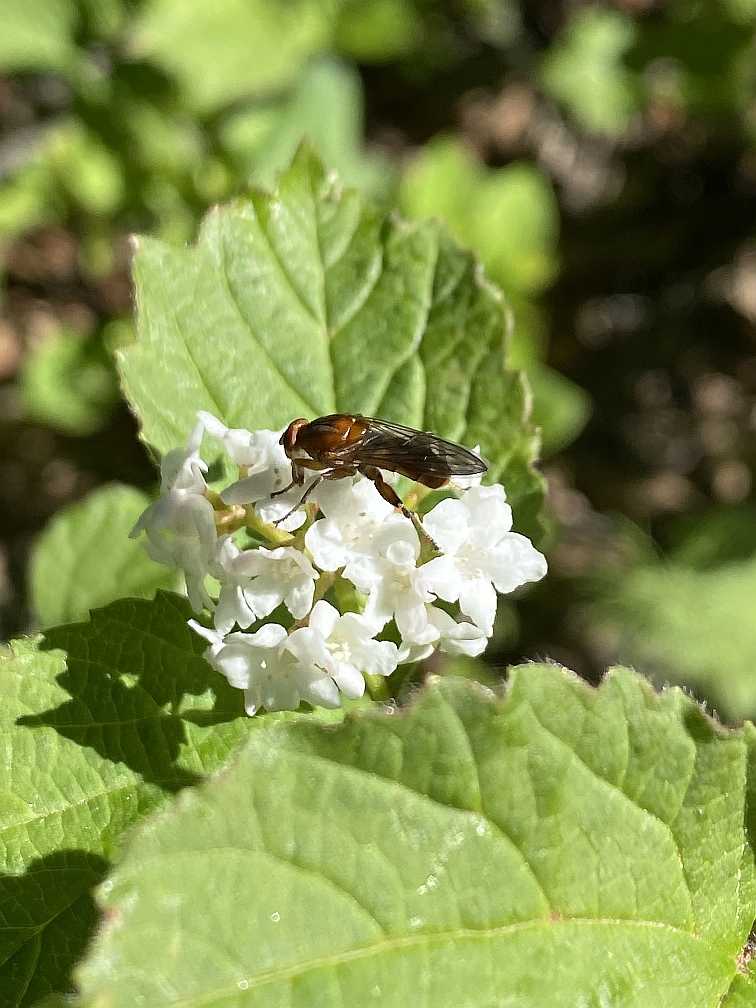
Flowering time in Alaskan boreal forest is advancing, and this may affect pollination rates of early-flowering species. Viburnum edule is one of the first understory plants to flower, when pollinator diversity and abundance are likely lower than later in the season. We evaluated the impact of flowering time on pollen deposition and composition of the pollinator community over two years (one in which plants flowered slightly earlier than average and one in which flowering time was close to average) using experimental arrays with branches that flowered either at the start or the peak of flowering for each year. Pollinator exclusion reduced fruit set by > 90%, but even plants freely pollinated by insects had fruit set rates of < 10%. Both within and across years, plants that flowered later had more insect visitors and higher proportions of stigmas visited (> 5 pollen grains per stigma); in the advanced year, plants that flowered later also had more pollen grains per stigma. Syrphid flies, solitary bees, and muscid flies constituted ~ 99% of visitors, with a higher proportion of syrphid flies for later-flowering plants within and across years. Despite evidence for potential pollen limitation, pollen loads for the earliest flowering plants were high (mean > 25 pollen grains per stigma). Fruit production in V. edule is likely limited by inefficient pollen transfer between genets, by resource availability, or both. Given the prevalence of syrphid and muscid flies as pollinators, we need a better understanding of what triggers emergence in these taxa to evaluate the potential for trophic mismatches in boreal forest.
References
Armbruster WS, Guinn DA (1989) The solitary bee fauna (Hymenoptera: Apoidea) of interior and arctic Alaska: flower associations, habitat use, and phenology. Journal of the Kansas Entomological Society 62:468-483. https://www.jstor.org/stable/25085123
Barrett SCH, Helenurm K (1987) The reproductive biology of boreal forest herbs. I. Breeding systems and pollination. Canadian Journal of Botany 65:2036-2046.
Bartomeus I, Ascher JS, Wagner D, Danforth BN, Colla S, Kornbluth S, Winfree R. (2011) Climate- associated phenological advances in bee pollinators and bee-pollinated plants. Proceedings of the National Academy of Sciences 108:20645-20649.
Bates D, Maechler M, Bolker B, Walker S (2015) Fitting linear mixed-effects models using lme4. Journal of Statistical Software 67:1-48.
Bishop JA, Armbruster WA (1999) Thermoregulatory abilities of Alaskan bees: effects of size, phylogeny and ecology. Functional Ecology 13:711-724.
Brandt JP (2009) The extent of the North American boreal zone. Environmental Reviews, 17:101–161.
CaraDonna P, Iler A, Inouye D (2014) Shifts in flowering phenology reshape a subalpine plant community. Proceedings of the National Academy of Sciences 111:4916-4921.
Díaz-Calafat J, Felton A, Öckinger E, De Frenne P, Cousins SAO, Hedwall P-O (2025) The effects of climate change on boreal plant-pollinator interactions are largely neglected by science. Basic and Applied Ecology 84:1-13.
Elberling H, Olesen JM (1999) The structure of a high latitude plant-flower visitor system: the dominance of flies. Ecography 22:314-323.
Fequet DD (2011) Towards the feasibility of wild-harvesting fruit from native Viburnum species (Adoxaceae) as sustainable NTFP in Newfoundland (Canada). Masters thesis, Memorial University of Newfoundland. https://research.library.mun.ca/9612/1/Fequet_DanielleD.pdf
Forrest JRK, Thomson JD (2011) An examination of synchrony between insect emergence and flowering in Rocky Mountain meadows. Ecological Monographs 81:469-491.
Fulkerson JR, Whittall JB, Carlson ML (2012) Reproductive ecology and severe pollen limitation in the polychromic tundra plant, Parrya nudicaulis (Brassicaceae). PLoS One 7:e32790.
Gillespie MAK, Baggesen N, Cooper EJ (2016) High Arctic flowering phenology and plant-pollinator interactions in response to delayed snow melt and simulated warming. Environmental Research Letters 11:115006.
Hollingsworth TN (2015) Point Bar Vegetation Survey of Bonanza Creek LTER Research Plots (2007-Present), Bonanza Creek LTER - University of Alaska Fairbanks. doi:10.6073/pasta/c3d2b72e7ba403fa565160853c048222
Høye TT, Forchhammer MC (2008) Phenology of high-arctic arthropods: effects of climate on spatial, seasonal, and inter-annual variation. Advances in Ecological Research 40:299-324.
Iler AM, Inouye DW, Høye TT, Miller-Rushing AJ, Burkle LA, Johnston EB (2013) Maintenance of temporal synchrony between syrphid flies and floral resources despite differential phenological responses to climate. Global Change Biology 19:2348-2359.
Kearns CA, Inouye DW (1993) Techniques for pollination biologists. University Press of Colorado, Boulder.
Kevan P (1972) Insect pollination of high arctic flowers. Ecology 60:831-847.
Kevan, PG, Tikhmenev EA, Usui M (1993). Insects and plants in the pollination ecology of the boreal zone. Ecological Research 8:247-267.
Kharouba HM, Wolkovich EM (2020) Disconnects between ecological theory and data in phenological mismatch research. Nature Climate Change 10:406-415.
Kharouba HM, Wolkovich EM (2023) Lack of evidence for the match-mismatch hypothesis across terrestrial trophic interactions. Ecology Letters 26:955-964.
Kudo G, Ida TY (2013) Early onset of spring increases the phenological mismatch between plants and pollinators. Ecology 94:2311-2320.
Laverty TM (1992) Plant interactions for pollinator visits: a test of the magnet species effect. Oecologia 89:502-508.
McKinney AM, CaraDonna PJ, Inouye DW, Barr B, Bertelsen CD, Waser NM (2012) Asynchronous changes in phenology of migrating Broad-tailed Hummingbirds and their early-season nectar resources. Ecology 93:1987-1993.
Mizunaga Y, Kudo G (2017) A linkage between flowering phenology and fruit-set success of alpine plant communities with reference to the seasonality and pollination effectiveness of bees and flies. Oecologia 185:453-464.
Molau U (1993) Relationships between flowering phenology and life history strategies in tundra plants. Arctic and Alpine Research 25:391-402.
Mulder CPH, Spellman KV (2019a) Do longer growing seasons give introduced plants an advantage over native plants in Interior Alaska? Botany 97:347-362.
Mulder CPH, Spellman KV (2019b) Flower and leaf phenology of Interior Alaska forbs and shrubs as observed near Fairbanks Alaska from 2013-2015, Bonanza Creek LTER - University of Alaska Fairbanks. BNZ:767. http://dx.doi.org/10.6073/pasta/ae8b2f7626fd96a24bf347ad5e8ba733
Mulder CPH, Spellman KV, Shaw J (2021) Berries in winter: a natural history of fruit retention in four species across Alaska. Madroño 58:487-510.
Nebot, JR, Mateu I (1990) Some observations on pollination in a mediterranean shrub, Viburnum tinus L.(Caprifoliaceae). VI International Symposium on Pollination 288:93-97.
Needham R, Odden M, Lundstadsveen SK, Wegge P (2014) Seasonal diets of red foxes in a boreal forest with a dense population of moose: the importance of winter scavenging. Acta Theriologica 59:391-398.
Oksanen, J, Simpson, G, Blanchet F, Kindt R, Legendre P, Minchin P, O'Hara R, Solymos P, Stevens M, Szoecs E, Wagner H, Barbour M, Bedward M, Bolker B, Borcard D, Carvalho G, Chirico M, De Caceres M, Durand S, Evangelista H, FitzJohn R, Friendly M, Furneaux B, Hannigan G, Hill M, Lahti L, McGlinn D, Ouellette M, Ribeiro Cunha E, Smith T, Stier A, Ter Braak C, Weedon J (2024). vegan: Community Ecology Package. R package version 2.6-8, https://CRAN.R-project.org/package=vegan.
Orford KA, Vaughan IP, Memmott J (2015) The forgotten flies: the importance of non-syrphid Diptera as pollinators. Proceedings of the Royal Society B 282:20142934.
Ovaskainen O, Skorokhodova S, Yakovleva M, Sukhov A, Kutenkov A, Kutenkova N, Shcherbakov A, Meyke E, del Mar Delgado M (2013) Community-level phenological response to climate change. Proceedings of the National Academy of Sciences 110:134343-13439.
Parazoo NC, Arneth A, Pugh TAM, Smith B, Steiner N, Luus K, Commane R, Benmergui J, Stofferahn E, Liu J, Rödenbeck, Kawa R, Euskirchen E, Zona D, Arndt K, Oechel W, Miller C. 2018. Spring photosynthetic onset and net CO2 uptake in Alaska triggered by landscape thawing. Global Change Biology 24:3416-3435.
Parmesan C, Yohe G (2003) A globally coherent fingerprint of climate change impacts across natural systems. Nature, 421:37-42.
Prather RM, Dalton RM, barr b, Blumstein DT, Boggs CL, Broday AK, Inouye DW, Irwin RE, Martin JGA, Smith RJ, Van Vuren DH, Wells CP, Whiteman HH, Inouye BD, Underwood N (2023) Current and lagged climate affects phenology across diverse taxonomic groups. Proceedings of the Royal Society B 290: 20222181.
Qian H, Kinka K, Kayahara GJ (1998) Longitudinal patterns of plant diversity in the North American boreal forest. Plant Ecology 138:161-178.
Rantanen M, Karpechko AY, Lipponen A, Nordling K, Hyvärinen O, Ruosteenoja K, Vihma T, Laaksonen A (2022). The Arctic has warmed nearly four times faster than the globe since 1979. Communications Earth & Environment 3:168.
Schmidt NM, Mosbacher JB, Nielsen PS, Rasmussen C, Høye TT, Roslin T (2016). An ecological function in crisis? The temporal overlap between plant flowering and pollinator function shrinks as the Arctic warms. Ecography 39:1250-1252.
Spellman KV, Schneller LC, Mulder CPH, Carlson ML (2015) Effects of non-native Melilotus albus on pollination and reproduction in two boreal shrubs. Oecologia 179:495-507.
Tiusanen M, Hebert, PDN, Schmidt NM, Roslin T (2016) One fly to rule them all — muscid flies are the key pollinators in the Arctic. Proceedings of the Royal Society B: Biological Sciences, 283: 20161271.
Waser NM (1983) Competition for pollination and floral character differences among sympatric plant species: a review of the evidence. In: Eugene CE, Little RJ (eds) Handbook of experimental pollination biology. Van Nostrand Reinhold Company Inc., New York, pp 341-359.
Wegge P, Kastdalen L (2008) Habitat and diet of young group broods: resource partitioning between Capercaillie (Tetrao urogallus) and Black Grouse (Tetrao terix) in boreal forests. Journal of Ornithology 149:237-244.
West SD (1982) Dynamics of colonization and abundance in Central Alaskan populations of the northern red-backed vole, Clethrionomys rutulis. Journal of Mammalogy 63:128-143.
Willmer PG (1983) Thermal constraints on activity patterns in nectar-feeding insects. Ecological Entomology 8:455-469.
Wipf S (2010) Phenology, growth, and fecundity of eight subarctic tundra species in response to snowmelt manipulations. Plant Ecology:207:53-66.
Downloads
Published
How to Cite
Issue
Section
License
Copyright (c) 2025 Kara Kornhauser, Christa Mulder

This work is licensed under a Creative Commons Attribution 4.0 International License.