Rare plant’s need for native pollinators threatened by invasive plant-pollinator relationship
DOI:
https://doi.org/10.26786/1920-7603(2025)837Keywords:
Chloropyron maritimum ssp. maritimum, non-native plants, non-native pollinators, Plant-pollinator networks, rare plant pollinationAbstract
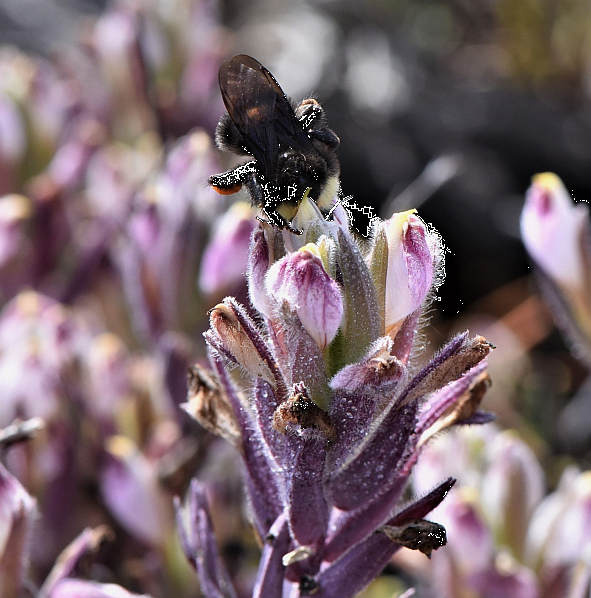
Many flowering plants rely on pollination for their reproductive success, but the introduction of non-native plants can impact these essential plant-pollinator relationships. Chloropyron maritimum ssp. maritimum is a rare salt marsh plant that has been known to benefit from insect pollination, and its habitat is being encroached on by the non-native Limonium duriusculum. We use plant-pollinator observation, network analysis, and small-scale experimental removal of L. duriusculum to understand which insects are visiting C. maritimum maritimum, and the impact, if any, of L. durisiculum on C. maritimum maritimum pollination and the plant-pollinator network. We documented infrequent visitation to C. maritimum maritimum at the Carpinteria Salt Marsh, California, USA, with native bees being the only observed C. maritimum maritimum visitors. We found that the pollinator composition of C. maritimum maritimum and L. duriusculum were significantly different. The vast majority (96%) of L. duriusculum visitors were two non-native insect species (Hymenoptera: Apis mellifera and Diptera: Eristalinus aeneus), neither of which entered C. maritimum maritimum flowers. The experimental removal of L. duriusculum had no effect on C. maritimum maritimum visitation. However, the plant-pollinator network was more nested, more connected and had higher specialization when L. duriusculum was removed. Future studies should implement larger-scale removal to further investigate these findings. Additionally, subsequent work should investigate if there is adequate nesting habitat for C. maritimum maritimum pollinators in surrounding areas, to ensure the survival of the few plant-pollinator interactions this rare plant currently maintains.
References
Aizen MA, Morales CL, Morales JM (2008) Invasive Mutualists Erode Native Pollination Webs. PLoS Biology 6:e31.
Albrecht M, Schmid B, Hautier Y, Müller CB (2012) Diverse pollinator communities enhance plant reproductive success. Proceedings of the Royal Society B: Biological Sciences 279:4845–4852.
Arceo‐Gómez G, Ashman T (2016) Invasion status and phylogenetic relatedness predict cost of heterospecific pollen receipt: implications for native biodiversity decline. Journal of Ecology 104:1003–1008.
Archbald G, Boyer K (2014) Distribution and Invasion Potential of Limonium ramosissimum subsp. provinciale in San Francisco Estuary Salt Marshes. San Francisco Estuary and Watershed Science. 12. http://doi.org/10.15447/sfews.2014v12iss2art6
Baskett CA, Emery SM, Rudgers JA (2011) Pollinator Visits to Threatened Species are Restored following Invasive Plant Removal. International Journal of Plant Sciences 172:411–422.
Blüthgen N, Menzel F, Blüthgen N (2006) Measuring specialization in species interaction networks. BMC Ecology 6:
Burkle LA, Marlin JC, Knight TM (2013) Plant-Pollinator Interactions over 120 Years: Loss of Species, Co-Occurrence, and Function. Science 339:1611–1615.
California Invasive Plant Council (2025) In: cal-ipc.org https://www.cal-ipc.org/plants/profile/limonium-duriusculum-profile/ Accessed 21 Mar 2025
Carpinteria Salt Marsh Reserve – University of California, Santa Barbara (2024) In: Ucsb.edu. https://csmr.nrs.ucsb.edu/about/ Accessed 12 Feb 2024
Charlebois JA, Sargent RD (2017) No consistent pollinator-mediated impacts of alien plants on natives. Ecology Letters 20:1479–1490.
Copeland SM, Munson SM, Bradford JB, et al (2019) Long‐term plant community trajectories suggest divergent responses of native and non‐native perennials and annuals to vegetation removal and seeding treatments. Restoration Ecology 27:821–831.
Dormann C (2011) How to be a specialist? Quantifying specialisation in pollination networks. Network Biology 1:1–20
Dormann CF, Frund J, Bluthgen N, Gruber B (2009) Indices, Graphs and Null Models: Analyzing Bipartite Ecological Networks. The Open Ecology Journal 2:7–24.
Ealy N, Pawelek J, Hazlehurst J (2023) Effects of forest management on native bee biodiversity under the tallest trees in the world. Ecology and Evolution 13:
Elle E, Elwell SL, Gielens GA (2012) The use of pollination networks in conservation. Botany 90:525–534.
Esri. “World Imagery” [basemap]. Scale Not Give. “World Imagery”. December 12, 2024. https://www.arcgis.com/home/item.html?id=10df2279f9684e4a9f6a7f08febac2a9 (December 19, 2024).
Etter KJ, Junquera G, J. Horvet-French, et al (2021) Interspecific pollen transport between non-native fennel and an island endemic buckwheat: assessment of the magnet effect. Biological invasions 24:139–155.
Fellows MQN, Zedler JB (2005) Effects of the non-native grass, Parapholis incurva (Poaceae) on the rare and endangered hemiparasite, Cordylanthus maritimus subsp. maritimus (Scrophulariaceae). Madroño 52:91–98.
Ferrero V, Castro S, Costa J, et al (2013) Effect of invader removal: pollinators stay but some native plants miss their new friend. Biological Invasions 15:2347–2358.
Fiedler AK, Landis DA, Arduser M (2011) Rapid Shift in Pollinator Communities Following Invasive Species Removal. Restoration Ecology 20:593–602.
Garner KL, Chang MY, Fulda MT, et al (2015) Impacts of sea level rise and climate change on coastal plant species in the central California coast. PeerJ 3:
GBIF.org (13 November 2024) GBIF Occurrence Download
Goodell K, Parker IM (2017) Invasion of a dominant floral resource: effects on the floral community and pollination of native plants. Ecology 98:57–69.
Goulson D (2003) Effects of Introduced Bees on Native Ecosystems. Annual Review of Ecology, Evolution, and Systematics 34:1–26.
Grozinger CM, Flenniken ML (2019) Bee Viruses: Ecology, Pathogenicity, and Impacts. Annual Review of Entomology 64:205–226.
Hegland SJ (2014) Floral neighbourhood effects on pollination success in red clover are scale‐dependent. Functional Ecology 28:561–568.
Hung K-LJ, Kingston J, Lee A, et al (2019) Non-native honey bees disproportionately dominate the most abundant floral resources in a biodiversity hotspot. Proceedings of the Royal Society B 286:
Ings TC, Montoya JM, Bascompte J, et al (2008) Review: Ecological networks – beyond food webs. Journal of Animal Ecology 78:253–269.
Kaiser‐Bunbury CN, Valentin T, Mougal J, et al (2010) The tolerance of island plant–pollinator networks to alien plants. Journal of Ecology 99:202–213.
Kearns CA, Inouye DW, Waser NM (1998) Endangered Mutalisms: The Conservation of Plant-Pollinator Interactions. Annual Review of Ecology and Systematics 29:83–112.
Knapp DA, Calloway SM, Cusser S (2024) Using historic data to understand the shrinking pollinators of the endangered salt marsh bird’s beak (Chloropyron maritimum subsp. maritimum). Western North American Naturalist 83:498–507.
Lincoln PG (1985) Pollinator Effectiveness and Ecology of Seed Set in Cordylanthus maritimus subsp. maritimus at Point Mugu, California. Final report to U.S. Fish and Wildlife Service, Sacramento, California. No. 10181-9750.
Lindström SAM, Herbertsson L, Rundlöf M, et al (2016) Experimental evidence that honeybees depress wild insect densities in a flowering crop. Proceedings of the Royal Society B: Biological Sciences 283:20161641.
Lopezaraiza–Mikel ME, Hayes RB, Whalley MR and Memmott J. (2007) The impact of an alien plant on a native plant–pollinator network: an experimental approach. Ecology Letters 10: 539-550.
Mathiasson ME, Rehan SM (2020) Wild bee declines linked to plant‐pollinator network changes and plant species introductions. Insect Conservation and Diversity 13:595–605.
McKinney AM, Goodell K (2010) Plant–pollinator interactions between an invasive and native plant vary between sites with different flowering phenology. Plant Ecology 212:1025–1035.
Morandin LA, Kremen C (2013) Hedgerow restoration promotes pollinator populations and exports native bees to adjacent fields. Ecological Applications 23:829–839.
Norfolk O, Gilbert F, Eichhorn MP (2018) Alien honeybees increase pollination risks for range‐restricted plants. Diversity and Distributions 24:705–713.
Oksanen J, Simpson G, Blanchet F, Kindt R, Legendre P, Minchin P, O'Hara R, Solymos P, Stevens M, Szoecs E, Wagner H, Barbour M, Bedward M, Bolker B, Borcard D, Carvalho G, Chirico M, De Caceres M, Durand S, Evangelista H, FitzJohn R, Friendly M, Furneaux B, Hannigan G, Hill M, Lahti L, McGlinn D, Ouellette M, Ribeiro Cunha E, Smith T, Stier A, Ter Braak C, Weedon J (2022). _vegan: Community Ecology Package_. R package version 2.6-4.
Ollerton J (2017) Pollinator Diversity: Distribution, Ecological Function, and Conservation. Annual Review of Ecology, Evolution, and Systematics 48:353–376.
Parra‐Tabla V, Arceo‐Gómez G (2021) Impacts of plant invasions in native plant–pollinator networks. New Phytologist 230:2117–2128.
Parsons L, Zedler J (1997) Factors Affecting Reestablishment of an Endangered Annual Plant at a California salt marsh. Ecological Applications 7:253–267.
R Core Team (2023). R: A language and environment for statistical computing. R Foundation for Statistical Computing, Vienna, Austria. URL https://www.R-project.org/.
Thébault E, Fontaine C (2010) Stability of Ecological Communities and the Architecture of Mutualistic and Trophic Networks. Science 329:853–856.
Thomson DM (2016) Local bumble bee decline linked to recovery of honey bees, drought effects on floral resources. Ecology Letters 19:1247–1255.
Thomson JD (1981) Spatial and Temporal Components of Resource Assessment by Flower-Feeding Insects. The Journal of Animal Ecology 50:49.
U.S. Fish and Wildlife Service (2020) 5-YEAR REVIEW Chloropyron maritimum subsp. maritimum [Cordylanthus maritimus subsp. maritimus (salt-marsh bird’s beak)]. Carlsbad Fish and Wildlife Office, Department of the Interior.
University of California Riverside, Entomology Research Museum (2019). Version 1.2 Dataset/Occurrence. https://ipt.idigbio.org/resource?r=ucrc
Valido A, Rodríguez-Rodríguez MC, Jordano P (2019) Honeybees disrupt the structure and functionality of plant-pollinator networks. Scientific Reports 9:4711.
Vázquez DP, Blüthgen N, Cagnolo L, Chacoff NP (2009) Uniting pattern and process in plant–animal mutualistic networks: a review. Annals of Botany 103:1445–1457.
Wickham H, Averick M, Bryan J, Chang W, McGowan LD, François R, Grolemund G, Hayes A, Henry L, Hester J, Kuhn M, Pedersen TL, Miller E, Bache SM, Müller K, Ooms J, Robinson D, Seidel DP, Spinu V, Takahashi K, Vaughan D, Wilke C, Woo K, Yutani H (2019) “Welcome to the tidyverse.” Journal of Open Source Software, *4*(43), 1686.
Downloads
Published
How to Cite
Issue
Section
License
Copyright (c) 2025 Kylie J Etter, Denise A Knapp, Sarah Cusser

This work is licensed under a Creative Commons Attribution 4.0 International License.